Stretches for Tight Hip Flexors: 5 Moves and a 6-Week Plan
Stretches for tight hip flexors with hold times, a 1-minute self-check and a 6-week plan, plus what research says about sitting and strength training.
PushSlayer Editorial Team · Updated · 7 min read
Leer en español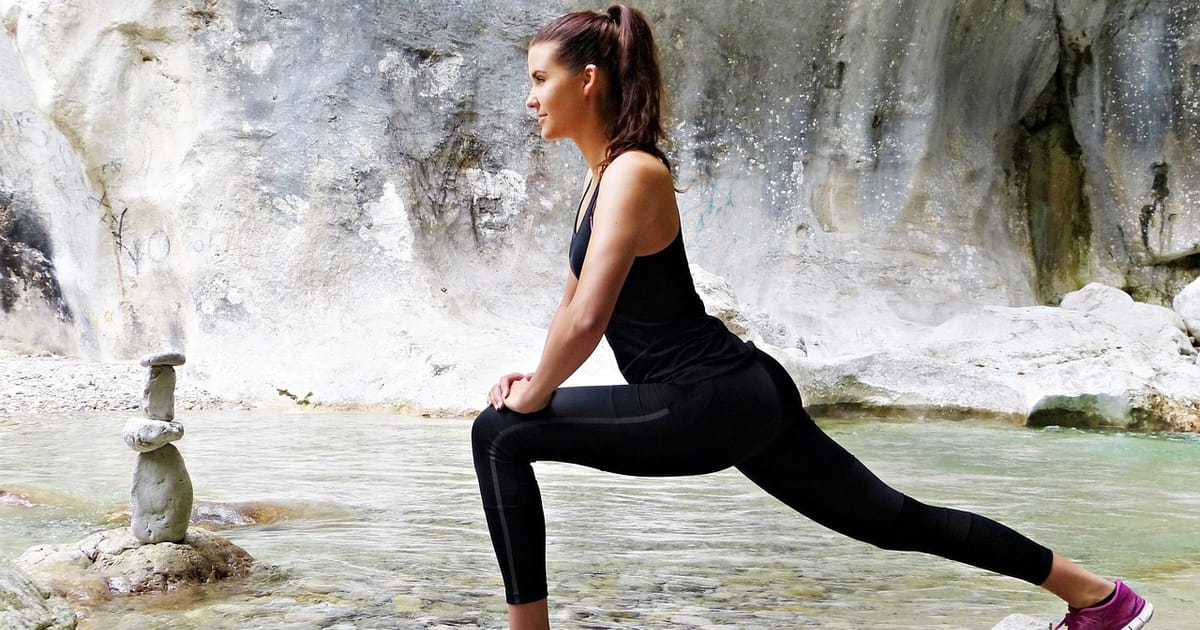
The best stretches for tight hip flexors move your thigh behind your body while your pelvis stays tucked: the half-kneeling hip flexor stretch, a standing lunge stretch, the couch stretch, a bed-edge stretch and a side-lying quad stretch. Hold each one for 30 seconds, twice per side, on at least 5 days a week. That is the 60 seconds per stretch that the ACSM's 2011 position stand recommends, done often enough to meet the weekly amount a 2018 review linked to gains. Expect slow change: trials saw gains after 3 to 10 weeks.
The 5 best stretches for tight hip flexors
All five stretch the front of the hip by taking the thigh behind the body. The couch stretch and the side-lying quad stretch bend the knee fully, which adds the rectus femoris, the thigh muscle that crosses both the hip and the knee. Start with the first one and add others when you want variety or when kneeling bothers your knee.
| Stretch | Best for | Hold |
|---|---|---|
| Half-kneeling hip flexor stretch | Everyone, the default | 2 x 30 s per side |
| Standing lunge stretch | Knees that dislike kneeling, at work | 2 x 30 s per side |
| Couch stretch | A deeper stretch once the first one feels easy | 2 x 30 s per side |
| Bed-edge stretch | Relaxing into it at night, and the self-check | 2 x 30 s per side |
| Side-lying quad stretch | The front of the thigh, lying down | 2 x 30 s per side |
Stretch to a clear pull you can breathe through, never to sharp or pinching pain. That limit and the cues below are our coaching choices.
1. Half-kneeling hip flexor stretch
- Kneel on a folded towel or cushion, then step your right foot forward so the right knee sits above the ankle.
- Squeeze your left glute and tuck your tailbone under, as if you were zipping up tight jeans.
- Keep your chest tall and shift your hips forward until you feel a stretch at the front of the left hip.
- Stop before your lower back arches. If you feel it in your back, tuck the pelvis again and go less far.
- For more stretch, reach your left arm overhead. Hold 30 seconds, then switch sides.
2. Standing lunge stretch
- Stand in a long split stance, right foot forward, left heel off the floor, one hand on a wall or chair.
- Tuck the pelvis the same way and bend the front knee until the front of the left hip pulls.
- Keep the back leg long and the torso upright. Hold 30 seconds per side.
3. Couch stretch
- Kneel with your back to a sofa, left knee on a cushion against the sofa and the left shin running up its front.
- Step the right foot forward into a lunge, hands on the floor or on the right knee.
- Tuck the pelvis and slowly bring your torso upright. This one is intense, so start leaning forward and skip it if your knee complains.
4. Bed-edge stretch
- Lie on your back with your hips at the end of a firm bed.
- Hug your right knee to your chest so your lower back presses flat.
- Let the left leg hang off the edge with the knee relaxed. Breathe out and let gravity do the work for 30 seconds, then switch.
5. Side-lying quad stretch
- Lie on your right side with your head on your arm.
- Hold your left ankle and bring the heel toward your buttock.
- Push the left hip gently forward so the knee moves slightly behind you. Hold 30 seconds per side.
How long should you hold a hip flexor stretch, and how often?
Hold for 30 seconds, twice per side, on at least 5 days a week. The ACSM's 2011 position stand recommends a total of 60 seconds per flexibility exercise on 2 or more days a week for healthy adults.
The research on frequency is mixed. A 2018 review of 23 studies found static stretching worked better than ballistic or PNF stretching, linked gains to at least 5 minutes of stretching per week, and found that more days per week went with bigger gains. A larger 2024 meta-analysis of 77 studies found static and PNF stretching beat dynamic or ballistic stretching, but volume, intensity and frequency did not change the results significantly. The plan below meets the higher bar without asking for more.
| Dose | What to do | Based on |
|---|---|---|
| Hold | 30 s, twice per side | ACSM 2011: 60 s total per stretch |
| Days | 5 or more a week | 2018 review: frequency linked to gains |
| Weekly time | 5+ minutes a week (this plan gives each hip about 10) | 2018 review |
| Type | Static holds for flexibility | 2018 review, 2024 meta-analysis |
How do you know if your hip flexors are tight?
Use the bed-edge position as a 1-minute self-check. It is the position of the modified Thomas test, the classic clinic test for the hip flexors.
- Sit at the very end of a firm bed and lie back while hugging both knees.
- Keep the right knee hugged firmly to your chest so your lower back stays flat.
- Lower the left leg toward the bed and let it relax.
- Look at, or ask someone to check, the back of the left thigh. Resting on the bed (or below it) means the hip reaches neutral. Floating above the bed suggests limited hip extension on that side.
Use the result as a personal before-and-after marker, not a diagnosis. In a small 2016 study of 29 college students, the modified Thomas test missed most real limits in hip extension even though the other knee was held to the chest, as in the standard test. Movement of the pelvis explained the error, and the authors concluded the test is not valid unless that movement is controlled. Repeat the check in week 6 and compare with yourself, not with a chart.
What causes tight hip flexors?
Long sitting is the usual suspect, and the evidence links the two without proving cause. A 2021 cross-sectional study measured 144 adults. Among the 98 placed in comparison groups, people who were active and sat less than 4 hours a day had 6.1 degrees more passive hip extension than people who were inactive and sat more than 7 hours. A snapshot like this cannot show that sitting caused the difference, and the study used the same modified Thomas test whose limits are described above.
The tight feeling is also not always a short muscle. A 2010 review found that most studies suggest gains after a single session or a 3- to 8-week program come from changed sensation, meaning you tolerate the stretch better. Newer evidence suggests programs can change the tissue too: a 2023 meta-analysis found that 3 to 12 weeks of static stretching moderately reduced muscle stiffness.
How long does it take to loosen tight hip flexors?
In trials, range improved within 3 to 6 weeks in young adults, and by a small amount after 10 weeks in older adults. In a small 2004 randomized trial, 33 young adults with limited hip extension who had low back pain or leg injuries stretched at home, and their range improved at 3 and 6 weeks. Active stretching (using your own muscles to move into the stretch) and passive stretching (relaxing into it) worked equally well.
In older adults, the gains were modest. A 2003 randomized trial split 96 healthy older adults into two groups. The 47 who stretched their hip flexors twice a day for 10 weeks, unsupervised, went from 6.1 to 7.7 degrees of static hip extension on average, while a control group doing shoulder stretches did not change.
Keep some stretching after the plan ends. A 2025 meta-analysis of 13 studies found that 2 to 6 weeks without stretching gave back part of the gain, though range stayed above where people started.
Should you stretch or strengthen tight hip flexors?
Both improve range of motion, so do both. A 2021 meta-analysis of 11 randomized trials with 452 participants found no difference in range-of-motion gains between strength training and stretching, although the trials varied widely.
A 2026 expert opinion paper adds that strength training at long muscle lengths gives long-term range gains comparable to stretching. For the front of the hip, the long position is the back leg of a split squat or a reverse lunge, so the plan adds split squats from week 3 (our coaching choice). Add weight as you go: a 2023 meta-analysis of 55 studies found that resistance training improved range of motion, except training with body weight alone, which did not improve it significantly. Hold a loaded backpack or dumbbells once 3 x 10 per leg feels easy. If you need an easier version, the split squat ladder in our bodyweight program starts with a hand on a wall.
The 6-week hip flexor plan
Each session takes about 4 to 6 minutes. Do the stretches on 5 or more days a week, at any time of day, and the split squats on 2 non-consecutive days. The exercise choices, the progression and the movement breaks are our coaching choices built on the evidence above.
| Week | Stretches (2 x 30 s per side each) | Strength |
|---|---|---|
| 1-2 | Half-kneeling stretch, bed-edge stretch | None yet |
| 3-4 | Half-kneeling stretch, couch stretch or standing lunge stretch | Split squats, 2 x 8 per leg, 2 days a week |
| 5-6 | Any 2 or 3 of the five | Split squats, 3 x 8-10 per leg, 2 days a week |
| After | Any 2 stretches, 2-3 days a week | Keep the split squats, holding a loaded backpack or dumbbells once 3 x 10 feels easy |
On long sitting days, also break up the sitting. The ACSM's 2011 position stand notes health benefits from frequent short bouts of standing and activity between sedentary periods, even in active adults. Standing up for a set of 10 squats is one easy way to do it, and a short brisk walk is another.
If sticking to 5 short sessions a week is the hard part, tie them to something you already do daily, like brushing your teeth. Our guide to staying consistent with working out has more on building the habit.
Should you stretch your hip flexors before a workout?
Short holds before a workout are fine; save long holds for afterward or another time of day. A 2016 systematic review found that static stretching under 60 seconds per muscle group lowered performance by about 1.1% on average when testing followed within minutes, against 4.6% for 60 seconds or more. When dynamic activity came after the stretching, no clear effect showed up.
The same review found that the range gained from one session typically lasted under 30 minutes. Before training, a few 15- to 20-second holds followed by dynamic moves like walking lunges and leg swings works well (our coaching choice). This also applies to runners using the run-walk method.
Can stretching fix anterior pelvic tilt or lower back pain?
In the most direct study, stretching changed pelvic tilt only slightly. In a small 2021 study of 23 men, one session of hip flexor stretching increased passive hip extension by 2.6 degrees and reduced anterior pelvic tilt in standing by 1.2 degrees, with no change in the curve of the lower back. The changes in hip extension and pelvic tilt were not correlated, and the study did not follow people over weeks.
The 2004 trial above included people with low back pain, but it measured range of motion, not pain, so it says nothing about stretching as a treatment. If your back or hip hurts, see a doctor or physiotherapist. The NHS advises seeing a GP when hip pain stops normal activities or disturbs sleep, keeps coming back or getting worse, has not improved after 2 weeks of home care, or comes with more than 30 minutes of stiffness after waking. Get urgent help for severe pain after a fall or injury, being unable to put weight on the leg, tingling or numbness after an injury, severe pain that starts suddenly without an injury, a hot and swollen hip, or hip pain with a high temperature or feeling unwell.