Incline Push-Ups: Pick the Right Height and Progress
Incline push-ups put about 41-55% of your body weight on your arms, versus 64% on the floor. See which height to pick and a 6-week plan to the floor.
PushSlayer Editorial Team · Updated · 3 min read
Leer en español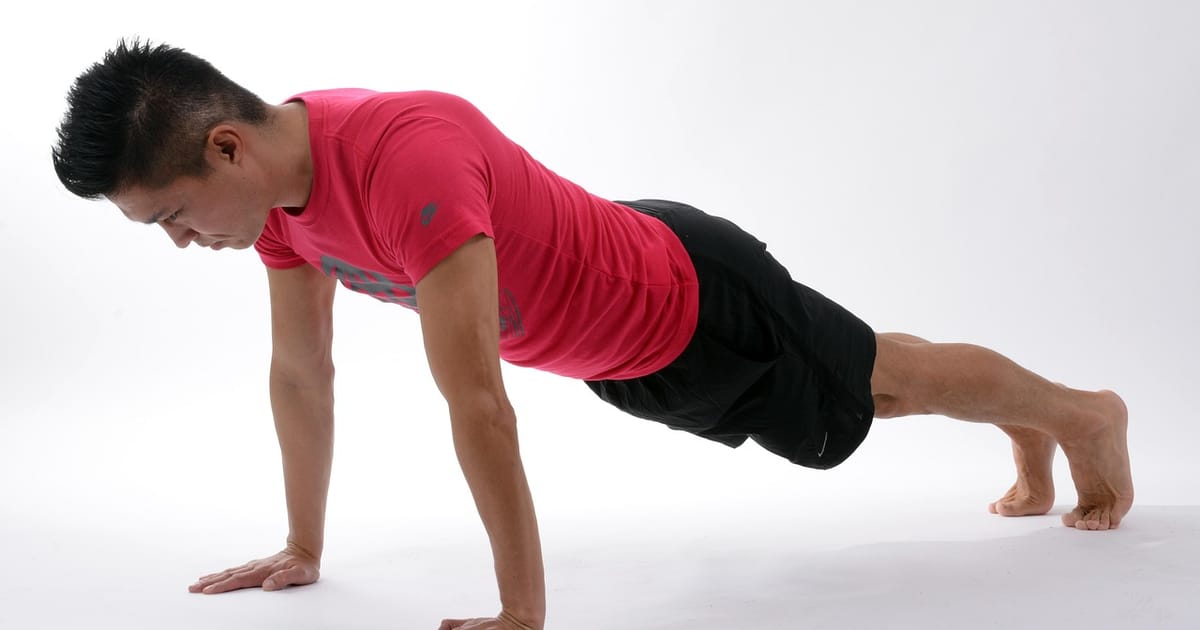
An incline push-up puts your hands on a raised surface, so your arms press less of your body weight than in a floor push-up. In a lab study, a 24-inch (61 cm) surface loaded the arms with about 41% of body weight and a 12-inch (30 cm) surface about 55%, against 64% for a regular push-up. Pick the height where you can do 8-12 clean reps, and lower it one step when 3 sets of 12 feel easy.
How much easier is an incline push-up?
Easier by a number you can measure. Researchers at Marquette University had 23 recreationally fit young adults (average age 22.5, average weight about 178 lb or 81 kg) do push-ups on a force platform, then expressed the peak force through the hands as a share of body weight. Each person did two reps of each variation, at a two-second pace, with hands shoulder-width apart.
| Variation | Load on the arms (% of body weight) |
|---|---|
| Hands on a 24-inch (61 cm) surface | 41% |
| Knee push-up, hands on the floor | 49% |
| Hands on a 12-inch (30 cm) surface | 55% |
| Regular push-up | 64% |
The table shows something most guides skip: the height matters more than the label. A 12-inch incline is harder than a knee push-up, and a 24-inch incline is easier. If knee push-ups feel too hard, a higher surface is the next step down.
The study did not measure a wall or a kitchen counter. Those are higher than 24 inches (61 cm), so the load is probably lower still, but that is an inference, not a result. The sample was small, young and fit, and the numbers are averages from a few reps, so your own load will differ.
What height should I start with?
Start where you can do 8-12 clean reps in your first set. A clean rep keeps a straight line from head to heels, lowers your chest to the edge of the surface, and presses back to straight arms.
- Fewer than 8 reps on a 12-inch (30 cm) bench or step: use a higher surface, such as a sturdy table or counter.
- 8-12 reps at 12 inches: stay there.
- 12 or more with ease: try the floor, or the next lower surface you have.
Use something that cannot slide or tip. If a push-up causes pain in your shoulder, elbow or wrist, stop and see a doctor or physiotherapist.
A 6-week plan from incline to floor
This is a coaching plan, not a protocol from one study. It uses three non-consecutive days a week, 3 sets per session and 1-2 minutes of rest between sets. Lower the surface by one step (for example, counter to table, table to bench, bench to step) whenever a session ends with all 3 sets at 12 clean reps.
- Choose your starting surface with the rule above.
- In week 1, do 3 sets of 8 reps. Stop each set 2 reps before your form breaks.
- Add 1 rep per set each week until you hit 12.
- When 3 x 12 feels easy, lower the surface one step and drop back to 8 reps per set.
- When you reach the floor, use the plan in how to increase push-ups to keep adding reps.
| Week | Sets x reps | If a 12-inch surface fits you |
|---|---|---|
| 1 | 3 x 8 | Stay at 12 inches (30 cm) |
| 2 | 3 x 9 | Stay at 12 inches |
| 3 | 3 x 10 | Stay at 12 inches |
| 4 | 3 x 11 | Stay at 12 inches |
| 5 | 3 x 12 | Stay at 12 inches |
| 6 | 3 x 8 | Lower one step, or try the floor |
If you move faster than one step every five weeks, good. The schedule is a ceiling for caution, not a target.
Do incline push-ups build muscle?
They can, as long as the sets are hard. In a 2017 randomized trial, 18 young men trained twice a week for 8 weeks, either with a bench press or with push-ups. The push-up group did 3 sets per session to failure, with the position adjusted (including kneeling) so the load matched 40% of their bench press max.
Triceps thickness in the push-up group grew from 27.7 to 30.4 mm, and their bench press max rose from 61.1 to 64.2 kg. The study found no significant difference between the push-up and bench press groups. It is small and short, and it did not test incline push-ups on their own. What it supports is the principle: an easier push-up variation still produces gains when you take the sets close to your limit.
Incline push-ups or knee push-ups?
For most people, incline. You keep the same body line as a floor push-up, so the skill carries over, and you can change the difficulty in small steps by changing the surface. Knee push-ups give you one step.
Knees can still be useful as a bridge. At 49%, they sit between the 12-inch and 24-inch surfaces in the study, so they are a reasonable choice if you have no surface at the right height.
Why am I not getting stronger on inclines?
Check three things first.
- You are not changing the height. If you do the same 3 x 12 for weeks, nothing new asks your body to adapt.
- You stop far from your limit. Finish sets with about 2 reps left, not 8.
- You count loose reps. Count only reps that reach the same depth every time.
A rep that stops halfway on a high surface is easy to do and does little. Lowering the surface is what adds load: in the study, going from 24 inches to 12 inches added 14 percentage points of body weight, and going to the floor added 9 more.