
Treadmill Workout for Beginners: An 8-Week Plan
A treadmill workout for beginners: the speed and incline to start at, 3 starter sessions, and an 8-week plan that takes you from walking to jogging.
PushSlayer Editorial Team · Updated · 5 min read
Leer en español
A good treadmill workout for beginners is 20-30 minutes, 3 days a week: walk easy for 5 minutes, walk briskly for 10-20 minutes at a pace where you can talk but not sing (usually 2.5-3.5 mph, or 4.0-5.6 km/h), then slow down for 5 minutes. Keep the incline at 0-1%. That is the first of 3 beginner workouts: a brisk walk, incline intervals and walk-jog intervals. After two weeks, add one incline interval session a week, and from week 5 add short jogs. The 8-week plan below lays out every session.
What speed and incline should a beginner use?
Start at 0-1% incline and the speed at which you can talk but not sing. The CDC's talk test marks that as moderate intensity, and the CDC counts walking at 2.5 mph (4.0 km/h) or faster as brisk. If you can only say a few words before you need a breath, you are at vigorous intensity.
Your speed will differ from someone else's at the same effort, so read the table as a starting range and let the talk test decide.
| Setting | Speed | Incline | How it should feel |
|---|---|---|---|
| Warm-up and cool-down | 2.0-2.5 mph (3.2-4.0 km/h) | 0-1% | Easy, you could sing |
| Brisk walk | 2.5-3.5 mph (4.0-5.6 km/h) | 0-1% | You can talk, but not sing |
| Incline walk | 2.5-3.0 mph (4.0-4.8 km/h) | 4-6% | You can talk in short sentences |
| Easy jog | 4.0-5.0 mph (6.4-8.0 km/h) | 0-1% | You can talk in short sentences |
To check your walking pace without a watch, count your steps for 15 seconds. In a 2019 lab study of 76 healthy adults aged 21-40 walking on a treadmill, about 100 steps a minute marked moderate intensity and about 130 marked vigorous. So 25 steps in 15 seconds puts you in the moderate range. The study covered younger adults, so treat the number as a rough guide and keep the talk test as your main check.
3 treadmill workouts for beginners
These three sessions cover the whole plan: a steady walk, incline intervals and walk-jog intervals. Each one starts and ends with 5 easy minutes.
Workout A: the brisk walk (20-30 minutes)
- Walk for 5 minutes at 2.0-2.5 mph (3.2-4.0 km/h), 0-1% incline.
- Raise the speed until you can talk but not sing. Hold it for 10-20 minutes.
- Slow back to 2.0-2.5 mph for 5 minutes, then press stop and wait for the belt to halt before you step off.
This is the 20-minute beginner treadmill workout in its simplest form: 5 easy, 10 brisk, 5 easy.
Workout B: incline intervals (26-34 minutes)
- Walk for 5 minutes at an easy pace, 1% incline.
- Raise the incline to 4-6% for 2 minutes, at a speed where you can still talk in short sentences.
- Lower it to 1% for 2 minutes at your brisk pace.
- Repeat steps 2 and 3 four times in week 3, building to six times by week 6.
- Cool down for 5 minutes at 0-1%.
Raise the incline, not the speed, when the session feels easy. The incline walking guide covers steeper grades once 6% feels comfortable.
Workout C: walk-jog intervals (25-35 minutes)
- Walk briskly for 5 minutes.
- Jog for 1 minute at a pace where you can still talk in short sentences, then walk for 90 seconds.
- Repeat step 2 six to eight times. From week 7 the jogs grow to 90 seconds, then 2 minutes.
- Walk easy for 5 minutes.
The 1 minute jog and 90 second walk is the same ratio the NHS Couch to 5K plan uses in its first week, and the NHS asks for a rest day between runs. The plan below follows both rules.
An 8-week treadmill plan for beginners
Train 3 days a week on days that are not back to back, for example Monday, Wednesday and Friday. This is a coaching plan built from the guidelines and studies cited here, not a tested protocol. If a week feels too hard, repeat it before you move on.
| Week | Day 1 | Day 2 | Day 3 |
|---|---|---|---|
| 1 | A, 20 min | A, 20 min | A, 20 min |
| 2 | A, 25 min | A, 25 min | A, 25 min |
| 3 | A, 30 min | B, 4 rounds | A, 30 min |
| 4 | A, 30 min | B, 5 rounds | A, 30 min |
| 5 | A, 30 min | B, 5 rounds | C, 6 jogs of 1 min |
| 6 | A, 30 min | B, 6 rounds | C, 8 jogs of 1 min |
| 7 | C, 6 jogs of 90 sec | B, 6 rounds | C, 8 jogs of 90 sec |
| 8 | C, 6 jogs of 2 min | B, 6 rounds | C, 7 jogs of 2 min |
In every C session, walk 90 seconds between jogs. You do not have to run. If jogging hurts or you just prefer walking, swap every C for another B. If the pain lasts more than a few days or returns every time you jog, see a doctor or physiotherapist. If you want to keep running after week 8, the run-walk method picks up where this plan stops and builds to 30 minutes of continuous running.
By week 3 you reach about 90 minutes a week. The CDC guidelines ask adults for 150 minutes of moderate activity a week, or 75 minutes of vigorous activity, and say activity can be split into smaller chunks across the week. To get there, add two 30-minute walks on other days, on the treadmill or outside. The brisk walking plan shows how to fit those in.
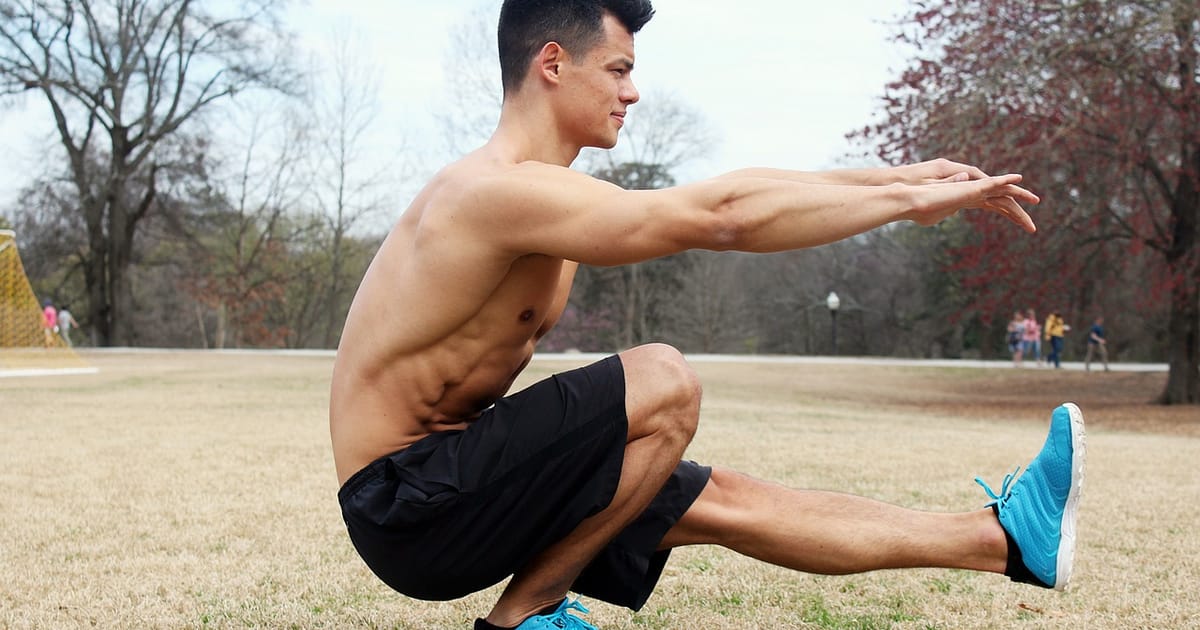
The same guidelines ask for muscle-strengthening work on at least 2 days a week. On two of your treadmill days, add squats and push-ups after the cool-down: 3 sets each, stopping 2 reps before your form breaks. The beginner bodyweight program gives you a complete session if you want more than those two moves.
How long should a beginner be on the treadmill?
Start with 20 minutes and build to 30 minutes per session over 2-3 weeks. If 20 minutes is too much on day one, do 10 and add 2-3 minutes each session. The CDC states that some physical activity is better than none, so a short session still counts.
Is 30 minutes on the treadmill enough? Five 30-minute brisk walks a week meet the CDC's 150-minute target, and the CDC gives "30 minutes a day, 5 days a week" as its own example. Three treadmill days plus two walks outside get you there too.
How do you use a treadmill safely?
Start the belt before you step on, use the safety key, and keep your hands off the rails once you are moving. Take the most care getting on and off, when the belt and your feet move at different speeds.
- Stand with your feet on the side rails, not the belt, and start it at the slowest speed.
- Clip the safety key to your clothing if your treadmill has one. It stops the belt if you fall back. Check your treadmill's manual for how it works.
- Step onto the moving belt and walk near the front, looking ahead, not down at your feet.
- Change speed or incline in small steps, and give each change a minute before the next.
- To finish, slow down, press stop, and wait for the belt to stop completely before you step off.
Should you hold the handrails? Only lightly, if you need balance. In a small 2006 study of 10 healthy adults aged 38-60, gripping the rails at the same speed and incline lowered heart rate by 12-21 beats a minute and oxygen use by roughly 15-21% compared with swinging the arms freely. The workout feels easier because it is easier. If you need the rails to keep up, lower the speed or incline instead.
Stop and get medical advice if you feel chest pain, dizziness or unusual shortness of breath. If you have a heart condition, joint pain or are pregnant, talk to a doctor or physiotherapist before you start.
Do you need a 1% incline on the treadmill?
No, not as a beginner. The 1% rule comes from a small 1996 study of 9 trained male runners, which found that a 1% grade best matched the energy cost of running outside, because a treadmill has no air resistance. At the two slowest speeds tested (about 6.5 and 7.5 mph, or 10.5 and 12 km/h), outdoor running matched both 0% and 1%.
Beginner jogs and walks are slower than any speed in that study, so the difference is small. Set 0% or 1%, whichever feels better, and save the incline for workout B.
Can a beginner do the 12-3-30 workout?
Not in week 1. The 12-3-30 workout is 30 minutes at a 12% incline and 3 mph (4.8 km/h), which is twice the steepest grade in this plan. In a small 2025 study, 14 adults who already exercised at least 3 times a week, average age about 25, burned an estimated 10 calories a minute doing it. Of the 16 people who enrolled, one could not finish the 12-3-30 session.
Finish the 8 weeks first. Then raise workout B's incline by 1-2% every week or two, and try 12-3-30 for 10 minutes before you try the full 30. Keep your hands off the rails: in that study, participants were not allowed to hold them.