
Pistol Squat Progression: 6 Levels and an 8-Week Plan
A pistol squat progression with an ankle test, 6 levels from assisted to full pistol, a pass mark for each, form cues and an 8-week plan.
PushSlayer Editorial Team · Updated · 8 min read
Leer en español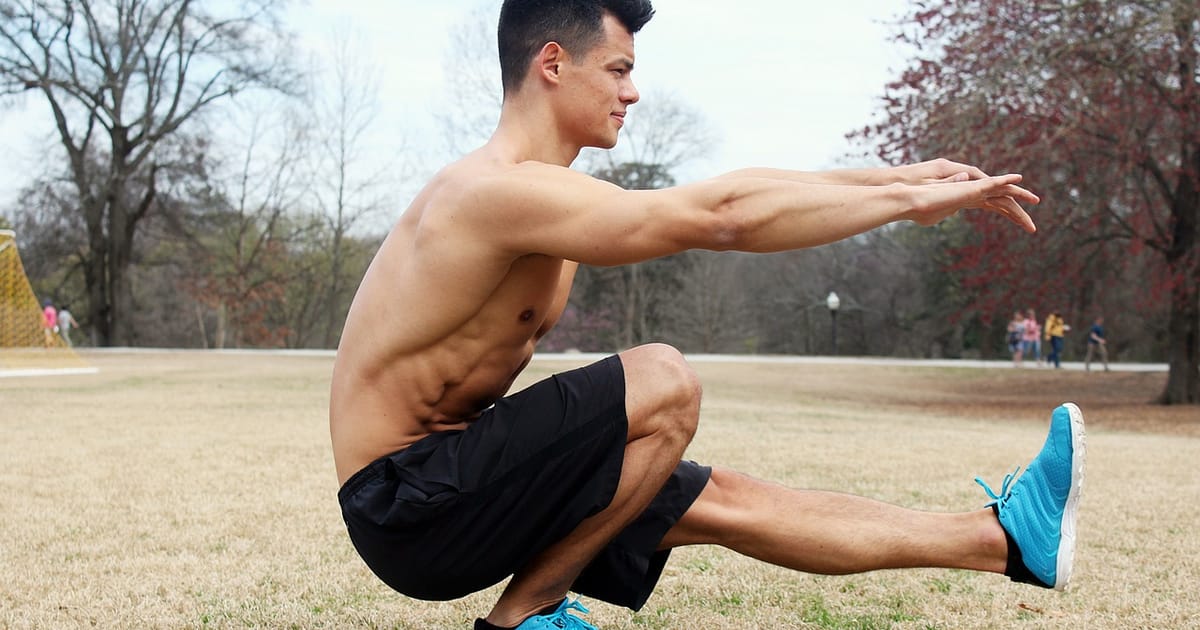
A pistol squat progression takes you from holding a doorframe to a free one-leg squat in six levels: assisted pistol, box pistol to a high box, box pistol to a low box, slow pistol negatives, counterbalanced pistol, then the full pistol. Start when you can do 20 deep two-leg squats with your heels down, and test your ankles first, because limited ankle bend is a common limit. Move up a level when you pass the test for the one you are on, and give it 8 weeks or more.
Are you ready to start a pistol squat progression?
You are ready when you can do 20 bodyweight squats in a row to full depth, hips below knees and heels on the floor, and you pass the knee-to-wall test below on both ankles. Below that, build your two-leg squat first with our guide to how many squats to do a day.
The 20-rep mark is our coaching choice, not a tested cutoff. The ankle test is the one to take seriously. In a 2014 study of 40 active adults, the half with less ankle bend in a weight-bearing lunge reached about 12 degrees less knee bend in a single-leg squat (77 vs 89 degrees at the deepest point). Ankle range measured lying down, without body weight, predicted nothing. A pistol needs more knee bend than that study's squat, so the ankle is often the first limit you hit.
The knee-to-wall test
- Kneel facing a wall, then put one foot flat on the floor with your toes 4 in (10 cm) from the wall.
- Keep your heel down and push your knee forward over your toes until it touches the wall.
- If it touches without your heel lifting, slide your foot back and try again. Measure the farthest distance where the knee still touches.
- Repeat on the other side.
A tape-measure version of this test gave nearly identical results on repeat in 20 healthy adults, and a change of about 1.1-1.5 cm (half an inch) was needed before it counted as real rather than measurement error. So retest every few weeks, and only trust gains of half an inch or more. The 4 in (10 cm) pass mark is our coaching choice: if you cannot reach it, stand with a weight plate or a folded towel under your heel for levels 1-4 and work on your calves in the meantime (see "Why can't I do a pistol squat?" below).
The 6 pistol squat levels at a glance
Each level takes away a bit of help: from your hands, from a box, or from a weight held in front of you. Test each leg and start both at the hardest level where your weaker leg passes.
| Level | Variation | Setup | Move up when |
|---|---|---|---|
| 1 | Assisted pistol squat | Hold a doorframe, pole or a band tied to something solid; pull only as much as you need | 3 x 8 per leg to full depth with a light grip |
| 2 | High box pistol | Sit back on one leg to a chair or box about 18 in (45 cm) high, then stand up without rocking | 3 x 8 per leg, two sessions in a row |
| 3 | Low box pistol | Same move to a box or step about 12 in (30 cm) high; add a cushion to go lower in small steps | 3 x 8 per leg, two sessions in a row |
| 4 | Pistol negative | Lower on one leg over 4-5 seconds to the floor or a very low step, then stand up on two legs | 3 x 5 controlled lowerings per leg |
| 5 | Counterbalanced pistol | Full pistol holding a 5-10 lb (2-5 kg) weight at arm's length in front of you | 3 x 5 per leg |
| 6 | Pistol squat | No support, no weight, hamstring to calf at the bottom | First clean rep; then build to 3 x 5 |
The weight at level 5 sounds like it should make the rep harder. It usually makes it easier, because it lets you sit back without falling over. Drop it by a few pounds at a time.
The heights, rep tests and the two-session rule are our coaching choices. They follow the ACSM position stand on resistance training, which advises adding load once you can do one or two reps more than your target. With body weight, adding load means taking away help: a lower box, a lighter grip, a lighter counterweight.
How to do a pistol squat with good form
A good rep keeps your heel down, your knee pointing over your middle toes and your free leg off the floor the whole way down and up.
- Stand on one leg with that foot pointing forward or turned out slightly. Lift the other leg a few inches in front of you.
- Reach both arms straight forward at shoulder height.
- Sit your hips back and down while your knee travels forward over your toes. Keep your weight over the middle of your foot.
- Raise the free leg as you go down so it stays clear of the floor. At the bottom it is roughly straight out in front.
- Lower for 2-3 seconds until your hamstring meets your calf.
- Drive through your whole foot to stand up, without letting your knee cave inward or your heel lift.
If your heel lifts, put a plate or towel under it. If your knee falls inward, go back a level. If your knee, hip or back hurts during a rep, stop and see a doctor or physiotherapist.
What muscles does a pistol squat work?
The quads and glutes of your standing leg do most of the work, and the hip muscles that keep your knee and pelvis level work hard because you balance on one foot. The front of your free leg works too, just to hold it up.
No study has measured a full pistol. The closest is a 2021 study in 17 healthy adults that compared single-leg squats with the free leg held in three positions. With the free leg straight out in front, the setup the authors describe as similar to a pistol, activity on the lowering phase was higher than with the free leg bent behind in the gluteus medius, gluteus maximus and medial hamstrings, and the tensor fascia lata (a hip muscle on the outside of the thigh) was the highest of all three positions. The rectus femoris, the quad muscle that also lifts the leg, was lower in that position on the way down. Participants squatted as low as they could, not to full pistol depth, so treat this as a guide to direction, not exact numbers.
Why can't I do a pistol squat?
Usually one of four things fails first: ankle range, leg strength, balance, or the free leg dropping. Film one rep from the side and look for which one breaks.
- Your heel lifts or you fall backward: ankle range. In the 2014 study above, limited ankle bend went with less knee bend in a single-leg squat. Calf stretching helps, but only a little: a systematic review of 5 trials found it added about 2-3 degrees of ankle bend. A raised heel is the faster fix. A 2021 review of 14 studies found that heel wedges and weightlifting shoes let lifters squat with a more upright trunk in barbell squats; that research did not test pistols. Our calf stretches for tight calves cover the stretches.
- You get down but can't stand up: strength. Stay at the box height where you can finish 3 x 8, add negatives, and add Bulgarian split squats on one day a week.
- You tip sideways: balance. Slow down, grip the floor with your whole foot, and use a light touch on the doorframe until it steadies.
- Your free heel hits the floor: the front of your hip can't hold the leg up at the bottom. Do pistols off the edge of a step so the free leg can hang lower, and do it as part of a daily mobility routine for your hips.
The 8-week pistol squat plan
Train pistols 3 days a week with a rest day between sessions, which matches the ACSM's 2-3 days a week for novices and 3-4 for intermediate lifters. Do 3 sets per leg at your level, start with your weaker leg, and rest about 2 minutes before you work the same leg again, within the 1-2 minutes the ACSM gives for muscle-building sets. Switching legs fills most of that rest. Stop each set 1-2 reps before your form breaks.
- In session 1, do the knee-to-wall test, then test each leg. Your level is the hardest one where your weaker leg can do at least 4 clean reps.
- Do 3 sets per leg at that level. Write down the reps and the box height.
- Each week, try to add 1 rep per set, or lower the box by about an inch (2-3 cm).
- When you pass the test for your level in two sessions in a row, move both legs up one level.
- Finish each session with 2 sets of 15-20 deep two-leg squats, heels down. They keep the full squat pattern in your legs on the days a pistol level feels slow.
| Week | Target per leg | Notes |
|---|---|---|
| 1 | 3 x 4-6 at your level | Learn the foot position, the reach and the speed down |
| 2 | 3 x 5-7 | Same level; retest the knee-to-wall if you used a heel plate |
| 3 | 3 x 6-8 | Move up if you pass the test twice |
| 4 | 2 x 6-8 | Easier week: two sets, same reps |
| 5 | 3 x 4-6 at the new level, or 3 x 7-8 | Expect fewer reps after moving up |
| 6 | Add 1 rep per set or lower the box | Same level |
| 7 | Add 1 rep per set | Move up if you pass the test twice |
| 8 | Retest each leg and both ankles | Try a full pistol if you passed level 5 |
The rep targets, the easier week, the weaker-leg-first order and the finishing squats are our coaching choices, built on the ACSM rule of adding load once you beat your target by a rep or two. If you start at level 1, expect to need more than 8 weeks. Run the plan again from your new level.
How long does it take to do a pistol squat?
No study has timed it. As a rough coaching guide, someone who already has 20 deep squats and good ankles often gets a first rep within 2-3 months of steady work. Stiff ankles, long legs or a higher body weight add time.
If you pass a level every 2-3 weeks, you are on track. If you stall at the same level for 4 weeks, change the variable that is failing: lower the box in smaller steps, add a fourth set for your weaker leg, or go back to a heel plate.
Are pistol squats better than regular squats?
Not for building leg strength in general. In two small training studies, one-leg and two-leg squat training gave similar gains.
- In a 2005 study of 38 untrained men and women, 8 weeks of one-leg or two-leg free-weight training twice a week improved one-leg and two-leg strength and power about equally. The one-leg group gained more on a one-leg jump.
- In a 2016 trial in 18 academy rugby players, 5 weeks of rear-foot-elevated split squats or back squats improved back squat strength, 40 m sprint and agility with no difference between groups.
Neither study used pistols, so read them as evidence that one-leg work can build strength as well as two-leg work, not that pistols beat squats. The pistol's real draws are that it needs no equipment, trains each leg on its own, and demands balance and ankle range that two-leg squats do not. For other options, see our list of 13 types of squats.
Are pistol squats bad for your knees?
No study has tested whether pistols raise the risk of knee injury, so there is no evidence either way. In the 2021 single-leg squat study, holding the free leg in front gave the largest knee adduction moment (a sideways load on the knee) of the three positions, which is one reason to keep the knee tracking over your toes and to take the levels in order.
If you have knee pain, a past knee injury or knee surgery, see a doctor or physiotherapist before you train pistols. Stop any rep that hurts, rather than pushing through it.
How many pistol squats should you do?
Do 3 sets of 3-8 per leg, 2-3 days a week. That sits inside the 1-12 rep range the ACSM gives intermediate and advanced lifters for strength and muscle growth, and keeps each rep hard enough to count as strength work.
Once you have 3 x 5 clean pistols per leg, make them harder by adding a weight held at your chest, pausing 2 seconds at the bottom, or standing on a step so you go lower. A goblet squat on the other days keeps two-leg strength moving if you have a weight at home.