Decline Push-Ups for Upper Chest: Box Height and a Plan
Decline push-ups for upper chest: what the research shows, how high to put your feet, and a 6-week plan with sets, reps and box heights.
PushSlayer Editorial Team · Updated · 6 min read
Leer en español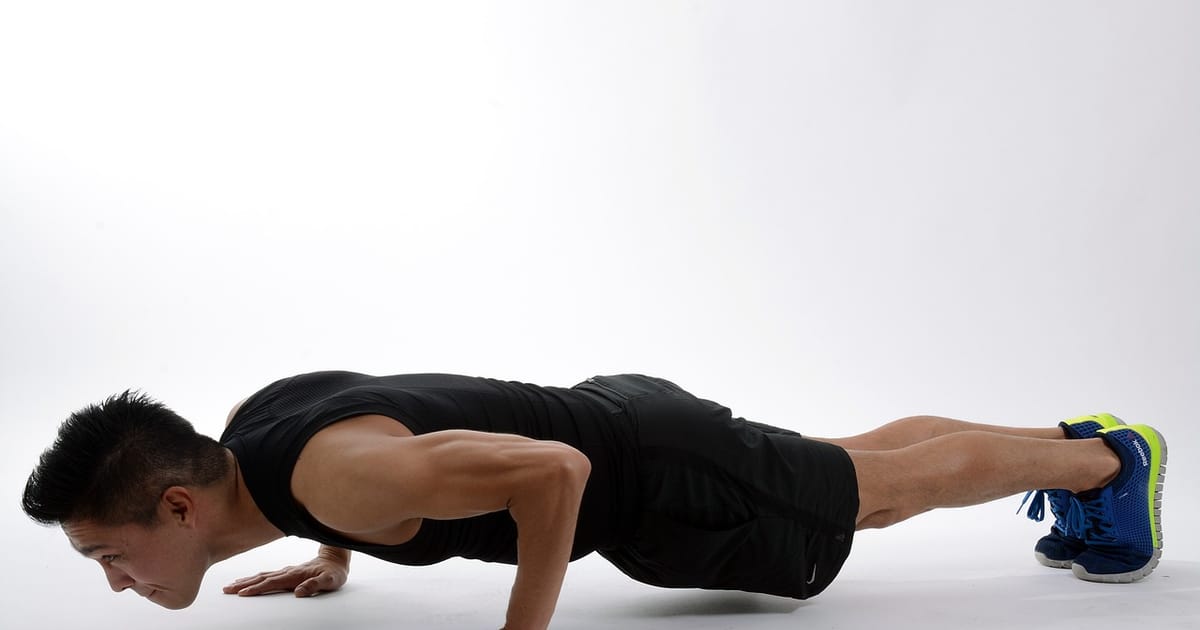
Decline push-ups do less for the upper chest than most guides claim. A 2026 study that measured push-ups at different angles found that tilting your body head-down moves work off the lower chest and onto the front of your shoulders and triceps; no study has measured the upper chest in this push-up. What a decline surely adds is load: with your feet on a 12-inch (30 cm) box, your arms press about 70% of your body weight, against 64% on the floor. Use declines as a harder push-up: 3 sets of 8-12, two or three times a week.
Do decline push-ups work the upper chest?
Partly, by shifting the balance rather than by making the upper chest work much harder. We found no peer-reviewed study that measured upper-chest activity in decline push-ups, but one measured the rest of the chest and the shoulders.
In a 2026 study of 19 trained men, each man did 5 push-ups at five body angles, on the floor and on suspension straps. For the declines, aerobic steps raised the feet so the shoulders sat 15 or 30 degrees below the ankles. The chest electrode sat on the middle and lower (sternocostal) fibers. On the floor, the results were:
| Body angle (floor push-ups) | Chest, lower and middle fibers | Front shoulder | Triceps |
|---|---|---|---|
| Flat (0 degrees) | 41% of max | 49% of max | 35% of max |
| 15 degrees head-down | 36% | 56% | 38% |
| 30 degrees head-down | 27% | 60% | 41% |
Chest activity at both decline angles was significantly lower than flat, and front-shoulder activity was significantly higher. The triceps rose significantly at 30 degrees. The study was small, each angle got only 5 reps, and it did not report how high the steps were.
For the upper chest itself, the closest evidence is the incline bench press, which puts your torso at a similar angle to your arms. In a 2020 study of 30 trained adults that tested the bench at 0, 15, 30, 45 and 60 degrees, upper-chest activity was highest at 30 degrees but not significantly above the flat bench, while lower-chest activity dropped from 15 degrees on. A 2014 study of 15 young men found the same pattern in a push-up bent 30 degrees at the waist: the upper (clavicular) part of the chest rose from 79% to 84% of maximum and the lower (sternocostal) part fell from 65% to 55%. That was one session, and it compared a straight body with a piked one, not a feet-raised push-up.
Put together, a decline push-up gives the upper chest a larger share of the chest's work mainly because the lower chest does less, while your shoulders and triceps pick up the slack.
How high should your feet be?
Start with a 12-inch (30 cm) step or box, and go higher only when 3 sets of 12 feel easy. The lab numbers for load come from a force-platform study of 23 recreationally fit young adults, presented at a biomechanics conference:
| Push-up | Load on the arms (% of body weight) |
|---|---|
| Regular push-up | 64% |
| Feet on a 12-inch (30 cm) box | 70% |
| Feet on a 24-inch (61 cm) box | 74% |
The jump from the floor to 12 inches is bigger than the jump from 12 to 24. For someone weighing 180 lb (82 kg), that is roughly 115 lb (52 kg) on the floor, 126 lb (57 kg) at 12 inches and 133 lb (60 kg) at 24 inches. These are averages from two reps per variation at a two-second pace, so your own numbers will differ.
Height matters more for the angle than for the load. By our rough geometry (shoulders about 7 inches or 18 cm off the floor at the bottom, about 57 inches or 145 cm from shoulders to toes, as for an adult about 5 ft 10 in or 178 cm tall), a 24-inch (61 cm) box tilts the body about 17 degrees at the bottom of the rep and only a few degrees at the top. Reaching the 30 degrees of the incline bench study would take feet roughly 3 feet (90 cm) off the floor. That is an estimate, not a measurement, and it depends on your size, but it explains why a low step mostly adds load and the shift toward your shoulders grows as the box gets higher.
Use something that cannot slide or tip, such as a bench, a sturdy box or a stair. A bench, or a chair pushed against a wall, at 16-18 inches (40-45 cm) makes a middle step between 12 and 24.
How to do a decline push-up
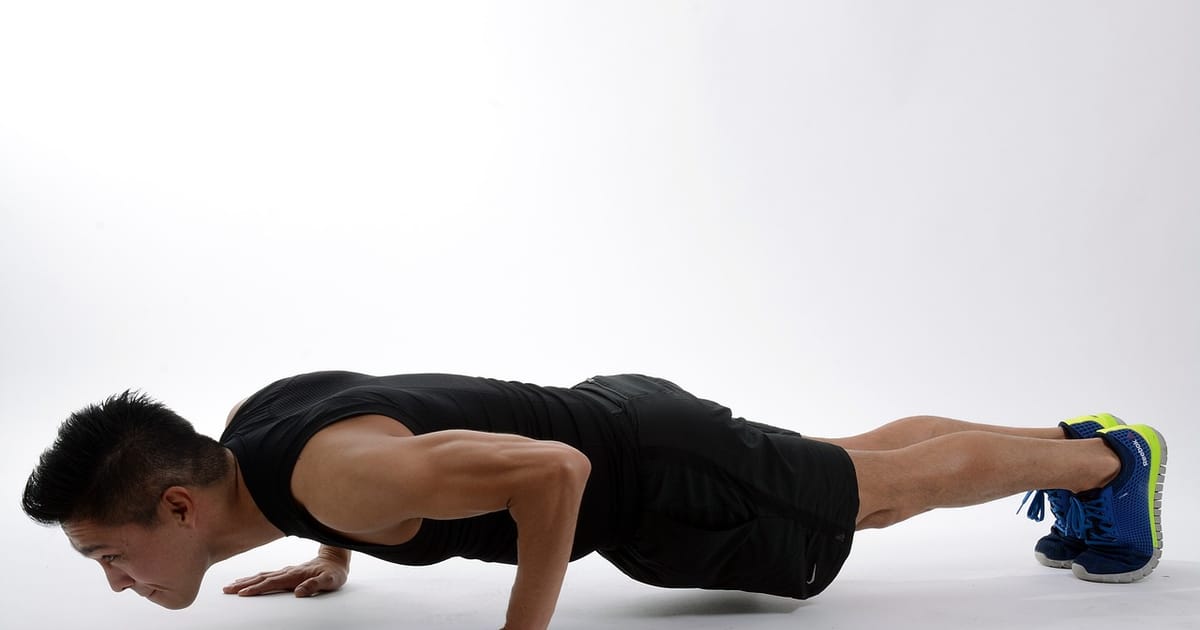
- Kneel facing away from your box, place your hands on the floor slightly wider than your shoulders, and put the tops of your feet or your toes on the box.
- Walk your hands forward until your body forms a straight line from head to heels. Squeeze your glutes and brace your stomach.
- Lower your chest toward the floor, elbows at about 45 degrees from your body, until your chest is a fist's width from the floor.
- Press back up to straight arms without letting your hips sag or pike.
- Lower in about two seconds and press in about one.
If your hips sag or your head drops toward the floor before your chest does, the box is too high for now. If a decline push-up causes pain in your shoulder, elbow or wrist, stop and see a doctor or physiotherapist.
Should you do decline or incline push-ups?
Decline if you can already do about 15 clean floor push-ups; incline if you can't. That cutoff is a coaching rule, not a study result. An incline push-up puts your hands up and lowers the load to 41-55% of body weight, so it is the step before the floor push-up. A decline push-up puts your feet up and raises the load, so it is the step after. The daily plan in is it OK to do push-ups every day uses it the same way, once your max passes 30.
Neither one isolates the lower or upper chest. Online guides disagree on this because the upper-chest claim rests on bench press studies, not push-up studies, and because "decline" means opposite things in the two exercises. In a decline push-up your head is lower than your feet, so your arms push toward your head, as in an incline press. In a decline bench press, the angle runs the other way.
A 6-week decline push-up plan
This is a coaching plan, not a protocol from one study. It draws on the ACSM's 2026 position stand, an overview of 137 systematic reviews, which found that muscle growth improved with 10 or more sets a week and that training to failure did not consistently change results. So we have you end each set with 1-2 reps left in reserve rather than at failure. That, the 8-12 rep range, the non-consecutive days and the 1-2 minutes of rest between sets are our coaching choices.
- Test yourself on a 12-inch (30 cm) box. If you can do 8 or more clean reps, start there. If not, keep building floor push-ups first.
- Train 2 or 3 non-consecutive days a week, with 3 sets per session and 1-2 minutes of rest.
- Add 1 rep per set each week until you reach 3 sets of 12.
- When 3 x 12 feels easy, raise the box one step (12, then 16-18, then 24 inches) and drop back to 3 x 8.
| Week | Sets x reps | Box height |
|---|---|---|
| 1 | 3 x 8 | 12 in (30 cm) |
| 2 | 3 x 9 | 12 in (30 cm) |
| 3 | 3 x 10 | 12 in (30 cm) |
| 4 | 3 x 11 | 12 in (30 cm) |
| 5 | 3 x 12 | 12 in (30 cm) |
| 6 | 3 x 8 | 16-18 in (40-45 cm) |
Do your decline sets first in the session, while you are fresh. For more volume, add 1-2 sets of regular push-ups afterward: 3 days of 3 decline sets plus 1 regular set gives you 12 chest sets a week. The plan in how to increase push-ups uses the same idea: move one set to the harder variation and keep the rest standard.
Can you build your chest with decline push-ups alone?
Push-ups can build the chest when the sets are hard enough. In a 2017 randomized trial, 18 young men with at least a year of resistance training trained twice a week for 8 weeks with either the bench press or push-ups, 3 sets to failure. In the push-up group, chest muscle thickness grew from 17.0 to 20.8 mm and bench press strength rose from 135 lb (61.1 kg) to 142 lb (64.2 kg), with no significant difference in muscle thickness from the bench press group.
The study was small and short and did not test decline push-ups. What it supports is the principle: push-ups taken to failure built the chest about as well as a bench press at the same load. A decline is one way to keep the load up once floor push-ups get easy.
Decline push-up benefits and muscles worked
The main benefit is a heavier push-up with no equipment. The movement trains your chest, the front of your shoulders and your triceps, and your core has to hold your body straight.
- More load: about 70-74% of body weight on the arms, against 64% on the floor.
- Less lower chest and more front shoulder and triceps as the tilt grows, as the 2026 study measured.
- An easy way to progress at home: raise the box instead of adding plates.
Expect the front of your shoulders to work harder than in a floor push-up, more so as the box gets higher. As a coaching precaution, if you already do a lot of overhead pressing, keep your decline volume moderate and give your shoulders at least a day between sessions. For a broader home routine, the beginner bodyweight workout program pairs push-ups with squats and rows.