Diamond Push-Up Form: Steps, Mistakes and a 6-Week Plan
Diamond push-up form in 5 steps, the mistakes that cost you reps, what the EMG research says about triceps, and a 6-week plan from incline to floor.
PushSlayer Editorial Team · Updated · 7 min read
Leer en español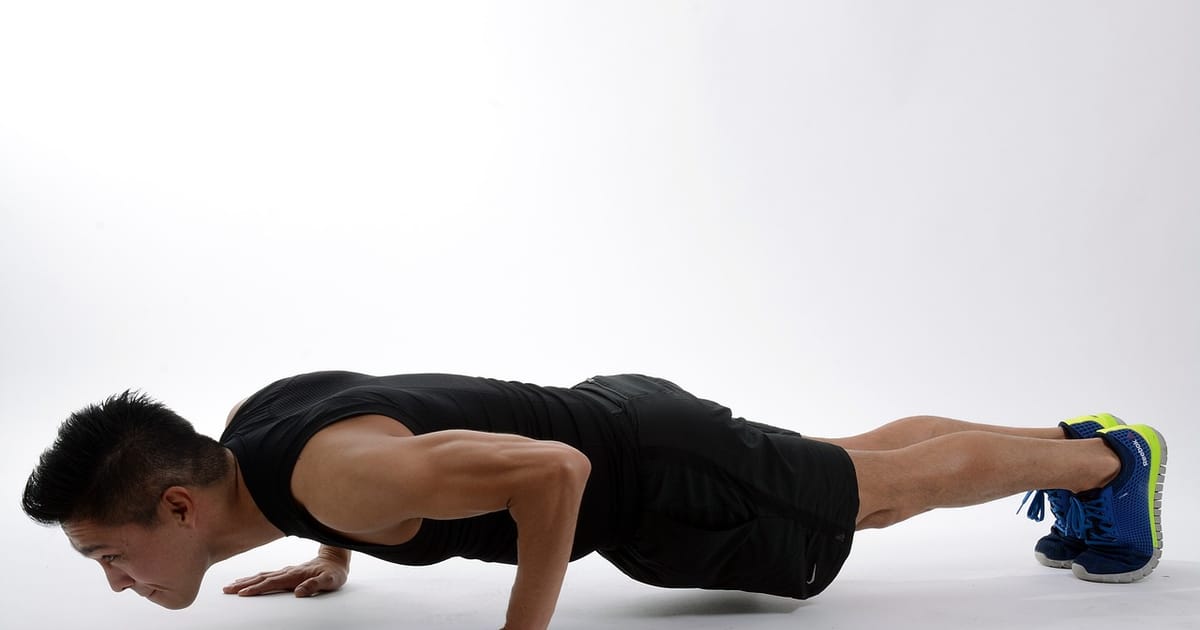
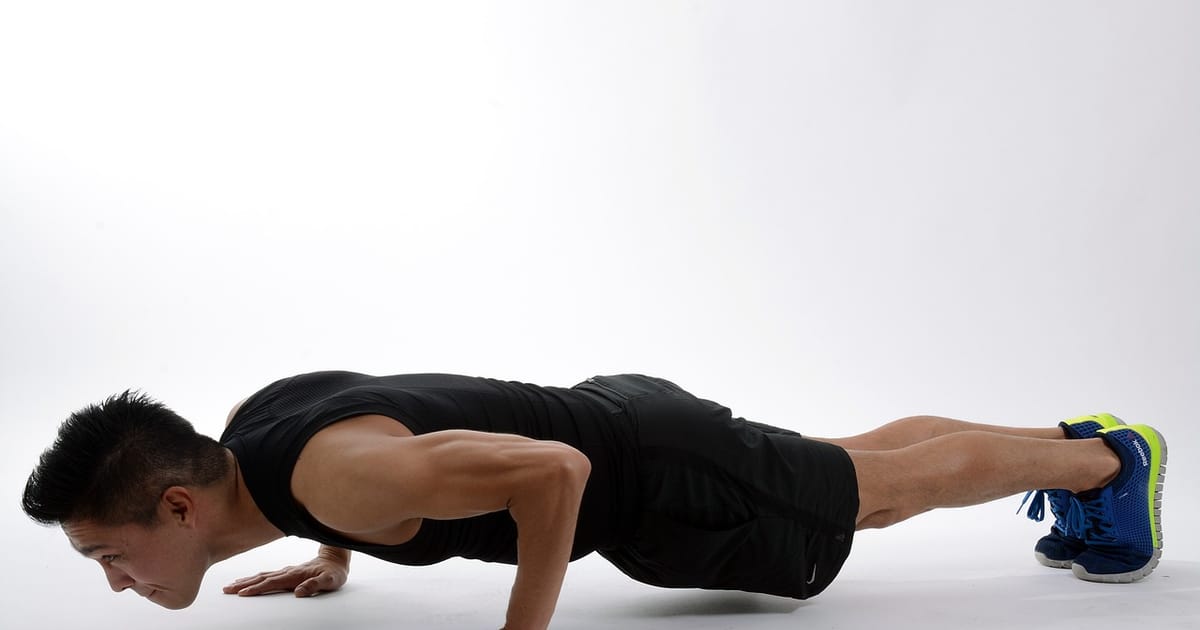
Good diamond push-up form looks like this: hands under the middle of your chest with thumbs and index fingers touching to make a diamond, body straight from head to heels, elbows brushing your ribs on the way down, chest lowered to just above your hands, then a full press back up. If you can't do 6 clean reps on the floor, start with your hands on a bench and work down over a few weeks.
How to do a diamond push-up
Set your hands first, then treat the rest like a strict push-up with your elbows kept in.
- Kneel and place your hands on the floor under the middle of your chest. Touch your thumbs together and your index fingers together so the gap between them makes a diamond (some people call it a triangle push-up).
- Step your feet back into a high plank. Squeeze your glutes and brace your stomach so your head, hips and heels form one line.
- Lower slowly, taking 2-3 seconds. Keep your elbows close to your sides so they point back toward your feet, not out to the sides.
- Stop when your chest is a fist's height or less above your hands.
- Press the floor away until your elbows are straight, without shrugging your shoulders up to your ears.
These cues match the instructions used in a 2026 lab study of diamond push-ups: hands under the middle of the chest forming a diamond, elbows kept close to the torso, no shrugging, and a slow 3-second descent. The fist-height depth target is our coaching choice, because the hands under your chest stop your chest from touching the floor.
Common diamond push-up mistakes
Most diamond push-up faults come from the narrow hands making the bottom of the rep hard, so the body finds a way to skip it.
- Elbows flaring out to the sides. It feels easier because it turns the rep into a wobbly regular push-up. Think "elbows to the back pockets."
- Hips sagging or piking up. Your core is part of the exercise. If your hips drop on the last reps, end the set there.
- Half reps. Stopping halfway down hides weak triceps. Count only reps that reach your depth target.
- Hands too far forward. Hands under your face tend to shift the work forward onto your shoulders. Slide them back under your breastbone.
- Rushing the descent. Dropping fast and bouncing makes the reps look easy and teaches nothing. Lower for 2-3 seconds.
If any rep causes pain in your wrist, elbow or shoulder, stop and see a doctor or physiotherapist.
What muscles do diamond push-ups work?
Diamond push-ups work your triceps hardest, with your chest close behind and your front shoulders and core helping. Four lab studies that measured muscle activity agree that narrow hands make your triceps work harder than wide hands do.
| Study | Who was tested | What they found |
|---|---|---|
| Intziegianni et al., 2026 | 20 recreationally active young men, 6 reps of each push-up | Triceps more active than chest in all three hand positions. Diamond and standard push-ups both beat wide push-ups for overall activity. |
| Cogley et al., 2005 | 40 adults (11 men, 29 women), 1 rep of each | Narrow hands produced more chest and triceps activity than wide hands. |
| Marcolin et al., 2015 | 8 healthy young volunteers, 10 reps of each | Triceps and chest were most active in the narrow-hand push-up. |
| Kim et al., 2016 | 12 healthy men | Hands at half shoulder width raised triceps activity above shoulder-width and wide hands. |
One result surprises people: narrow hands did not take work away from the chest. In Cogley's and Marcolin's studies, the chest was more active with narrow hands than with wide ones, and the 2026 study found no sign that hand position changed the chest's share differently from the triceps. The 2026 authors suggest that tucked elbows keep your upper arms close to your midline, so your chest works hard to drive them there.
These are small studies that measured muscle electrical activity over a few reps. Higher activity hints at which muscles do more of the work. It does not prove that one variation builds more muscle over months.
Are diamond push-ups better than regular push-ups?
Diamond push-ups are harder on your triceps, but not clearly better than regular push-ups. In the 2026 study, the difference in muscle activity between diamond and standard push-ups was small and not statistically significant. Only the wide push-up fell clearly behind.
So pick by goal:
- You want more triceps work from body weight alone: diamond push-ups are a good tool.
- You want the most reps or a test number: regular push-ups, since most people can do more of them.
- Your wrists or elbows complain with your hands together: a close-grip push-up with your hands about half your shoulder width apart.
The close-grip option is backed by data too. The 2016 study by Kim used hands at half your shoulder width, not touching, and still found more triceps activity than at shoulder width.
Are diamond push-ups bad for your wrists and elbows?
No study has tested whether they injure healthy joints, but they load your elbows more than regular push-ups, which is why you should build up to them. In a 1993 biomechanics study of 9 healthy men, the peak torque trying to bend the elbow reached 71% of the men's maximum elbow-extending strength with hands together, against 56% in a normal push-up and 29% with hands set apart.
That extra torque is exactly why diamond push-ups train your triceps: they have to resist it. It also means jumping straight into high-rep diamond sets is a bad idea if your elbows aren't used to it.
To make them friendlier:
- Turn your fingertips slightly outward so your wrists sit in a natural angle.
- Spread your hands to about half your shoulder width so the thumbs no longer touch. That is the close-grip version above.
- Start on an incline, which lowers the share of body weight your arms press.
- Warm up with a set of incline or regular push-ups first.
These are coaching suggestions, not tested fixes. If pain stays after a session or keeps coming back, stop the exercise and have a doctor or physiotherapist look at it.
Can't do a diamond push-up yet? Start on an incline
Raise your hands and the push-up gets lighter, so an incline diamond is the best place to start. No study has measured the load of a diamond push-up on an incline, but one measured regular-width push-ups.
Researchers at Marquette University had 23 recreationally fit young adults do push-up variations on a force platform and recorded the peak force through the hands as a share of body weight:
| Push-up variation (hands at shoulder width) | Load on the hands (% of body weight) |
|---|---|
| Hands on a 24-inch (61 cm) box | 41% |
| Knee push-up | 49% |
| Hands on a 12-inch (30 cm) box | 55% |
| Regular push-up on the floor | 64% |
Diamond hands were not tested, so treat the numbers as a rough guide. What they show is the pattern: the higher your hands, the less of your body weight your arms press. Use that as a ladder:
| Level | Diamond variation | Move up when |
|---|---|---|
| 1 | Hands on a kitchen counter or bench, about 24-36 inches (61-91 cm) high | 3 x 12 clean, two sessions in a row |
| 2 | Hands on a sturdy step or low box, about 12 inches (30 cm) high | 3 x 12 clean, two sessions in a row |
| 3 | Knees on the floor, hands in a diamond | 3 x 12 clean, two sessions in a row |
| 4 | Full diamond push-up on the floor | Add reps, or slow the lowering to 3 seconds |
The ladder and the 3 x 12 test are our coaching choices. If regular push-ups are still a struggle, build those first with our incline push-up guide, which uses the same idea with your hands at shoulder width.
The 6-week diamond push-up plan
Train diamond push-ups 2-3 days a week, and leave a rest day between sessions (our coaching choice). Do 3 sets, rest 1-2 minutes between sets, and end each set 1-2 reps before your form breaks.
This follows the ACSM position stand on resistance training progression, which recommends that beginners train 2-3 days a week with a load they can lift for 8-12 reps, rest 1-2 minutes between sets when training for muscle growth, and increase the load once they can do one or two reps more than the target. With body weight, increasing the load means moving down the ladder toward the floor.
- In session 1, find your level: the hardest one where you can do at least 6 clean reps.
- Do 3 sets at that level and write down your reps.
- Each week, try to add 1 rep to each set.
- When you reach 3 x 12 clean in two sessions in a row, move to the next level and start again at whatever you can do cleanly.
- Finish each session with 1 set of regular push-ups to a few reps short of failure. It keeps your chest in the plan and gives you a second number to watch.
| Week | Target per session | Notes |
|---|---|---|
| 1 | 3 x 6-8 at your level | Learn the hand position and the 2-3 second lowering |
| 2 | 3 x 7-9 | Same level |
| 3 | 3 x 8-10 | Same level |
| 4 | 3 x 9-11 | Drop to 2 sets if your elbows feel beaten up |
| 5 | 3 x 10-12 | Move up a level if you hit 3 x 12 twice |
| 6 | Add 1 rep per set, then retest | Expect fewer reps right after moving up |
Moving up one or two levels in 6 weeks is solid progress. The weeks are a guide: move faster if your reps say you can, and repeat a week when they don't.
How many diamond push-ups should you do?
Do 3 sets of 6-12 clean reps, 2-3 days a week. That fits the 8-12 rep range and 2-3 weekly sessions the ACSM recommends for beginners, with room at the bottom for the first week at a new level.
If you can do 20 or more clean floor diamonds, a longer set is not the best next step. Slow the lowering to 3 seconds, pause at the bottom, or raise your feet on a low step. To fit diamonds into a wider push-up routine, our guide on how to increase push-ups covers rep tests and weekly volume, and our article on doing push-ups every day explains when daily sets help and when they don't.
Do diamond push-ups build bigger triceps?
They can, if your sets are hard and you keep making them harder. No trial has tested diamond push-ups alone for muscle growth, but two trials of push-up training point the same way.
- In a 2017 randomized trial, 18 young men did either bench presses at 40% of their max or push-ups adjusted to the same load, twice a week for 8 weeks. Triceps thickness in the push-up group rose from 27.7 to 30.4 mm, and both groups gained similar strength and chest thickness.
- In a 2018 trial, 23 moderately trained men trained 3 days a week for 4 weeks, with either the bench press or a push-up program that moved to harder variations over time. Both groups raised their bench press max. Neither group's muscle thickness changed significantly in that short time.
Both studies were small and short. What they support is the method: push-up variations build strength and muscle when you take sets close to your limit and progress them. Diamond push-ups give your triceps a bigger share of that work. For more shoulder-focused bodyweight pressing, the pike push-up progression uses the same ladder approach.