How Many Squats Should I Do a Day? A Plan by Level
How many squats should you do a day? A number for your level from training research, a weekly plan, calorie estimates and when daily squats stop helping.
PushSlayer Editorial Team · Updated · 6 min read
Leer en español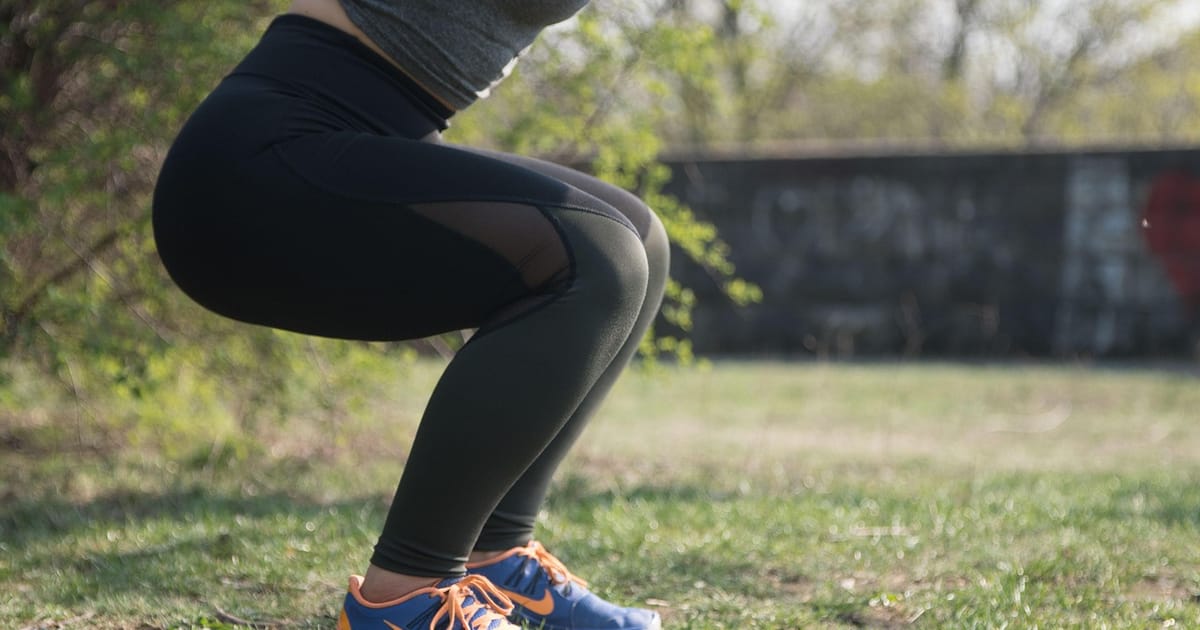
Most people should do 2-4 sets of squats, 6-25 reps per set, on 2-4 days a week. For a beginner that's about 12-45 squats per session; for someone fitter, 45-100, or fewer and harder reps once squats get easy. The number of reps matters less than how hard each set is. A set builds muscle when it ends within a few reps of the point where you can't do another clean one, and research ties muscle growth to how many of those hard sets you do each week, not to a daily rep count. Find your level below, then follow the plan.
How many squats a day for your level
Test yourself first: after a warm-up, do as many bodyweight squats as you can with good form, thighs parallel to the floor on every rep. Stop when a rep loses depth or your heels lift. That number is your max. Then find your row:
| Your max (good reps) | Variation | Sets x reps | Days per week | Squats per session |
|---|---|---|---|---|
| Fewer than 10 | Box squat (sit to a chair and stand) | 2 x 6-8 | 3 | 12-16 |
| 10-25 | Bodyweight squat | 3 x 8-15 | 3 | 24-45 |
| 26-50 | Bodyweight squat | 3-4 x 15-25 | 3-4 | 45-100 |
| More than 50 | Split squat, or a squat holding a weight | 3-4 x 8-12 (per leg for split squats) | 2-3 | 24-48 |
Rest 1-2 minutes between sets. Retest your max every two weeks and move down a row when it climbs. The table's cut-offs, rest times and retest schedule are our coaching rules, not research findings; the evidence behind the ranges follows.
These ranges come from a few findings. The American College of Sports Medicine's 2026 position stand, an overview of 137 systematic reviews, found more muscle growth with 10 or more sets per muscle group per week, and better strength gains with 2 or more sessions a week. A 2017 meta-analysis of 15 studies found a graded dose-response: each extra weekly set for a muscle was linked to slightly more growth. The rows above give you 6-16 hard sets for your legs per week, with fewer than 10 at the start while you learn the movement.
The last row drops the rep count on purpose, which brings us to the reason more squats isn't always better.
Why more reps stop helping
Once bodyweight squats get easy, adding reps is the slow road. A 2017 meta-analysis of 21 studies found that light and heavy loads built similar muscle when every set was taken to failure, while heavy loads built more maximal strength. So light work does grow muscle, as long as the set gets hard.
There's a floor. In a 12-week trial in 30 men, legs trained at 20% of their one-rep max grew 8.9% in the thigh, about half the 19.5% seen with 80%, while 40% and 60% loads kept up with the heavy one. Very light loads were the weak option.
Our rule of thumb from those findings: when a set needs more than about 30 bodyweight squats before it gets hard, make the squat harder instead of longer. Switch to split squats, which put most of your weight on one leg, or use a slow 3-second descent, a pause at the bottom, or a backpack or dumbbell held at your chest.
How to do a squat so the reps count
A rep counts when it reaches the same depth as your first one. A review of knee biomechanics during the squat found that the parallel squat, thighs parallel to the floor, was not injurious to healthy knees and worked the quadriceps, hamstrings and calves. It recommended the parallel squat over a deep squat for healthy athletes.
- Stand with your feet about shoulder-width apart, toes turned out slightly.
- Push your hips back and bend your knees at the same time, keeping your chest up.
- Let your knees travel in line with your toes, not caving inward.
- Lower until your thighs are parallel to the floor, heels down.
- Drive through your whole foot to stand all the way up.
If you can't reach parallel without your heels lifting or your back rounding, squat to a chair or box at the lowest height you control, and lower the box as you improve.
Is it OK to do squats every day?
Yes, if you split your weekly sets across the days instead of adding to them, and most sets stop short of failure. A 2019 meta-analysis of 25 studies found no meaningful difference in muscle growth between training a muscle more or less often once weekly volume was equal. Its authors concluded you can choose your frequency by preference.
Stopping before failure costs you little. A 2022 meta-analysis of 15 studies in young adults found no significant difference in strength or muscle size between training to failure and stopping short of it.
So 3 sets of 15 three days a week and 2 sets of 15 most days are similar plans. The daily version suits you if a short habit is easier to keep than a longer session. End each daily set with 2 or 3 good reps left in you. Our rule for rest days: take one when your max drops two sessions in a row or your legs are too sore for clean depth.
Is 100 squats a day too much? For a beginner, often yes at first: start from your row in the table. For someone whose max is above 50, 100 bodyweight squats spread over the day is a manageable workload, but sets that never get hard are a weak stimulus for muscle, for the reasons in the section above.
If your knees or hips hurt during squats, which is different from tired muscles, stop and see a doctor or physiotherapist.
How many squats a day to see results?
Results depend on the weekly plan above, not on a magic daily number, and they take weeks. Training studies usually measure muscle changes after 6-12 weeks: the low- versus high-load meta-analysis only included trials of at least 6 weeks, and the trial in 30 men measured growth at 6 and 12 weeks.
Use your rep max as the progress check. Our rule: test it every two weeks, and if it hasn't changed in four weeks, add a set or move to a harder variation.
How many squats a day for bigger glutes?
The same weekly plan works, with one change: squat deep if you can do it without pain. In a 10-week trial in 17 men who did barbell squats twice a week, the group that squatted deep (knees bent to 140 degrees, below parallel) grew their glutes by 6.7%. The group that stopped at 90 degrees, above parallel, grew theirs by 2.2%. Both groups grew their front thighs by a similar amount.
That was a small study in men using a barbell, so treat it as a pointer, not a promise. The knee review above preferred the parallel squat because injury risk to the knee's menisci and ligaments may rise with deep squats, so depth is a trade-off, not a free upgrade. Go only as deep as you can with your heels down and your back flat, and add depth gradually from the parallel squat described above.
How many calories do 100 squats burn?
About 15-50 calories, depending on your weight and how hard you work. These are estimates. The 2024 Adult Compendium of Physical Activities rates general bodyweight exercises such as squats at 3.0 METs and high-intensity bodyweight exercise at 6.5 METs. One MET is about 1 calorie per kilogram of body weight per hour, according to the Compendium's authors.
Assuming 100 squats take about 5 minutes with short breaks:
| Body weight | Steady pace (3.0 METs) | Fast and hard (6.5 METs) |
|---|---|---|
| 130 lb (59 kg) | About 15 calories | About 32 calories |
| 160 lb (73 kg) | About 18 calories | About 40 calories |
| 200 lb (91 kg) | About 23 calories | About 49 calories |
These totals include what you'd burn sitting still for those 5 minutes. Squats are worth doing for strength, not as a way to burn a big number.
Will squats get rid of belly fat?
Squats won't target fat in any one spot, including the legs you train. In a 12-week study of 11 young adults, each person trained one leg with 960-1,200 leg press reps per session, three times a week. Total fat mass fell 5.1%, but fat in the trained leg didn't change; the losses showed up in the arms and trunk. It was a small study, but it shows that where you lose fat isn't decided by which muscle you work.
For fat loss, squats help as one part of a full plan: strength training for your whole body, more daily movement and your diet. The CDC's activity guidelines for adults recommend muscle-strengthening work on 2 or more days a week covering all major muscle groups, legs, hips, back, abdomen, chest, shoulders and arms. Squats cover the legs and hips; add push-ups and a pulling exercise. This full body workout plan for weight loss puts them together with walking.
The short version
Test your max, pick your row in the table and squat 2-4 days a week, or a little most days if you prefer. Stop most sets with 2-3 good reps left. When a set takes more than about 30 reps to get hard, switch to split squats, a slower tempo or added weight. If you want squats inside a full routine, the beginner bodyweight workout program runs them alongside push-ups for 8 weeks, and the same logic applies to doing push-ups every day.