
30-Day Push-Up Challenge: A Calendar Scaled to Your Max
A 30-day push-up challenge that starts from your own max: a test on day 1, a day-by-day calendar with rest days, a retest on day 15 and what a month can change.
PushSlayer Editorial Team · Updated · 5 min read
Leer en español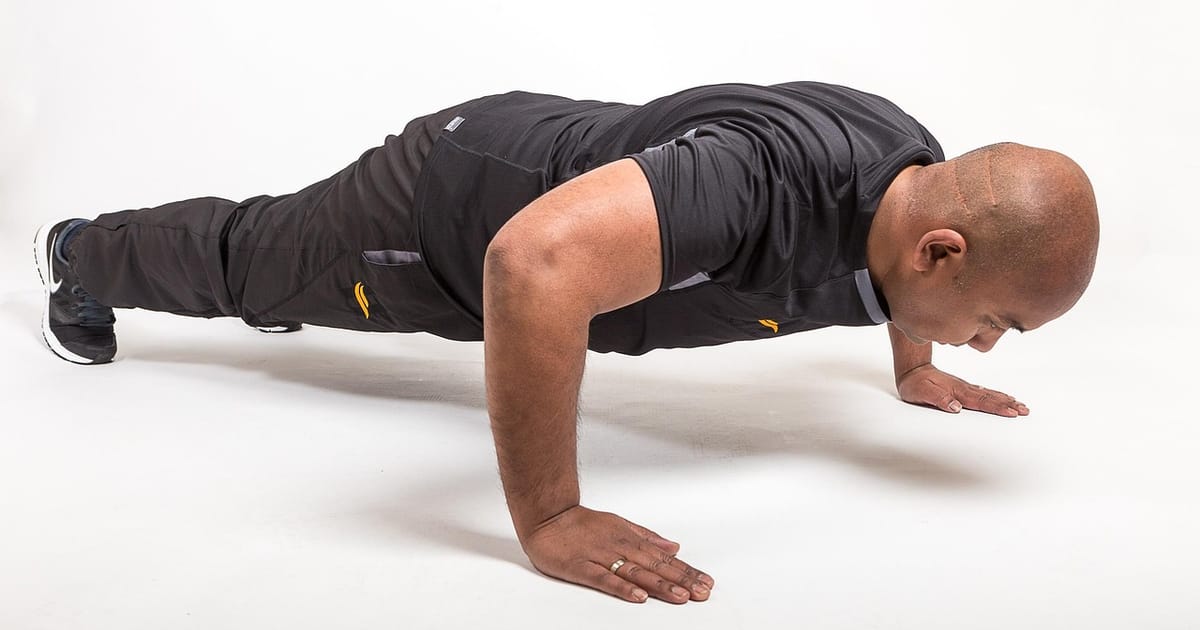
A good 30-day push-up challenge starts from your own number, not from a chart someone else wrote. On day 1, test how many clean push-ups you can do in one set. Then train in sets of about half that number, with full days, light days and a rest day each week. Retest on day 15 to raise your sets, and test again on day 30. Most fixed calendars, like 100 push-ups a day for everyone, skip that first test.
How the challenge works
The whole plan runs on one number: your max, the most good push-ups you can do in a row. Every set in the calendar is about half of it, rounded down.
A good rep means:
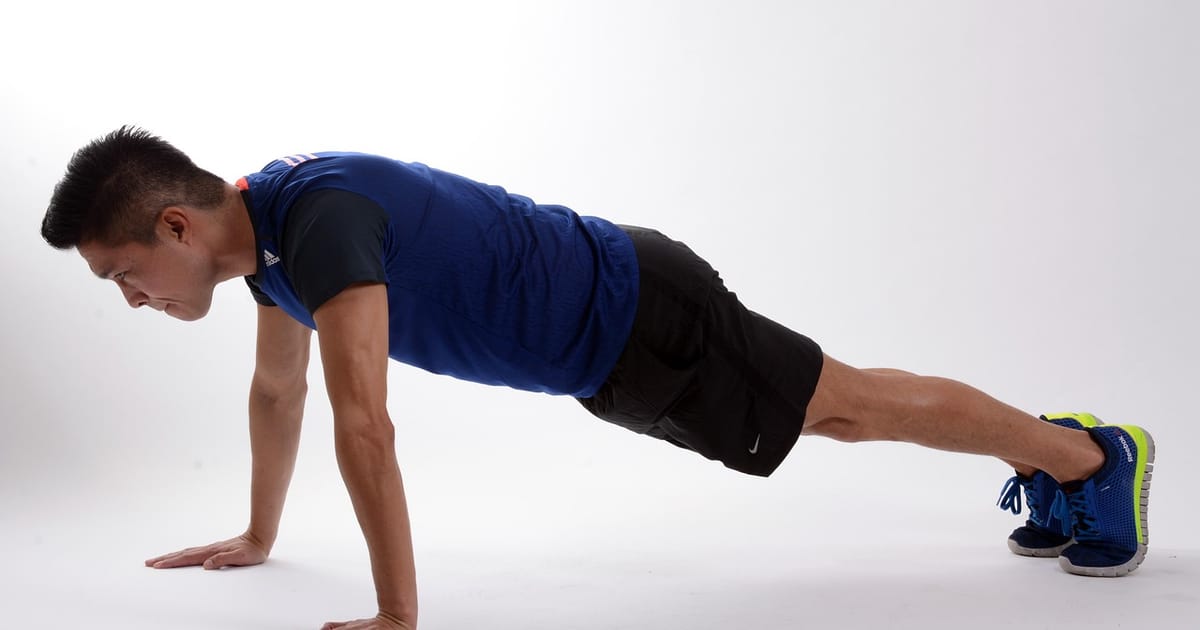
- Hands a little wider than your shoulders, body straight from heels to head.
- Chest lowers to about a fist's height above the floor.
- Arms push back to straight before the next rep starts.
When your hips sag or your chest stops short, the set is over. Those reps don't count toward your max or your daily total.
Half-max sets end well before failure on purpose. A 2022 meta-analysis of 15 studies found no significant difference in strength or muscle growth between sets taken to failure and sets stopped short of it. Stopping early keeps you fresh enough to train again tomorrow.
Find your starting level on day 1
Warm up with arm circles and a few easy push-ups against a counter, rest two minutes, then do one set of as many good push-ups as you can. Your result picks your version of the challenge.
| Your day-1 max | Push-up to train | Reps per set |
|---|---|---|
| 0-4 on the floor | Incline push-up, hands on a kitchen counter or sturdy table. Test your max on that surface | Half your incline max, at least 3 |
| 5-14 | Floor push-up | Half your max (2-7) |
| 15-29 | Floor push-up | Half your max (7-14) |
| 30 or more | Feet raised on a step, or a slow 3-second lowering. Test your max on the harder version | Half that max |
Write your number down. You'll compare it with day 15 and day 30.
The 30-day push-up challenge calendar
Full days use 3-5 sets, light days use 2 sets, and every week has at least one rest day. The example column follows someone who did 10 push-ups on day 1 (sets of 5) and 13 on day 15 (sets of 6).
| Days | Session | Example: max 10, then 13 |
|---|---|---|
| 1 | Test your max | 10 push-ups |
| 2, 4, 6 | Full day: 3 sets of half your max | 3 x 5 |
| 3, 5 | Light day: 2 sets | 2 x 5 |
| 7 | Rest | Rest |
| 8, 10, 12 | Full day: 4 sets | 4 x 5 |
| 9, 11, 13 | Light day: 2 sets | 2 x 5 |
| 14 | Rest | Rest |
| 15 | Retest your max, then halve the new number | 13 push-ups, new sets of 6 |
| 16, 18, 20 | Full day: 4 sets | 4 x 6 |
| 17, 19 | Light day: 2 sets | 2 x 6 |
| 21 | Rest | Rest |
| 22, 24, 26 | Full day: 5 sets | 5 x 6 |
| 23, 25, 27 | Light day: 2 sets | 2 x 6 |
| 28, 29 | Rest | Rest |
| 30 | Final test | Compare with day 1 |
Rest 1-2 minutes between sets. If a full day doesn't fit in one go, split it: two sets in the morning and two at night count the same.
Use the same rule on any day you're struggling. If you can't finish a set with good reps, stop and do the light day instead. If your reps drop two days in a row, take the next day off.
Can beginners do a 30-day push-up challenge?
Yes, if the challenge starts at their level. A beginner who can't do a floor push-up yet starts with incline push-ups and still follows the same calendar. Knee push-ups work too, as long as you test and train the same version all month.
If you're new to strength training and the calendar feels like too much, train three days a week instead: days 1 (test), 3 and 5; 8, 10 and 12; 15 (retest), 17 and 19; 22, 24 and 26; then the final test on day 30. Use the full-day sets for that week. That matches the American College of Sports Medicine recommendation of 2-3 training days a week for beginners.
You can also train most days. A 2019 meta-analysis of 25 studies found that, with the same total work, how many days a week you train a muscle made no meaningful difference to growth, so you can pick the schedule you'll stick to. For more on daily training, see is it OK to do push-ups every day.
Will a 30-day push-up challenge make a difference?
In the closest study to a one-month challenge, four weeks of push-up training raised upper-body strength but did not change chest muscle thickness. In that study, a month was long enough to measure strength gains but not muscle growth.
In a 2018 randomized trial, 23 moderately trained men did either progressive push-up training or bench press 3 days a week for 4 weeks. Both groups raised their bench press max significantly, and the push-up group improved more on a push-up progression test. Neither group showed a significant change in muscle thickness after the 4 weeks. It was a small, short study, but its length matches this challenge.
Muscle size takes longer. In a small 8-week trial of 18 young men, push-ups twice a week increased chest muscle thickness from an average of 17.0 mm to 20.8 mm, about the same as a light bench press did. If size is your goal, treat the 30 days as the first month of a longer plan.
What about 100 push-ups a day for 30 days?
It suits people who can already do about 40 push-ups in a row. At half-max sets, 100 reps takes 5 sets of 20 for them. Someone with a max of 10 would need 20 half-max sets every day, four times the biggest day in this calendar.
More work does help, up to a point. A 2018 meta-analysis of 22 studies found that training more often led to bigger strength gains, mostly because people ended up doing more total work. The gains came from the extra total work, not from a round number. If 100 a day appeals to you, use this calendar until your max reaches about 40, then switch.
The same logic covers 50 push-ups a day: it fits a max around 20, which makes it 5 sets of 10.
When to stop or skip a day
Sore muscles and painful joints call for different answers. Stop and rest if your shoulder, elbow or wrist hurts during the movement. If the pain doesn't settle after a few days, see a doctor or physiotherapist before you continue.
Missing a day doesn't ruin the challenge. In a 2010 study of 96 volunteers who repeated a new daily health habit for 12 weeks, missing one chance to do the behavior did not materially affect how the habit formed. Pick up the calendar where you left off.
What to do after day 30
Keep the habit, change the plan. In that same habit study, for the 39 people whose data fit the model, a new behavior took 18 to 254 days to reach 95% of its peak automaticity. Thirty days is a start, not a finish line, so keep the same time and cue you used during the challenge.
From day 31:
- Train push-ups 2-4 days a week, the range the ACSM gives for beginner to intermediate lifters. The how to increase push-ups plan gives you six more weeks with a clear rule for adding reps.
- When sets of 12 or more feel easy, move to a harder version, such as decline push-ups with your feet on a step.
- Add your legs and back. The WHO physical activity guidelines recommend muscle-strengthening work for all major muscle groups on 2 or more days a week, and push-ups leave out your legs and back. Squats and rows are an easy place to start.
If showing up was the hard part of the month, how to stay consistent with working out has a 10-week plan built on habit research.