
Calf Stretches for Tight Calves: 5 Moves and a 6-Week Plan
Calf stretches for tight calves that reach both calf muscles, the dose trials support, a 1-minute knee-to-wall test and a 6-week plan with heel drops.
PushSlayer Editorial Team · Updated · 7 min read
Leer en español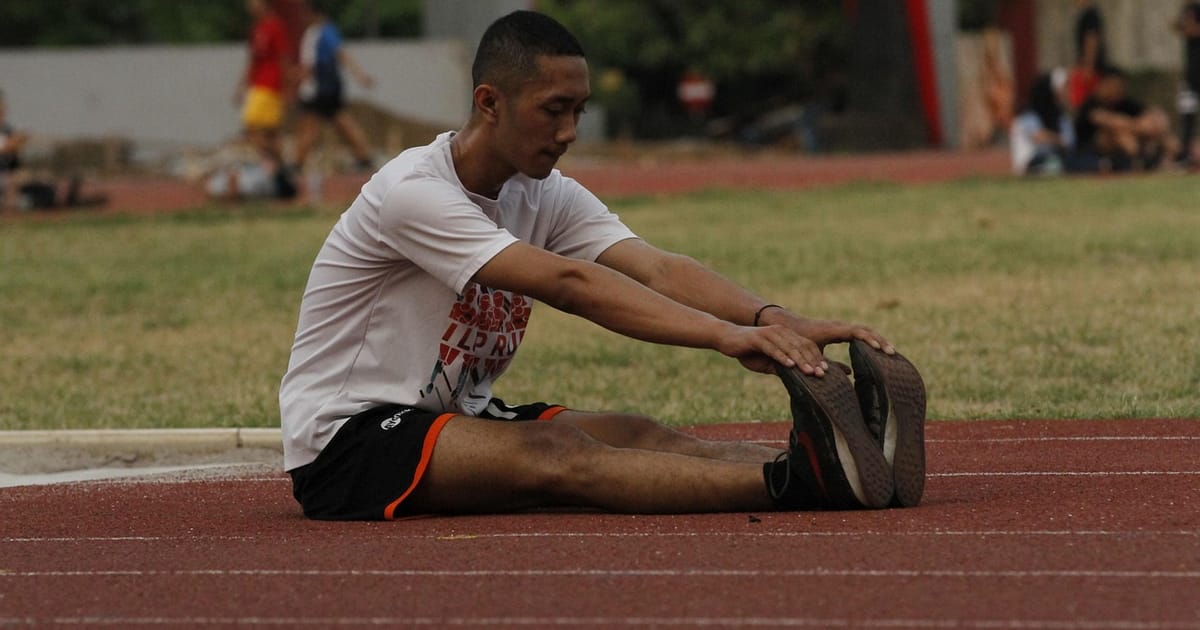
The best calf stretches for tight calves come in two kinds: straight-knee stretches for the gastrocnemius, the big calf muscle, and bent-knee stretches for the soleus underneath it. Do one of each, 2 holds of 30 seconds per side, on 5 days a week. A 2018 meta-analysis of 20 trials found that regular static stretching added about 5 degrees of ankle bend in healthy people. In a 2003 trial of 101 adults, one wall stretch a day did not improve active ankle bend after 6 weeks, so the plan also adds heel drops (our choice).
The 5 best stretches for tight calves
All five bend the ankle so the toes come toward the shin while the heel stays down. The first three keep the knee straight and mostly stretch the gastrocnemius; the last two bend the knee and shift the stretch to the soleus.
| Stretch | Knee | Targets | Hold |
|---|---|---|---|
| Wall calf stretch | Straight | Gastrocnemius, the default | 2 x 30 s per side |
| Step heel drop stretch | Straight | Gastrocnemius, a stronger pull | 2 x 30 s per side |
| Seated towel stretch | Straight | Gastrocnemius, no standing needed | 2 x 30 s per side |
| Bent-knee wall stretch | Bent | Soleus, the default | 2 x 30 s per side |
| Kneeling soleus stretch | Bent | Soleus, a stronger pull | 2 x 30 s per side |
Stretch to a clear pull in the calf you can breathe through, never to sharp pain, and keep the heel on the floor. The cues and the limit are our coaching choices.
1. Wall calf stretch
- Stand an arm's length from a wall with both hands on it. Step your right foot back about 2 feet (60 cm).
- Point both feet straight ahead and press the right heel into the floor.
- Keep the right knee straight and bend the front knee until the right calf pulls. Move your hips toward the wall, not up.
- Hold 30 seconds, then switch. Step the back foot farther away to make it harder.
2. Step heel drop stretch
- Stand on a step with the balls of both feet on the edge, holding a rail or wall.
- Keep both knees straight and let your heels sink below the step until the calves pull.
- Hold 30 seconds. Do one leg at a time once both together feels easy.
3. Seated towel stretch
- Sit on the floor with your right leg straight and loop a towel or band around the ball of your foot.
- Sit tall and pull the towel toward you so your toes come back toward your shin.
- Hold 30 seconds per side. Keep the back of the knee on the floor.
4. Bent-knee wall stretch
- Set up as for the wall calf stretch, with the back foot a little closer to the wall.
- Keep the right heel down and bend both knees, as if sitting back slightly.
- Feel the pull move lower, toward the Achilles tendon. Hold 30 seconds per side.
5. Kneeling soleus stretch
- Kneel on your left knee with your right foot flat in front of you, as in a lunge.
- Rest your chest near your right thigh and shift your weight forward so the right knee travels past your toes.
- Keep the right heel down. Hold 30 seconds per side. Press down on the right knee with your hands for a stronger pull.
Why stretch with the knee both straight and bent?
The gastrocnemius crosses the knee and the soleus does not, so with the knee straight the gastrocnemius stops the ankle before the soleus reaches its full stretch. In a 2014 study of 20 healthy adults, bending the knee 20 degrees let the ankle flex 13 to 15 degrees further, because the gastrocnemius no longer held it back. Bending the knee further than 20 degrees added nothing.
That is why the plan pairs a straight-knee stretch with a bent-knee one. A slight bend is enough: in that study, 20 degrees of knee bend already took the gastrocnemius out of the way.
How long should you hold a calf stretch?
Hold for 30 seconds, twice per side, and stretch on 5 or more days a week. The ACSM's 2011 position stand recommends 60 seconds in total per flexibility exercise on 2 or more days a week, and a 2018 review of 23 studies found the best gains with static stretching on at least 5 days a week and at least 5 minutes of stretching a week.
The size of the gain is where the calf evidence is mixed. A 2006 systematic review of 5 trials found static calf stretching added only 2 to 3 degrees of ankle bend, and the authors were unsure it mattered clinically. The 2018 meta-analysis, with 20 trials, found about 5 degrees. In the 2003 randomized trial, 101 adults did one wall stretch a day for 30 seconds, 1 minute or 2 minutes; after 6 weeks, none of the groups could actively bend the ankle further than the controls.
| Dose | What to do | Based on |
|---|---|---|
| Hold | 30 s, twice per side | ACSM 2011: 60 s total per exercise |
| Days | 5 a week | 2018 review: 5+ days a week |
| Weekly time | 5+ minutes | 2018 review |
| Stretches | 1 straight-knee, 1 bent-knee | 2014 knee-position study |
| Extra | Heel drops on 3 days | 2008 trial: heel drops raised ankle range (3 days is our choice) |
Two stretches of 2 x 30 seconds per side on 5 days come to 5 minutes a week for each calf muscle on each leg, which meets the 5-minute minimum.
How do you know if your calves are tight?
Use the knee-to-wall test, a version of the weight-bearing lunge test physiotherapists use to measure ankle bend. It takes a minute and a tape measure.
- Face a wall barefoot with your right big toe 4 inches (10 cm) from it.
- Keep your heel down and bend your knee forward until it touches the wall.
- If it touches, slide the foot back and try again. Find the farthest distance at which the knee still touches with the heel down.
- Measure from the big toe to the wall. Repeat on the left.
A small 1998 study of 13 healthy adults found this toe-to-wall distance highly reliable between testers. A 2015 systematic review found that a change has to exceed about 5/8 to 3/4 inch (1.6 to 1.9 cm) to be more than measurement error, so only trust a change of 3/4 inch (2 cm) or more when you retest in week 6. Treat the number as your own marker, not a diagnosis; a large gap between sides is worth showing a physiotherapist.
Why are my calves always tight?
The research does not pin down one cause, but it shows that tightness responds to regular stretching. In a small 2012 study, 9 young men who did 4 weeks of static calf stretching gained ankle range and their calf resisted the stretch less, while their muscle fibers did not get longer. The authors concluded the whole muscle-tendon unit had become more flexible.
If you stand all day or sit with your feet pointed, your calves spend long periods in one position; if you walk or run a lot, they do a lot of repeated work. The same answer holds either way: a regular dose of stretching and strength work over weeks.
Should you strengthen tight calves instead of stretching them?
Do both, because slow heel drops improved calf flexibility in a trial. In a 2008 randomized trial, 74 healthy adults did either 6 weeks of eccentric heel drops or nothing. Only the heel-drop group gained ankle range, and their calves resisted stretching less. The authors thought the change came from the tissue itself rather than from tolerating the stretch better.
Eccentric heel drop (the sets and reps are our coaching choice):
- Stand on a step on the balls of both feet, holding a rail.
- Rise onto your toes with both feet, then lift your left foot.
- Lower your right heel slowly, over 3 seconds, until it sits below the step. Put the left foot back down and rise with both.
- Follow the plan below: start at 2 x 8 per leg with the knee straight and build to 3 x 12 with the knee straight and slightly bent, which loads the soleus.
The 6-week calf stretching plan
Stretching takes 4 to 6 minutes; heel-drop days add about 5 to 12 minutes. Stretch on 5 days a week at any time of day, and do the heel drops on 3 non-consecutive days. The exercise choices and progression are our coaching choices built on the evidence above.
| Week | Stretches (2 x 30 s per side each) | Heel drops, 3 days a week |
|---|---|---|
| 1-2 | Wall calf stretch, bent-knee wall stretch | 2 x 8 per leg, knee straight |
| 3-4 | Swap in the step heel drop stretch for the wall calf stretch | 2 x 10 per leg: 1 set knee straight, 1 set knee bent |
| 5-6 | Add the kneeling soleus stretch | 3 x 12 per leg: 2 sets knee straight, 1 set knee bent |
| After | 1 straight-knee and 1 bent-knee stretch, 3 days a week | 2 x 12 per leg, 2 days a week |
Retest the knee-to-wall distance at the end of week 6. The maintenance dose is our choice; no calf study above tested how long the gains last. If the backs of your thighs feel tight too, add the routine for stretches for tight hamstrings, and the 10-minute daily mobility routine covers the rest of the body.
Is foam rolling or stretching better for tight calves?
They work about equally well in the short term. A 2020 meta-analysis of 26 trials found that foam rolling gave a large short-term gain in range of motion compared with doing nothing, but no more than stretching. Use whichever you will do; a minute of rolling before the stretches is fine (our coaching choice).
Should you stretch your calves before a run?
A short hold is fine; save the full routine for after or another time. A 2016 systematic review found that static stretches under 60 seconds per muscle lowered performance by about 1.1% on average when tested within minutes, against 4.6% for 60 seconds or more. When dynamic activity followed, no clear effect showed up. The range gained in one session usually lasted under 30 minutes.
Before a run, do one 20-second wall stretch per side, then ankle bounces and a few minutes of brisk walking (our coaching choice). If you follow the run-walk method, do the wall stretch and ankle bounces, then count your first walking interval as the brisk walk.
Do calf stretches help leg cramps at night?
They might, but the trials disagree. In a 2012 randomized trial of 80 adults over 55 who had night cramps, stretching the calves and hamstrings every night before bed for 6 weeks left people with 1.2 fewer cramps a night than the group that did not stretch, and the cramps hurt less. In a 2005 randomized trial of 191 people taking quinine for night cramps, advice to do calf stretches made no difference.
The NHS says regular calf stretching may help reduce cramps but may not stop them, and that stretching and massaging the muscle may ease a cramp while it happens. It advises seeing a GP if cramps disturb your sleep, last longer than 10 minutes, or come with numbness or swelling in your legs.
When is calf tightness a reason to see a doctor?
When it comes with swelling, a sudden injury or pain that is getting worse. A throbbing pain in one calf with swelling and red or darkened skin can be a blood clot (deep vein thrombosis); the NHS advises asking for an urgent GP appointment or calling NHS 111, and calling 999 or going to A&E if you also feel short of breath or have chest pain. In the US, call 911 for those emergency signs; elsewhere, use your local equivalent.
A sudden pain in the heel or calf, sometimes with a snap or a feeling of being hit in the back of the leg, can be an Achilles tendon rupture. Cambridge University Hospitals notes it is confirmed at A&E or a minor injury unit, so go to one rather than waiting it out. For any calf pain that does not settle, or pain during the stretches, see a doctor or physiotherapist before you continue.