

Hand Release Push-Ups: Form, Army Standards and a Plan
How to do a hand release push up step by step, the muscles it works, why it is harder than a regular push-up, the 2025 Army scores and a 6-week plan.
PushSlayer Editorial Team · Updated · 6 min read
Leer en español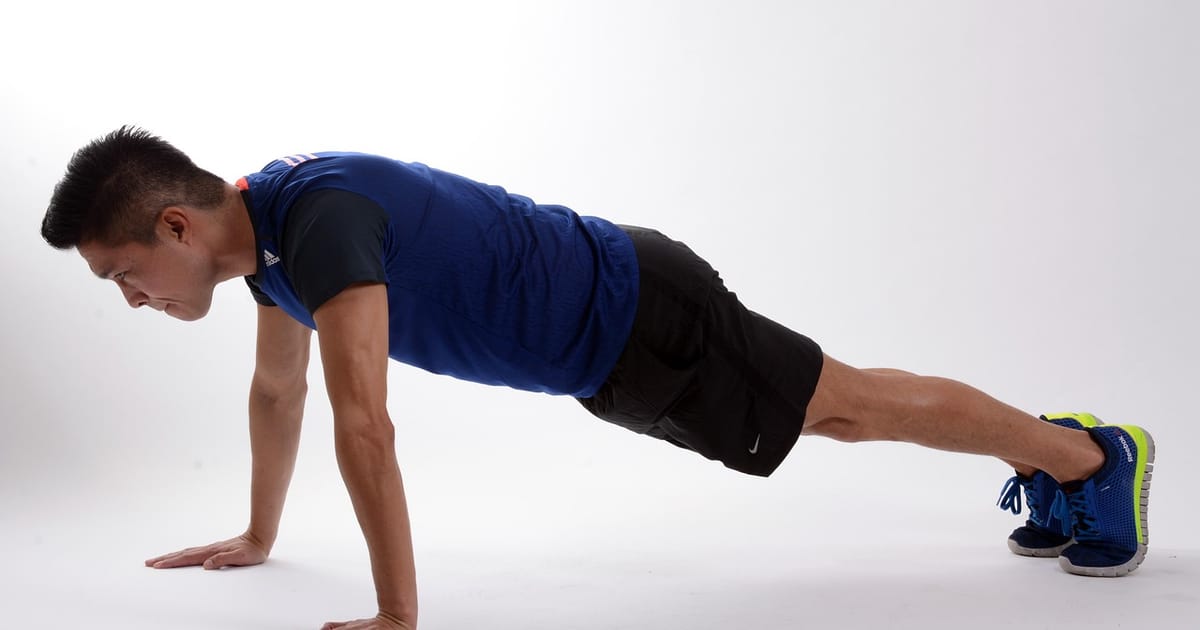
A hand release push-up starts and ends lying flat on the floor. You press up to straight arms, lower until your chest, hips and thighs touch the floor together, lift both hands off the floor and sweep your arms out into a T, then put your hands back and press again. That brief release takes away the bounce at the bottom, so every rep starts from a dead stop and you cannot cut the depth short. It is the push-up event of the U.S. Army Fitness Test, scored as clean reps in 2 minutes.
How do you do a hand release push-up?
Follow the Army's four movements, with a set-up first. The steps below use the official event standard, which is also a good form standard for anyone training at home.
- Lie face down with your hands flat on the floor beside your chest. Your chest, hips and thighs touch the floor, your toes are on the floor, and your feet are together or up to a shoe's width apart.
- Press up as one unit until your elbows are straight. Your body stays in a straight line from your head to your heels.
- Bend your elbows and lower until your chest, hips and thighs touch the floor at the same time. Keep your head and face off the floor.
- Without moving your head, body or legs, lift both hands and extend your arms straight out to the sides into a T. Your arms may brush or slide along the floor.
- Bring your hands straight back under your shoulders. That completes one rep, and you press up into the next.
The Army does not count a rep if your body loses its straight line, and the only rest allowed is holding the top of the push-up. Sagging at the hips, piking your butt up or bending your knees while resting all break the standard.
What muscles do hand release push-ups work?
The same pushing muscles as a regular push-up: mainly your chest, the front of your shoulders and your triceps, with your abs and the muscles around your shoulder blades holding your body straight.
A 2014 study of 29 young men recorded muscle activity in eight muscles during push-up and press variations and found that the chest (pectoralis major), front deltoid and serratus anterior work harder in stable pushing exercises, such as push-ups on a solid floor, than in unstable ones. The arm sweep into the T also lifts your arms with your upper back for a moment, but no study has measured how much the release adds, so treat claims that it "builds your back" with caution.
Are hand release push-ups harder than regular push-ups?
Yes, for most people, because the pause at the bottom removes the elastic rebound you get from dropping and pushing straight back up.
When a muscle is stretched and then contracts right away, it produces more force than it does from a standstill. Wilson and colleagues (1991) had 12 experienced lifters bench press 95% of their max with pauses of different lengths at the chest. The extra force from that rebound faded with a half-life of 0.85 seconds. By our calculation from their equation, a 2-second release leaves only about a fifth of the rebound. The study was small and used a heavy bench press rather than push-ups, but the same principle likely applies: you start each hand release rep with almost no help from the bounce.
That is why your hand release total will be lower than your regular push-up total, and why the release is such a good form check. You cannot do half reps when your chest has to touch the floor every time.
Hand release push-up vs regular push-up
Both build the same muscles. Pick the version that matches your goal.
| Hand release push-up | Regular push-up | |
|---|---|---|
| Bottom position | Chest, hips and thighs on the floor, hands lifted | Chest a fist's height from the floor or touching lightly |
| Rebound at the bottom | Almost none | Yes, if you do not pause |
| Depth | Fixed by the floor | Up to you, so easy to cut short |
| Best for | Army test prep, strict form, pushing from a dead stop | Higher rep totals, endurance, daily practice |
Push-ups of any kind can build muscle when the sets are hard. In a 2017 randomized trial, 9 young men did push-ups, adjusted to a load close to 40% of their bench press max, twice a week for 8 weeks. Their chest and triceps grew about as much as those of a group that bench-pressed, with no significant difference between the groups. It was a small, short study, and it did not test hand release push-ups specifically.
How many hand release push-ups does the Army require?
On the Army Fitness Test, which replaced the ACFT on 1 June 2025, 60 points takes 10 to 15 reps in 2 minutes depending on age and sex, and 100 points takes 24 to 62. Soldiers in combat specialties need at least 60 points in every event and are scored on the men's column, which is also the combat standard.
| Age | 60 points, men and combat | 60 points, women | 100 points, men and combat | 100 points, women |
|---|---|---|---|---|
| 17-21 | 15 | 11 | 58 | 53 |
| 22-26 | 14 | 11 | 61 | 50 |
| 27-31 | 14 | 11 | 62 | 48 |
| 32-36 | 13 | 11 | 60 | 47 |
| 37-41 | 12 | 10 | 59 | 43 |
| 42-46 | 11 | 10 | 57 | 40 |
| 47-51 | 11 | 10 | 55 | 38 |
| 52-56 | 10 | 10 | 51 | 36 |
| 57-61 | 10 | 10 | 46 | 24 |
| 62 and over | 10 | 10 | 43 | 24 |
Figures come from the AFT score tables approved on 15 May 2025. The Army updates its standards from time to time, so check the current table before a test.
How many hand release push-ups should you do?
Start with 3 sets of a number you can finish with clean form and 2 reps left in reserve, 2-3 days a week. That fits the ACSM's advice for novices: 8-12 reps per set, 2-3 days a week. Its 2026 update found that strength improved with a full range of motion, 2-3 sets and at least 2 sessions a week, and a hand release rep is full range by design.
Test yourself first: do as many clean hand release push-ups as you can without stopping, then use the table.
| Clean reps in one set | Where to start |
|---|---|
| 0-7 | Hand release push-ups from your knees, or regular knee push-ups, until you reach 8 |
| 8-12 | The plan below from week 1 |
| 13-20 | The plan from week 3 |
| More than 20 | Add a fourth set, or practice timed 2-minute tests every other week |
A 6-week hand release push-up plan
This is a coaching plan built on the ACSM ranges, not a protocol tested in a study. Train on three non-consecutive days, such as Monday, Wednesday and Friday, and rest 1-2 minutes between sets.
| Week | Sets x reps | Extra |
|---|---|---|
| 1 | 3 x 6 | None |
| 2 | 3 x 8 | None |
| 3 | 4 x 8 | None |
| 4 | 3 x 10 | Last session: one max set instead |
| 5 | 4 x 10 | Hold the T for 1 second |
| 6 | 3 x 12 | Last session: 2-minute test |
- Count a rep only when your chest, hips and thighs touch down together and your body stays straight on the way up.
- Repeat a week if you could not finish every set with clean form.
- For the 2-minute test, start with steady sets of 5-10 and rest in the top position before your form breaks, since a rep with a sagging body does not count.
- After week 6, retest and restart at the level that matches your new number, or move to the plan in how to increase push-ups.
What are the benefits of hand release push-ups?
The main benefit is honest reps. The floor sets your depth, so every rep goes through the full range, and the dead stop trains you to push without a bounce, which the Wilson study suggests makes each rep harder at the same body weight.
They also make counting simple for a partner or a test grader: either your hands left the floor and your chest touched down, or the rep does not count. If you are training for the Army test, practicing the exact event is the most direct preparation. For general strength, mix them with other variations such as diamond push-ups for more triceps or incline push-ups on easy days.
Common hand release push-up mistakes
Watch for four errors.
- Chest up first. If your chest rises before your hips, the rep turns into a cobra stretch. Squeeze your glutes and press as one unit.
- Hips down first. If your thighs touch before your chest, your stomach has switched off. Brace before you lower.
- Bouncing off the floor. Dropping your chest onto the floor to get a rebound defeats the point. Lower under control.
- Lifting your head or feet during the release. The Army standard allows only your arms to move, so keep your eyes on the floor and your toes down.
Your hands come off the floor every rep, so the floor matters. Use a mat or a clean, flat surface. If your shoulders, elbows or wrists hurt during the movement, stop and see a doctor or physiotherapist. If you already train push-ups often, read whether daily push-ups are a good idea before adding hand release work on top.