Beginner Core Workout Routine: 5 Moves and a 4-Week Plan
A beginner core workout routine of 5 floor moves in about 12 minutes, a 4-week plan, plank time benchmarks and a clear rule for when to make each move harder.
PushSlayer Editorial Team · Updated · 6 min read
Leer en español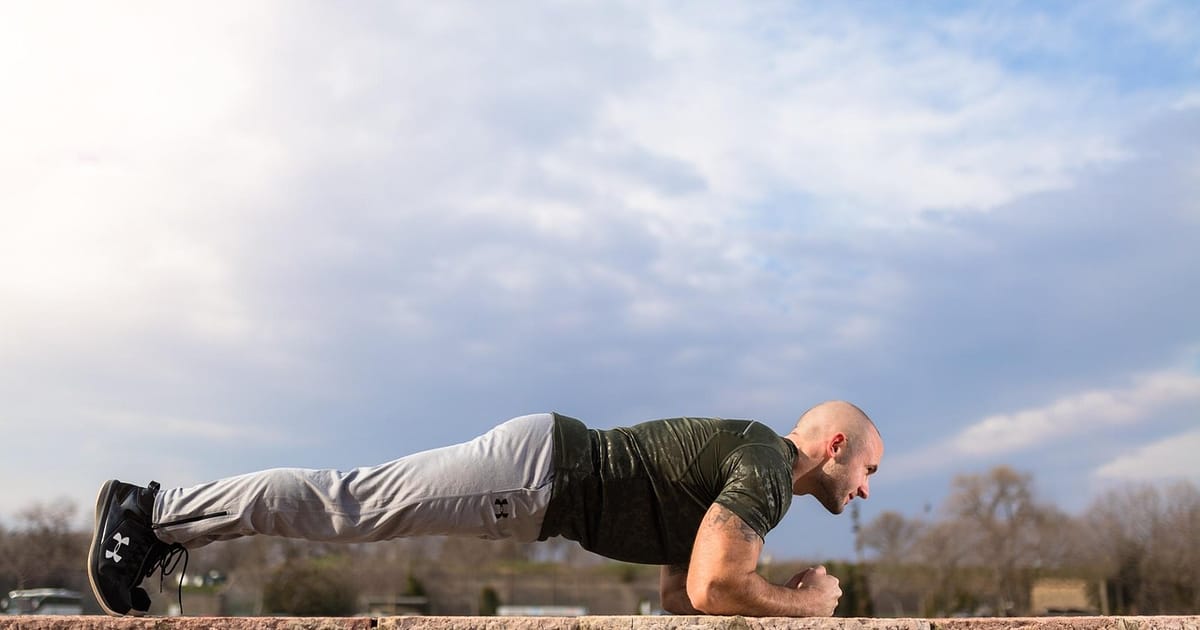
A good beginner core workout routine takes about 12 minutes and needs five floor moves: the dead bug, the curl-up, the bird dog, the side plank and the front plank. Do 2 sets of each, 2-3 days a week, and make a move harder only when you hit the top of its rep or time range in every set. Four of the five have lab data on muscle activity or lower-back load behind them, and the 4-week plan below shows how to build up from there.
The routine: 5 moves in about 12 minutes
Do the moves in this order, resting 30-45 seconds between sets. The order, the set counts and the rest times are coaching choices; the exercise picks are explained under each move.
| Move | What it trains | Week 1 dose |
|---|---|---|
| Dead bug | Front of the core, keeping the lower back still | 2 x 6 slow reps per side |
| Curl-up | Front abdominals | 2 x 5 reps, 5-second hold each |
| Bird dog | Back, glutes, balance | 2 x 6 reps per side, 3-second hold each |
| Side plank (on knees) | Side abdominals, outer hip | 2 x 15 seconds per side |
| Front plank (on knees or toes) | Whole front of the body | 2 x 20 seconds |
Warm up first with a minute of marching in place and a few slow cat-cow movements on hands and knees. Move slowly and breathe normally through every hold. If any move causes back pain rather than muscle effort, stop it, and see a doctor or physiotherapist if the pain does not settle.
How to do each move
Each move has a beginner version and a harder version for later. Start every move at the beginner version unless it is clearly easy.
Dead bug
- Lie on your back with your arms pointing at the ceiling and your knees bent at 90 degrees above your hips.
- Press your lower back gently into the floor.
- Slowly lower one heel to tap the floor, then bring it back. Switch sides.
The dead bug is a coaching choice: it trains the same skill as the plank, holding the trunk still while the limbs move, from a position where beginners can feel their lower back on the floor. Harder version: straighten the leg as it lowers and reach the opposite arm back over your head at the same time.
Curl-up
- Lie on your back with one knee bent and the other leg straight. Slide your hands, palms down, under the arch of your lower back.
- Lift your head and shoulders just off the floor, keeping your neck in line with your chest. Hold 5 seconds and lower.
- Switch which knee is bent halfway through the set.
This small movement is the beginner's crunch. In a 1997 lab study of 9 volunteers doing 12 abdominal exercises, partial curl-ups generally gave the best ratio of abdominal muscle work to lower-spine compression. Harder version: lift your elbows off the floor during the hold.
Bird dog
- Start on hands and knees, hands under shoulders, knees under hips.
- Reach one arm forward and the opposite leg back until both are level with your body. Hold 3 seconds.
- Return and switch sides. Keep your hips level, as if a cup of water were resting on your lower back.
In a 2007 study that recorded muscle activity in 30 healthy adults during 9 exercises, this arm-and-leg lift worked the gluteus maximus hard enough that the authors suggested it may help strengthen it. Harder version: hold for 6 seconds.
Side plank
- Lie on your side, propped on your forearm with your elbow under your shoulder and your knees bent behind you.
- Lift your hips until your body is straight from head to knees. Hold.
- Repeat on the other side.
The same 2007 study found that the side plank worked the outer abdominals (external obliques) and the gluteus medius, a muscle on the side of the hip, hard enough that the authors suggested it may help strengthen them. Harder version: straighten your legs and balance on your feet.
Front plank
- Rest on your forearms with your elbows under your shoulders, on your knees or toes.
- Squeeze your glutes and keep a straight line from head to knees or heels. Do not let your hips sag or pike up.
- Hold, then rest.
In the 2007 study, the plank stayed below the activity level the authors linked to strength gains, so they suggested it suits endurance and stability training. That is why it closes the routine. Harder version: from your toes, lift one foot about an inch (2-3 cm) for 2 seconds, then switch.
Your 4-week plan
Train on 2-3 non-consecutive days a week, for example Monday, Wednesday and Friday. The plan adds sessions first, then sets, then harder versions.
| Week | Sessions | Sets per move | What changes |
|---|---|---|---|
| 1 | 2 | 2 | Learn the moves at the week 1 dose |
| 2 | 3 | 2 | Add 1-2 reps or 5 seconds per hold when the last set felt solid |
| 3 | 3 | 3 | Same reps and holds, one more set |
| 4 | 3 | 3 | Switch any move you have earned to its harder version |
The rule for a harder version: once you reach the top of the range in every set for two sessions in a row, move up and drop back to the bottom of the range. The ranges are 6-10 reps per side for the dead bug and bird dog, 5-8 curl-ups, and holds up to 30 seconds for the side plank and 45 seconds for the front plank. The rule and the ranges are coaching choices.
The American College of Sports Medicine's 2026 position stand says healthy adults should train progressively, raising the challenge as the body adapts. With bodyweight moves, more reps, longer holds and harder versions are how you raise it.
Pair it with push-ups and squats
A core routine on its own does not cover your arms, chest or legs. The WHO 2020 guidelines ask adults to do muscle-strengthening work for all major muscle groups on 2 or more days a week, so add push-ups and squats to the same sessions, or run this routine after a full-body workout such as the beginner bodyweight workout program.
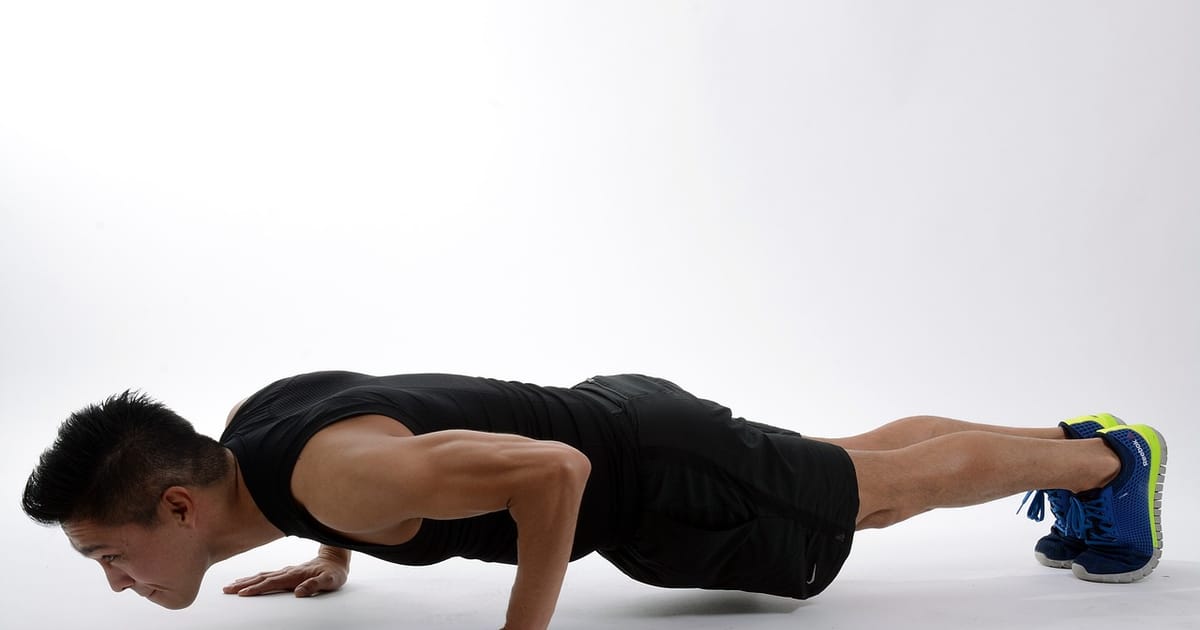
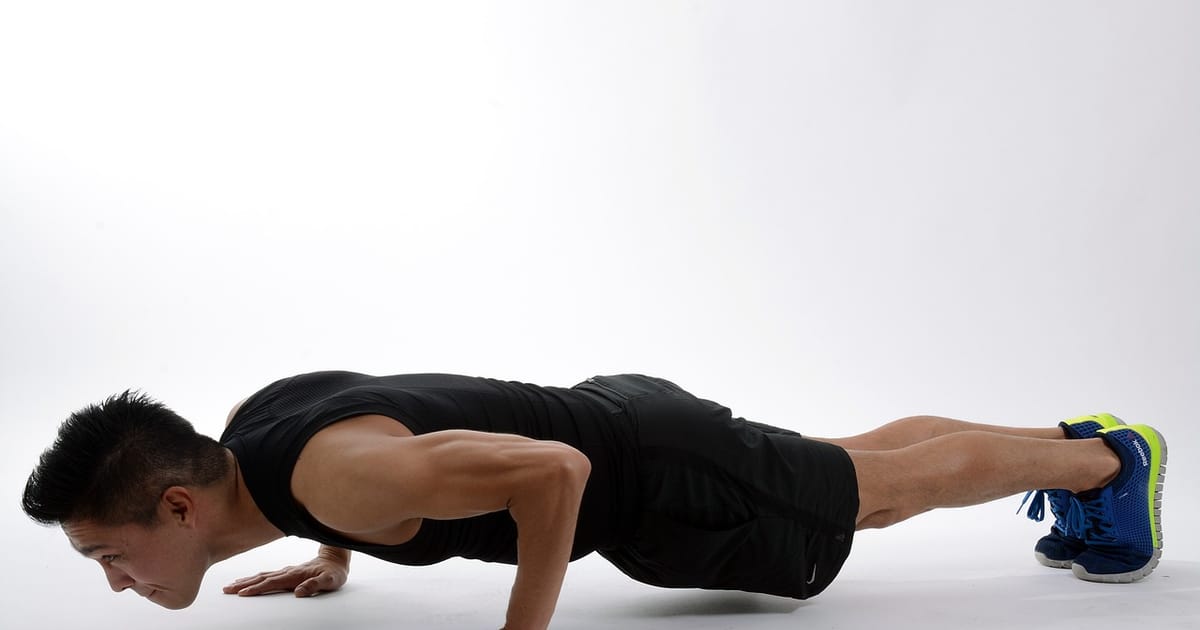
The push-up already uses the core: its starting position is the front plank on your hands.
How often should a beginner train their core?
Two to three days a week is enough to start. The WHO guidelines and the ACSM position stand both set 2 or more strength sessions a week as the base, and the ACSM review found strength gains were better with at least 2 sessions a week than with fewer.
More days can work with low-load moves like these. In a 2011 randomized trial, sedentary adults did 7 abdominal exercises, 2 sets of 10, 5 days a week for 6 weeks. Three days still leaves room for the push-ups, squats and walking that the rest of your week needs.
How long should a beginner hold a plank?
Start with holds of 20 seconds and build toward 45. A longer single hold is a test, not a training target.
For a benchmark, a 2014 study timed 471 college students holding a forearm plank on their toes until they could not keep the position. The median was 110 seconds for men and 72 seconds for women, and students who exercised more than 3 times a week held longer. Those are young adults, so treat the numbers as a rough guide.
| Group in the 2014 study | Median plank time |
|---|---|
| Men, aged about 20 | 110 seconds |
| Women, aged about 20 | 72 seconds |
To test yourself, hold a plank on your toes until your hips sag or rise, once at the start of week 1 and again at the end of week 4.
Will a core workout burn belly fat?
No, not by itself. In the 2011 trial above, 6 weeks of abdominal exercise, 5 days a week, did not change body weight, body fat percentage, abdominal fat or waist circumference compared with a group that did nothing. The trial was small, with 24 adults, and both groups kept their usual calorie intake.
The exercise group did gain endurance: they did 47 curl-ups on the final test, against 32 in the control group. The trial's authors concluded that ab exercise alone was not enough to reduce belly fat. The full body workout plan for weight loss pairs strength training with brisk walking for that goal.
Are crunches and sit-ups bad for beginners?
They are not banned, but they are not the best place to start. The 1997 study found that no single exercise worked all the abdominal muscles while keeping lower-back load low, and partial curl-ups generally gave the best ratio of the 12 exercises it tested. That is why this routine uses a curl-up and spreads the work across five moves.
If you already have back pain, get a doctor or physiotherapist to choose your exercises.
How long until you see results?
In the 2011 trial, endurance rose within 6 weeks while body fat and waist size did not change. The ACSM position stand, which pooled 137 systematic reviews of trials lasting 6 weeks or more, found that resistance training improved muscle endurance, strength and balance compared with no exercise.
Your best measure is your own log: compare your week 4 plank time and your reps with week 1.
What comes after week 4?
Keep the five moves at their harder versions and add one more demanding exercise. A 2010 study of 18 people found that the Swiss ball roll-out and the Swiss ball pike worked the abdominal muscles harder than most of the 10 exercises it tested, a list that included the crunch and the bent-knee sit-up. A roll-out on your knees with a stability ball is a reasonable next step.
If sticking with any plan is the hard part, our guide on how to stay consistent with working out covers what to do after a missed week.