
Stretches for Tight Hamstrings: 5 Moves and a 6-Week Plan
Stretches for tight hamstrings with the hold time trials support, a 1-minute self-check and a 6-week plan with strength work and a maintenance dose.
PushSlayer Editorial Team · Updated · 7 min read
Leer en español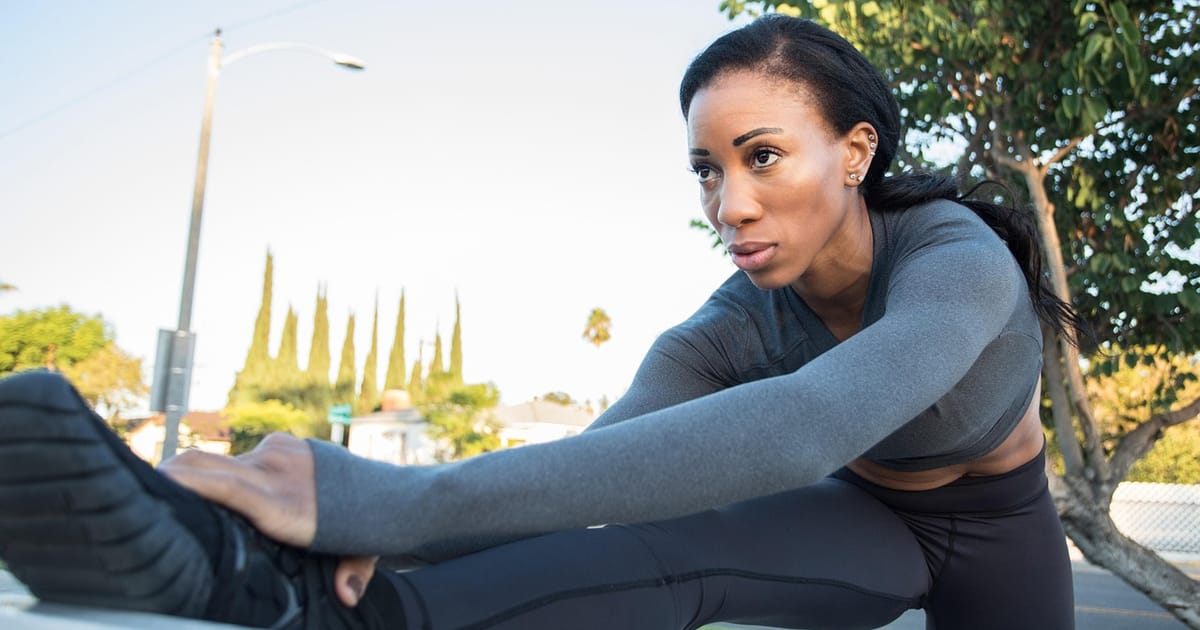
The best stretches for tight hamstrings straighten your knee while you bend forward from the hips with a long back: the lying towel stretch, the seated single-leg stretch, the standing heel-up stretch, the active knee extension and the doorway stretch. Hold each one for 30 seconds, twice per side, on 5 days a week. In a 1994 randomized trial, 30-second holds worked as well as 60-second holds and better than 15. Trials saw gains after 3 to 6 weeks, and in two small studies static-stretching gains faded within 4 weeks of stopping.
The 5 best stretches for tight hamstrings
All five lengthen the back of the thigh by combining a bent hip with a straight knee. Pick one you can do daily, then add others for variety. A 2011 randomized trial in 36 adults with short hamstrings found that seated and standing stretches lengthened them equally over 4 weeks, so position matters less than doing it.
| Stretch | Best for | Hold |
|---|---|---|
| Lying towel stretch | Everyone, the default; protects a sensitive back | 2 x 30 s per side |
| Seated single-leg stretch | Stretching on the floor after a workout | 2 x 30 s per side |
| Standing heel-up stretch | At work or outdoors, no floor needed | 2 x 30 s per side |
| Active knee extension | Gains that last longer (see below) | 2 x 30 s per side, as slow reps |
| Doorway stretch | Relaxing into it with no effort | 2 x 30 s per side |
Stretch to a clear pull in the back of the thigh you can breathe through, never to sharp pain or a pull behind the knee. That limit and the cues below are our coaching choices. A tingling or burning feeling down the leg is a sign to ease off; if it keeps happening, see a doctor or physiotherapist.
1. Lying towel stretch
- Lie on your back with both knees bent and loop a towel, belt or band around the ball of your right foot.
- Straighten your right leg toward the ceiling, keeping a slight bend in the knee at first.
- Pull the leg toward you with the towel until the back of the thigh pulls. Keep your hips and the left foot on the floor.
- Hold 30 seconds, then switch. Straighten the left leg along the floor to make it a little harder.
2. Seated single-leg stretch
- Sit on the floor with your right leg straight and the sole of your left foot against the inside of your right thigh.
- Sit tall, then lean forward from the hips, as if bringing your belly button toward your thigh.
- Reach toward your shin or foot only as far as your back stays long. Rounding to grab your toes moves the stretch into your back.
- Hold 30 seconds per side. Sit on a folded towel if your back rounds before you lean.
3. Standing heel-up stretch
- Stand facing a step, low chair or bench and put your right heel on it, toes up, knee straight but not locked.
- Keep your hips square and your back long, then hinge forward from the hips with your hands on your thigh.
- Stop at the first clear pull. Hold 30 seconds per side. Use a lower surface if your back rounds.
4. Active knee extension
- Lie on your back and hold the back of your right thigh with both hands so the thigh points straight up.
- Using your thigh muscles, straighten the knee until the back of the thigh pulls. Hold 2 to 3 seconds, then bend the knee.
- Repeat slowly for 30 seconds, then switch. The thigh stays vertical the whole time.
5. Doorway stretch
- Lie on your back in a doorway with your left leg flat through the opening and your right buttock close to the wall.
- Rest your right leg up the wall, knee straight. Slide your hips away from the wall if the pull is too strong.
- Relax for 30 seconds, then switch sides by turning around.
How long should you hold a hamstring stretch?
Hold for 30 seconds. In the 1994 trial, 57 adults with tight hamstrings stretched 5 days a week for 6 weeks. Holds of 30 and 60 seconds gained more range than 15 seconds or no stretching, and 60 seconds did no better than 30.
A follow-up 1997 randomized trial of 93 adults found no extra gain from 60-second holds or from stretching 3 times a day instead of once. Two holds per side, as in the plan below, meet the ACSM's 2011 position stand, which recommends 60 seconds in total per flexibility exercise on 2 or more days a week.
| Dose | What to do | Based on |
|---|---|---|
| Hold | 30 s, twice per side | 1994 and 1997 trials; ACSM 2011: 60 s total |
| Days | 5 a week | Both trials stretched 5 days a week |
| Weekly time | 5+ minutes in total | 2018 review |
| Times per day | Once is enough | 1997 trial: 3 times a day added nothing |
A 2018 review of 23 studies adds that static stretching beat ballistic and PNF stretching, that at least 5 minutes a week seemed to matter for gains, and that more days a week went with bigger gains.
How do you know if your hamstrings are tight?
Use the 90/90 test, the position research uses to measure hamstring length. It takes a minute and needs a phone.
- Lie on your back with both legs straight.
- Lift your right thigh until it points straight up, holding it behind the knee with both hands.
- Straighten the knee as far as you can without letting the thigh move.
- Ask someone to take a photo from the side, or prop your phone on the floor and use the timer.
A straight knee means full length. Researchers set different cutoffs: the 1994 trial counted a knee that stopped 30 degrees or more short of straight as limited, while the 2011 trial used 45 degrees for men and 24 for women. Treat the photo as your own before-and-after marker, not a diagnosis, and repeat it in week 6.
Why are my hamstrings so tight?
The research does not settle why some people's hamstrings feel tight, but it does show that the feeling is partly how much stretch you tolerate. In a small 1996 study, 7 adults stretched their hamstrings for 3 weeks. They could then straighten the knee further, yet the muscle resisted the same stretch just as much as before. The authors concluded the extra range came from higher stretch tolerance, not a looser muscle.
Longer programs may change the muscle too. A 2023 meta-analysis of 10 studies found that 3 to 12 weeks of static stretching moderately reduced muscle stiffness. Either way, the fix is the same: a regular dose over weeks.
How long does it take to loosen tight hamstrings?
Trials measured gains after 3 to 6 weeks. In a 2010 randomized trial, 33 healthy adults who completed the program gained 3 to 5.7 degrees of knee extension after 3 weeks and 5.3 to 8.7 degrees after 6 weeks, depending on the method. A small 2001 trial in 40 young adults found that 4 and 8 weeks of static stretching gave the same range gain.
The gains do not last on their own. In a 2001 study, 18 inactive students did two 30-second stretches a day, 5 days a week. Their knee range went from 143 to 152 degrees in 6 weeks, fell back to 145 after 4 weeks off, and returned to 154 after 6 more weeks of stretching. Plan to keep a smaller maintenance dose after week 6.
Is active stretching better than static stretching for hamstrings?
In one trial, yes: active stretching gained more and kept more. In the 2010 trial, the active group gained 8.7 degrees in 6 weeks against 5.3 for passive static stretching. Four weeks after stopping, the 22 people who were measured again had kept 6.3 degrees in the active group and 0.1 in the passive group. The study was small and many people dropped out, so treat it as a promising result, not a settled one. The plan uses both: active knee extensions plus static holds.
Should you stretch or strengthen tight hamstrings?
Do both. In a small 2011 randomized trial in 25 untrained adults, 5 weeks of full-range strength training improved hamstring flexibility as much as static stretching. The authors called it preliminary.
The Nordic hamstring curl adds more. A 2020 meta-analysis of 12 randomized trials found that Nordic training increased eccentric hamstring strength by 10% to 15% on a dynamometer and lengthened the muscle fibers of the biceps femoris, one of the hamstrings, by 12% to 22%. In athletes, a 2019 meta-analysis of 15 studies covering 8,459 people found that prevention programs including Nordic curls cut hamstring injuries roughly in half (51% on average).
The plan adds two moves you can do at home (the exercise choices are our coaching choices):
- Single-leg Romanian deadlift: stand on one leg, hinge forward with a long back while the other leg reaches behind you, then stand up. Touch a wall for balance at first, and hold a loaded backpack once 3 x 10 per leg feels easy.
- Nordic curl negative: kneel on a cushion with your heels hooked under a heavy sofa, then lower your body forward as slowly as you can, catch yourself with your hands, and push back up. Start with 2 sets of 3.
The 6-week hamstring plan
Each session takes 4 to 6 minutes. Stretch on 5 days a week, at any time of day, and do the strength moves on 2 non-consecutive days. The exercise choices and the progression are our coaching choices built on the evidence above.
| Week | Stretches (2 x 30 s per side each) | Strength, 2 days a week |
|---|---|---|
| 1-2 | Lying towel stretch, active knee extension | None yet |
| 3-4 | Add the seated or standing stretch | Single-leg Romanian deadlift, 2 x 8 per leg |
| 5-6 | Any 3 of the five | Romanian deadlift 3 x 8-10 per leg, Nordic curl negatives 2 x 3 |
| After | Any 2 stretches, 3 days a week | Keep both, adding a backpack or 1 rep at a time |
The maintenance dose of 3 days a week is our choice; the 2001 study only shows that stopping entirely loses the gain. If your hips feel tight too, the same routine format works for stretches for tight hip flexors and stretches for tight glutes, and the lower legs get their own plan in calf stretches for tight calves. If showing up 5 days a week is the hard part, our guide to staying consistent with working out covers how to build the habit.
Should you stretch your hamstrings before a workout or a run?
Short holds before a workout are fine; save the full routine for afterward or another time of day. A 2016 systematic review found that static stretching under 60 seconds per muscle group lowered performance by about 1.1% on average when testing followed within minutes, against 4.6% for 60 seconds or more. When dynamic activity followed the stretching, no clear effect showed up.
The same review found that range gained in one session typically lasted under 30 minutes. Before a run or leg workout, one 20-second hold per side followed by leg swings and walking lunges works well (our coaching choice). The 10-minute daily mobility routine also fits before training, and runners on the run-walk method can use it as their warm-up.
Can tight hamstrings cause lower back pain?
The evidence does not show that stretching the hamstrings changes the lower back. In the 2011 trial, 4 weeks of hamstring stretching made the hamstrings longer but did not change how far the lower back bent or the curve of the spine. The study measured healthy adults, not people in pain, so it says nothing about stretching as a treatment.
If your back or the back of your thigh hurts, see a doctor or physiotherapist. A sudden sharp pain in the back of the thigh during exercise, sometimes with a pop, swelling or bruising, can be a hamstring injury. The NHS advises getting help from NHS 111 (or your local equivalent) if the pain is severe or getting worse, the swelling or bruising is large or growing, walking or standing is painful, the leg is very stiff, or it is not improving with self-care.