
Daily Mobility Routine: 10 Minutes, 8 Moves and a Plan
A daily mobility routine you can do in 10 minutes: 8 moves with reps and hold times, a 4-week plan and what research says about doing mobility every day.
PushSlayer Editorial Team · Updated · 7 min read
Leer en español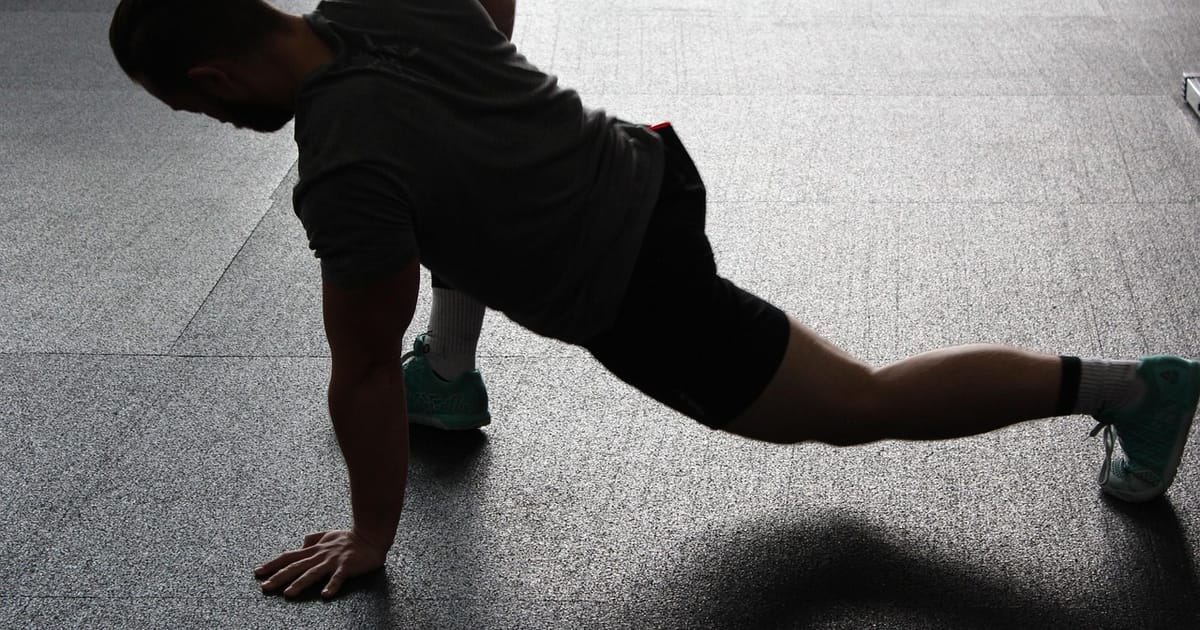
A good daily mobility routine takes about 10 minutes and moves your spine, shoulders, hips and ankles through their full range, then finishes with two static holds for the hips and the deep squat. The eight moves below do that with no equipment. Do the routine on at least 5 days a week. The ACSM's 2011 position stand recommends flexibility work for each major muscle group on 2 or more days a week, and a 2018 review linked range-of-motion gains to stretching at least 5 days a week.
The 10-minute daily mobility routine
Work from the floor up to standing, in this order. The first six moves are slow, controlled reps; the last two are holds, because static stretching built more lasting range than dynamic moves in the research covered below.
| # | Move | Main area | Dose | Time |
|---|---|---|---|---|
| 1 | Cat-cow | Whole spine | 8 slow reps | 45 s |
| 2 | Thread the needle | Upper back | 5 per side | 1 min |
| 3 | Wall slides | Shoulders | 8 reps | 45 s |
| 4 | World's greatest stretch | Hips, hamstrings, upper back | 4 per side | 1.5 min |
| 5 | 90/90 hip switches | Hip rotation | 6 per side | 1 min |
| 6 | Knee-to-wall ankle rocks | Ankles | 10 per side | 1 min |
| 7 | Deep squat hold | Hips, knees, ankles | 2 x 30 s | 1.5 min |
| 8 | Half-kneeling hip flexor stretch | Front of the hip | 2 x 30 s per side | 2.5 min |
Move to a clear stretch you can breathe through, never to sharp pain, pinching or tingling. The exercise choices, order and reps are our coaching choices; the hold times and weekly dose come from the research below.
1. Cat-cow
- Start on hands and knees, hands under shoulders, knees under hips.
- Breathe in and let your belly drop and your chest lift (cow).
- Breathe out and round your back up toward the ceiling, tucking your chin (cat).
- Take about 3 seconds each way. Do 8 reps.
2. Thread the needle
- From hands and knees, slide your right arm under your body, palm up, until your right shoulder and the side of your head rest on the floor.
- Pause, then sweep the right arm back out and up toward the ceiling, following your hand with your eyes.
- Do 5 slow reps, then switch sides.
3. Wall slides
- Stand with your back, head and buttocks against a wall, feet a step away from it.
- Raise your arms into a goalpost shape, backs of the hands and elbows touching the wall if you can.
- Slide your arms up as far as you can while keeping your lower back and arms on the wall, then slide them down. Do 8 reps.
4. World's greatest stretch
- Step your right foot forward into a long lunge and put both hands on the floor inside the right foot, back leg straight. This is the position on the cover photo.
- Drop your right elbow toward the inside of the right foot.
- Rotate your chest to the right and reach the right arm to the ceiling.
- Put both hands back down, push your hips back and straighten the front leg to feel the hamstring. That is one rep. Do 4 per side. If this part feels very tight, add these stretches for tight hamstrings.
5. 90/90 hip switches
- Sit with both knees bent to about 90 degrees and both feet on the floor, wider than your hips, hands behind you for support.
- Let both knees drop to the right so the right shin lies in front of you and the left shin lies to the side.
- Lift the knees and drop them to the left. Each drop is one rep. Do 6 to each side, sitting taller as it gets easier.
6. Knee-to-wall ankle rocks
- Face a wall in a split stance, front toes a few inches from it.
- Keep the front heel down and push the knee forward over the toes toward the wall.
- Rock in and out 10 times, then switch. When the knee touches easily, move the foot back a little.
7. Deep squat hold
- Stand with your feet a bit wider than your hips, toes turned out slightly.
- Squat as low as you can with your heels on the floor and your chest up. Hold a door frame or a table leg if you tip backward.
- Hold 30 seconds, stand up, and repeat once.
8. Half-kneeling hip flexor stretch
- Kneel on a cushion with your right foot forward, right knee over the ankle.
- Squeeze your left glute and tuck your pelvis under, then shift your hips forward until the front of the left hip pulls.
- Hold 30 seconds, switch sides, and do each side twice. Our guide to stretches for tight hip flexors has four more options for this spot.
Is it OK to do mobility every day?
Yes. Gentle, pain-free mobility work is fine every day, and daily is the easiest schedule to remember. The ACSM sets the minimum at 2 days a week, at a total of 60 seconds per flexibility exercise.
More days may help, but the evidence is mixed on that point. A 2018 review of 23 studies found weekly frequency was positively associated with range of motion, and suggested at least 5 days and at least 5 minutes a week. A larger 2024 meta-analysis of 77 studies found that neither volume, intensity nor frequency changed the gains significantly. Five or more short sessions a week meets the higher bar at little cost, which is why the plan below asks for it.
How long should a daily mobility routine be?
Ten minutes is enough. The 2018 review found that total time per week mattered and time within a single session did not, so five 10-minute sessions beat one long weekly session on paper. The two holds in this routine give the front of each hip and the deep squat position 60 seconds each, the amount the ACSM recommends per exercise.
| Dose | This routine | Based on |
|---|---|---|
| Days per week | 5 or more | 2018 review: frequency linked to gains |
| Hold per stretch | 2 x 30 s | ACSM 2011: 60 s total per exercise |
| Weekly time | About 50 minutes (the review's threshold is 5+ minutes a week) | 2018 review |
| Session length | About 10 minutes | Session length did not matter in the 2018 review |
What's the difference between mobility and flexibility?
Flexibility is one part of your range of motion, not all of it. A 2026 expert opinion paper in Sports Medicine describes range of motion as a mix of things you can change, like how far soft tissue will lengthen and how your nervous system controls it, and things you cannot, like bone structure. Flexibility mostly means the first one.
Coaches usually say "mobility" for the range you can actually use and control. The same paper argues that stretching is not the only way to train it: strength training at long muscle lengths and foam rolling gave comparable long-term range gains. That is why the plan adds strength work from week 3.
Dynamic moves or static stretches?
Use both, for different jobs. Static holds build more lasting range: the 2024 meta-analysis found static and PNF stretching produced greater long-term gains than ballistic or dynamic stretching. Controlled dynamic moves suit a warm-up, because a 2016 systematic review found dynamic stretching gave small-to-moderate performance improvements when done within minutes of activity.
So the rule is simple. If one area feels tightest, add 2 x 30-second holds for it to the end of the routine. If that is the back of your hip, our stretches for tight glutes use the same dose.
Should you do mobility in the morning, at night or before a workout?
Do it whenever you will actually do it, unless you want it for a workout. In that case, do it right before training. The 2016 review found the range gained in one session typically lasted under 30 minutes, so a morning routine will not still be loosening you up at an evening workout.
Long static holds right before effort cost a little performance. In the same review, static stretching of 60 seconds or more per muscle group lowered performance by 4.6% on average when testing followed within a few minutes, against 1.1% for under 60 seconds, and most studies had no dynamic activity in between. Before a workout, run the six dynamic moves and keep the holds short, or save them for afterward.
The 4-week daily mobility plan
Do the routine on 5 or more days a week and add the strength work on 2 or 3 non-consecutive days. The progression is our coaching choice built on the research above.
| Week | Mobility (5+ days a week) | Strength (2-3 days a week) |
|---|---|---|
| 1 | The 8 moves as listed, about 10 minutes | None yet |
| 2 | Same, plus 2 x 30 s holds for your tightest area | None yet |
| 3 | Same as week 2 | Slow bodyweight squats to full depth, 2 x 10 |
| 4 | Same as week 2, then redo the self-check below | Squats 3 x 10, adding a loaded backpack once that feels easy |
| After | The routine on 2-5 days a week | Keep the squats and keep adding load |
Strength work earns its place. A 2021 meta-analysis of 11 randomized trials found no difference in range-of-motion gains between strength training and stretching, though the trials varied widely. A 2023 meta-analysis of 55 studies found resistance training improved range of motion, but training with body mass alone did not improve it significantly, so the plan adds load in week 4. Our guide to how many squats to do a day has a full squat plan by level.
If five sessions a week is the hard part, attach the routine to something you already do daily, like the first coffee or brushing your teeth. Our guide to staying consistent with working out has more ways to make it stick.
How do you know your mobility is improving?
Pick three positions, note where you are on day 1, and redo them at the end of week 4. These are our coaching choices and personal markers, not clinical tests.
- Deep squat: can you hold the bottom for 30 seconds with your heels down, and without holding on?
- Toe touch: standing with straight knees, where do your fingertips reach (knees, shins, ankles, floor)?
- Wall slide: how high do your hands get before your lower back or arms leave the wall?
Expect weeks, not days. In a 2025 meta-analysis of 13 studies with 556 people, stretching programs lasted 5 to 15 weeks and produced large range-of-motion gains. When people stopped for 2 to 6 weeks, they lost part of the gain but stayed above where they started. Keep some mobility or strength work going after week 4 to hold on to it.
On long sitting days, a short movement break between sessions also counts. The ACSM notes health benefits from frequent short bouts of standing and activity between sedentary periods, even in people who exercise.
When should you skip a move or see a doctor?
Skip or shrink any move that causes sharp pain, pinching or tingling, and see a doctor or physiotherapist if a joint stays painful. The NHS advises seeing a GP when joint pain stops normal activities or affects sleep, keeps getting worse or coming back, has not improved after 2 weeks of home care, or when joints stay stiff for more than 30 minutes after waking. Get urgent help for a hot, swollen joint, joint pain with a high temperature or feeling unwell, or very bad pain, being unable to put weight on a joint, or numbness after a fall or injury.