Knee Push-Up Form: 6 Steps, Mistakes and a 6-Week Plan
Knee push-up form in 6 steps, the mistakes that waste reps, how much body weight you lift (about 49%), and a 6-week plan to your first full push-up.
PushSlayer Editorial Team · Updated · 5 min read
Leer en español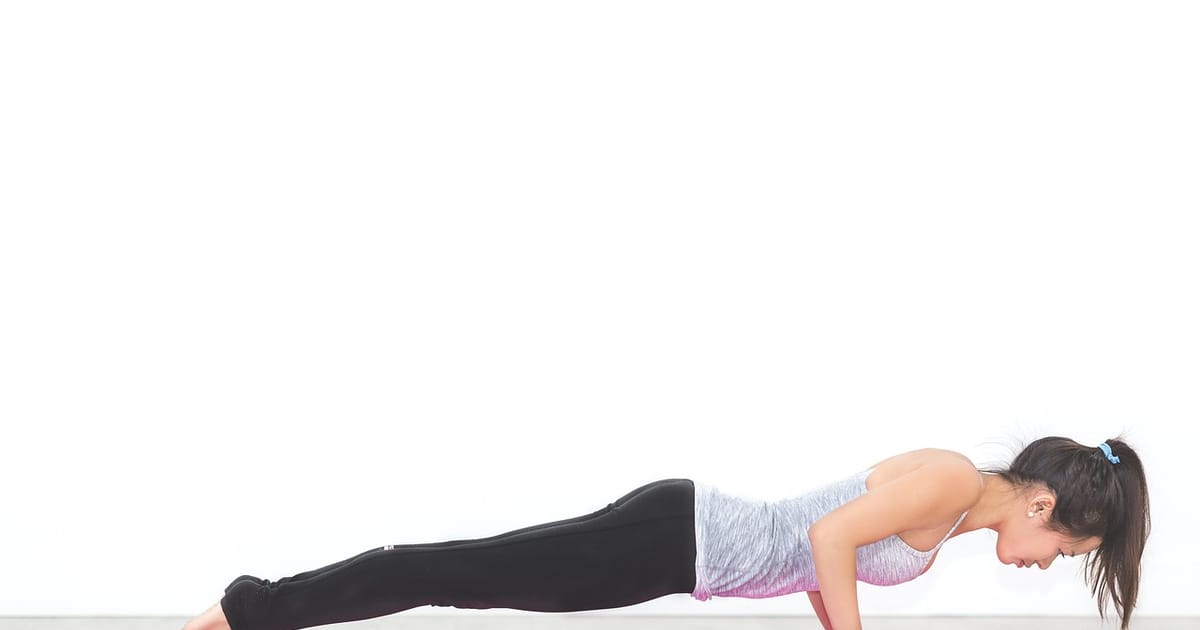
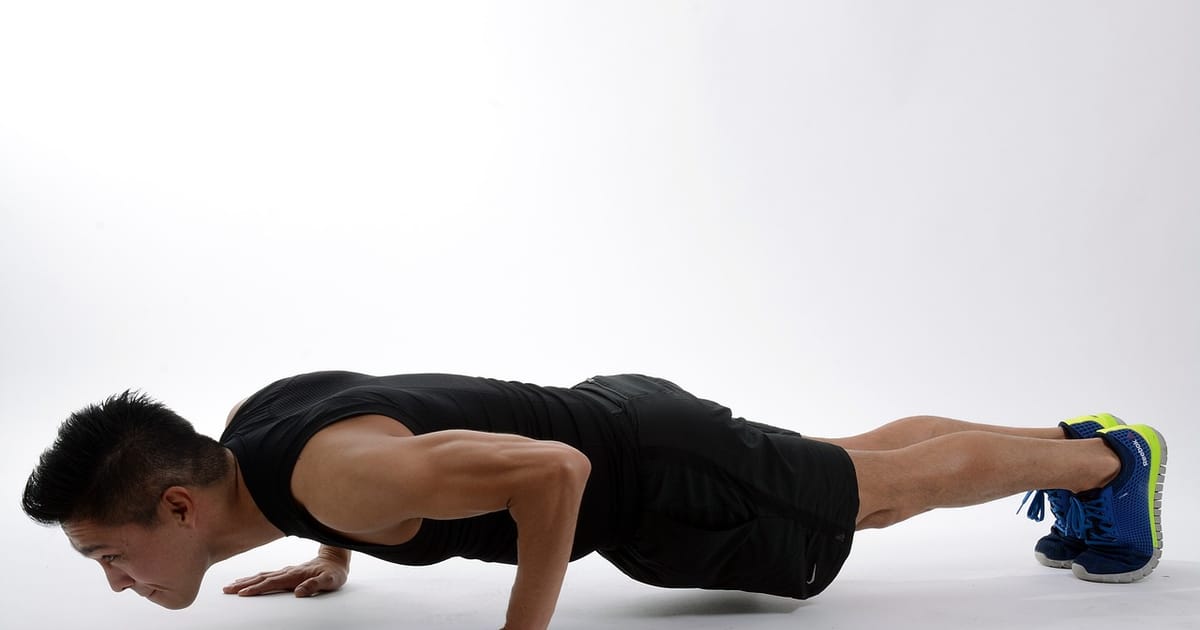
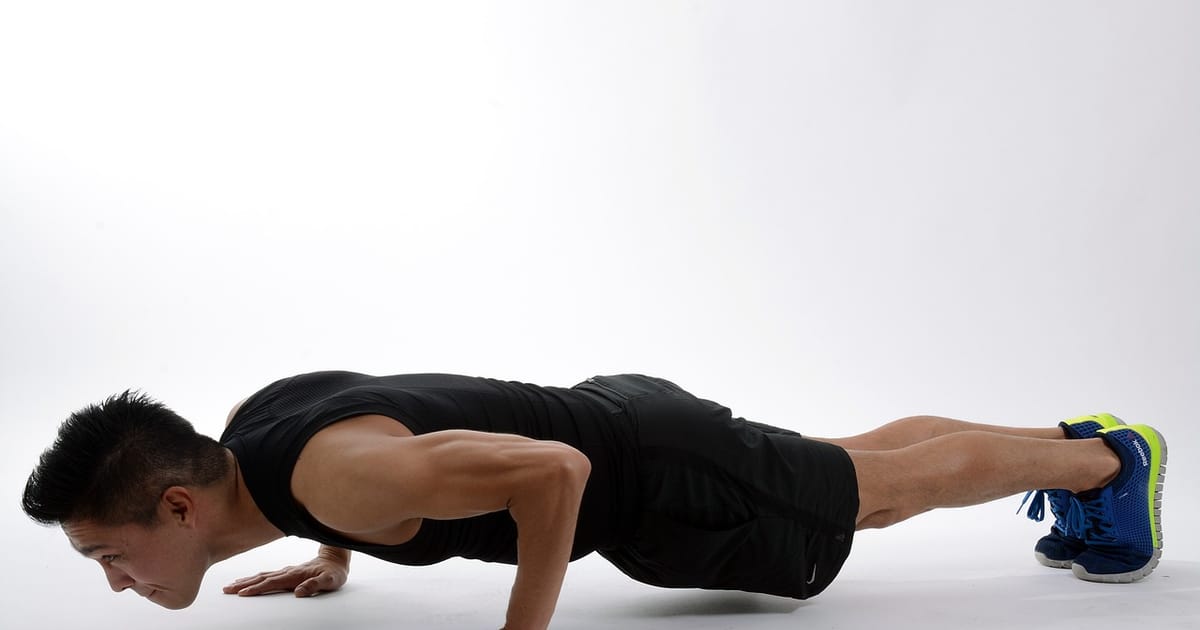
Good knee push-up form is a regular push-up that pivots at the knees: hands under your shoulders, a straight line from your head to your knees, chest lowered to a fist's height from the floor, then pressed back to straight arms. The hips never bend. Done this way, a knee push-up puts about half your body weight on your arms, against roughly two thirds in a full push-up. Start with 3 sets of 8-12 clean reps, and test a full push-up once 3 sets of 12 feel easy.
How do you do a knee push-up with good form?
Set up like a plank on your knees, then lower and press as one rigid piece. These six steps cover it.
- Kneel on a mat or folded towel and put your hands on the floor, a little wider than your shoulders, fingers pointing forward.
- Walk your hands forward until your hips, shoulders and head line up. Your thighs should slant down toward the floor, not hang straight under your hips.
- Squeeze your glutes and brace your stomach as if someone were about to poke it. Your feet can rest on the floor or lift and cross, whichever feels steadier.
- Bend your elbows and lower your chest, keeping your elbows angled back toward your ribs rather than straight out to the sides.
- Stop when your chest is about a fist's height from the floor, or touches it lightly.
- Press back to straight arms without letting your hips drop first or lag behind.
Breathe in on the way down and out on the way up, and lower under control rather than dropping.
What are the most common knee push-up mistakes?
Most bad knee push-ups fail in one of four ways, and each one makes the exercise easier without making you stronger.
- Bent hips. If your butt is in the air and your thighs are vertical, you have turned the push-up into a shorter, easier movement. Walk your hands forward until your hips straighten.
- Half reps. Stopping a few inches down skips the hardest part of the movement. The 2026 ACSM position stand found that training through a complete range of motion improved strength, so lower all the way to your fist.
- A sagging lower back. If your hips touch the floor before your chest does, your stomach switched off. Squeeze your glutes and do fewer, cleaner reps.
- Elbows flared straight out. Your upper arms and body form a T, which most people find harder to control. Turn your elbows back so your arms form more of an arrow shape.
If your knees hurt on a hard floor, add padding. If they still hurt with padding, or you have a knee injury, skip knee push-ups for inclines and see a doctor or physiotherapist. If your shoulder, elbow or wrist hurts during the movement, stop and see a doctor or physiotherapist.
How much easier are knee push-ups?
About a fifth to a quarter less weight on your hands. Two force-plate studies put a knee push-up near 50% of body weight and a full push-up near 65%.
| Study | Knee push-up | Full push-up |
|---|---|---|
| Wurm and colleagues, 23 fit young adults | 49% of body weight | 64% of body weight |
| Gouvali and Boudolos (2005), 8 healthy men | 52.9% of body weight | 66.4% of body weight |
For a 160 lb (73 kg) person, that is roughly 80 lb (36 kg) on the knees versus 100 lb (47 kg) on the toes. Those figures are estimates from averages, and both studies were small and used healthy adults, so your own numbers will differ.
The Wurm study also measured hands-elevated push-ups. A knee push-up landed between a 12-inch (30 cm) and a 24-inch (61 cm) incline, which helps if you need a step between the two. The incline push-ups guide covers those heights.
Are knee push-ups effective, or a waste of time?
They work, as long as the sets are hard. Knee push-ups train the same muscles as full push-ups, only with less load.
In a 2018 study in the Journal of Applied Biomechanics, researchers recorded muscle activity in 12 active men during push-ups on the toes and on the knees. They found no significant difference in how much each of the main muscles contributed to the movement, and concluded that knee push-ups "may be ideal as a novice push-up variation." The total amount of muscle activity is a different matter: Gouvali and Boudolos measured less activity in the chest and triceps on the knees, which fits the lower load.
Do knee push-ups build muscle?
They can, if you take the sets close to failure. In a 2017 randomized trial, 9 young men did push-ups with their position adjusted (kneeling, for example) to match 40% of their bench press max. They trained twice a week for 8 weeks, 3 sets to failure each session.
Their triceps thickness grew from 27.7 to 30.4 mm, with no significant difference from a group that bench-pressed, and their bench press max rose from 61.1 to 64.2 kg. The authors concluded the two were comparably effective for strength. The trial was small and short, and it tested easier push-ups in general rather than knee push-ups alone. What it shows is that a lighter variation still produces gains when each set ends near your limit.
How many knee push-ups should a beginner do?
Pick a number of reps you can do 8-12 times with clean form, for 2-3 sets, 2-3 days a week. That matches the ACSM's recommendation for novices: loads you can lift for 8-12 reps, trained 2-3 days a week. The 2026 update found that strength improved with 2-3 sets and at least 2 sessions a week.
| Clean knee push-ups in one set | What to do |
|---|---|
| Fewer than 10 | Use a high incline, such as a table or counter, until you reach 10 |
| 10-15 | Follow the plan below from week 1 |
| 16 or more | Start at week 4, or test a full push-up |
A 6-week knee push-up plan to your first full push-up
This is a coaching plan built on the ACSM ranges, not a protocol tested in one study. Train on three non-consecutive days a week, such as Monday, Wednesday and Friday, and rest 1-2 minutes between sets. End each set with about 2 good reps left in you.
| Week | Knee push-ups | Full push-up test |
|---|---|---|
| 1 | 3 x 8 | None |
| 2 | 3 x 10 | None |
| 3 | 3 x 12 | None |
| 4 | 3 x 12, lowering for 3 seconds | 1 attempt at the start of the last session |
| 5 | 1-3 full push-ups, then 3 x 10 knee | Every session |
| 6 | 2-5 full push-ups, then 2 x 10 knee | Every session |
- Do your full push-ups first in each session from week 5, while you are fresh.
- Count a full push-up only if your chest reaches a fist's height from the floor and your body stays straight.
- Repeat a week if you could not finish its sets with clean form.
- When you can do 3 sets of 5 full push-ups, switch to the plan in how to increase push-ups.
If the 3-second lowering in week 4 feels too hard, keep the normal tempo and repeat week 3.
When should I switch from knee push-ups to regular push-ups?
Try a full push-up as soon as 3 sets of 12 knee push-ups feel easy. The ACSM advises moving to a harder load once you can do one or two reps more than your target, and 3 x 12 is the top of the novice range.
You do not have to pick one or the other. You do not need to wait until you can do 10 full push-ups in a row. Mixed sets let you practice the real thing now: do as many full push-ups as you can with good form, then finish the set on your knees. Each week, the full reps make up more of the set.
Knee push-ups or incline push-ups?
Both work, and the better one is the one you can set up today. Knee push-ups need nothing but floor space. Inclines let you adjust the difficulty in small steps and keep the same body line as a full push-up, so the skill carries over more directly.
If you have a sturdy bench or table, inclines give you a finer ladder. If you train in a small room or a hotel, knees are the simpler choice. Either one fits into a beginner bodyweight program, and once you can do full push-ups, you can read whether daily push-ups are a good idea before adding frequency.