
Progressive Overload for Muscle Growth: When to Add Weight
Progressive overload for muscle growth, made simple: add reps until you reach the top of your range, then add weight. The tested rule and an 8-week plan.
PushSlayer Editorial Team · Updated · 6 min read
Leer en español
Progressive overload for muscle growth means making your sets a little harder as you adapt. The simplest version works like this: pick a range such as 3 sets of 8-12 reps, add reps each session until every set reaches 12, then add the smallest weight jump you have and start again near 8. In a 2026 trial, arms trained with a version of that rule grew about twice as much in 8 weeks as arms that kept the same weight and reps.
Do you need progressive overload to build muscle?
You will grow some muscle without it, but you grow more with it. That is the finding of a trial built to test the question directly, published in 2026 by Kassiano and colleagues.
Each arm of 55 untrained young women was randomly assigned to one of three conditions: progressive overload, the same load throughout, or no training. Both training conditions did one-arm triceps extensions for 3 sets of 8-12 reps, 3 days a week, for 8 weeks. The progressive arm added load every time it reached 12 reps; the other arm kept the same load and reps for the whole study.
| Group | Triceps thickness gain (sum of two sites) |
|---|---|
| Progressive overload | +0.79 cm, +22.9% |
| Same load for 8 weeks | +0.41 cm, +11.6% |
| No training | +0.05 cm, +1.8% |
The study is short, used one exercise and tested only untrained women, so the exact numbers may not carry over to you. The direction matches the 2026 ACSM position stand, which reviewed 137 systematic reviews and concludes that healthy adults should perform progressive resistance training.
When should you add weight?
Add weight when you can do more reps than your range asks for. The 2009 ACSM position stand on progression recommends a 2-10% increase in load once you can complete your current workload for 1-2 reps over the target. The Kassiano trial used a version of the same rule: add load at the top of the range.
This method is often called double progression, because reps go up first and weight goes up second. Here is how it looks with a 3 x 8-12 target:
| Session | Weight | Reps in 3 sets | What to do next |
|---|---|---|---|
| 1 | 50 lb (23 kg) | 10, 9, 8 | Same weight, try for more reps |
| 2 | 50 lb (23 kg) | 11, 10, 9 | Same weight |
| 3 | 50 lb (23 kg) | 12, 12, 11 | Same weight, one set short |
| 4 | 50 lb (23 kg) | 12, 12, 12 | Add weight next time |
| 5 | 55 lb (25 kg) | 9, 8, 8 | Back near the bottom, build reps again |
Two practical notes. Use the smallest jump your equipment allows, since 5 lb (2 kg) on a 135 lb (61 kg) squat is under 4%, well inside the ACSM range. On light dumbbells the next pair is often a 20-25% jump, so expect your reps to drop further and rebuild them, or stay at the old weight and add a set first.
Is adding reps as good as adding weight?
For muscle size, yes, within limits. In an 8-week trial in 43 trained lifters, one group added load and kept reps steady while the other kept load steady and added reps. Muscle growth was similar between groups, and the strength difference slightly favored the load group by an amount the authors called of questionable practical significance.
A 2017 meta-analysis of 21 studies points the same way: when sets went to failure, light and heavy loads built similar muscle, while heavy loads built more maximal strength. The limit shows up at the very light end. In a 12-week trial in 30 men, training at 20% of max grew noticeably less muscle than 40-80%, even with the same total volume.
So adding reps works, but once a set runs past roughly 20-30 reps, a heavier load or a harder version is the better next step. That cutoff is a coaching rule, not a number from one study.
The ways to progress, ranked by evidence
Not every way to make training harder has the same support. The 2026 ACSM stand found that most variables changed results little, and listed the ones that did.
| Lever | What it looks like | Evidence for muscle growth |
|---|---|---|
| Load | Same reps with more weight | Good: one 8-week trial (Kassiano 2026) plus ACSM 2009 guidance |
| Reps | Same weight, more reps | Good up to moderate rep counts: one 8-week trial in 43 lifters (Plotkin 2022), plus the 2017 load meta-analysis |
| Weekly sets | Going from 2 to 3 or 4 sets | Strong: ACSM 2026 found at least 10 sets a week grew more |
| Effort | Ending sets closer to failure | Mixed: one exploratory meta-regression favors it for size; ACSM 2026 found no consistent effect |
| Eccentric overload | Lowering more than you lift, such as up with two legs and down with one | Listed by ACSM 2026 as enhancing growth |
| Harder variation | Knee to floor to feet-elevated push-up | Supported by a small trial: Kikuchi 2017, below |
| Tempo, time under tension | Slower reps for their own sake | Weak: ACSM 2026 found no consistent effect |
| Periodization schemes | Planned waves of heavy and light weeks | Weak: no consistent effect in ACSM 2026 |
Pick one lever at a time, usually reps or load. Change sets every few weeks, not every session.
How many sets per week do you need?
Aim for at least 10 hard sets per muscle group each week. The 2026 ACSM stand found that hypertrophy was enhanced by volumes of 10 or more sets a week. An earlier meta-analysis estimated that each extra weekly set added about 0.37% to the percentage gain.
More is not endlessly better. A 2026 meta-regression of 67 studies found that muscle growth kept rising with volume but with diminishing returns. For a beginner, 3 full-body sessions with 3-4 sets per muscle land at 9-12 weekly sets, around the 10-set mark the ACSM stand points to. To spread those sets over the days you have, see our guide to choosing a workout split for muscle growth.
How close to failure should your sets be?
Close, but most sets do not need to hit failure. A 2024 series of meta-regressions found that muscle growth improved as sets ended closer to failure, while strength gains were similar across a wide range. The 2026 ACSM stand, on the other hand, found that training to momentary failure did not consistently change outcomes. The evidence is mixed on how close is close enough, not on whether effort matters.
A sensible middle ground is to end most sets with 1-3 reps left in you, and let the last set of an exercise go a little closer. Progressive overload depends on this: if every set ends with 6 reps left, adding a rep is not a real increase.
Can you do progressive overload with bodyweight?
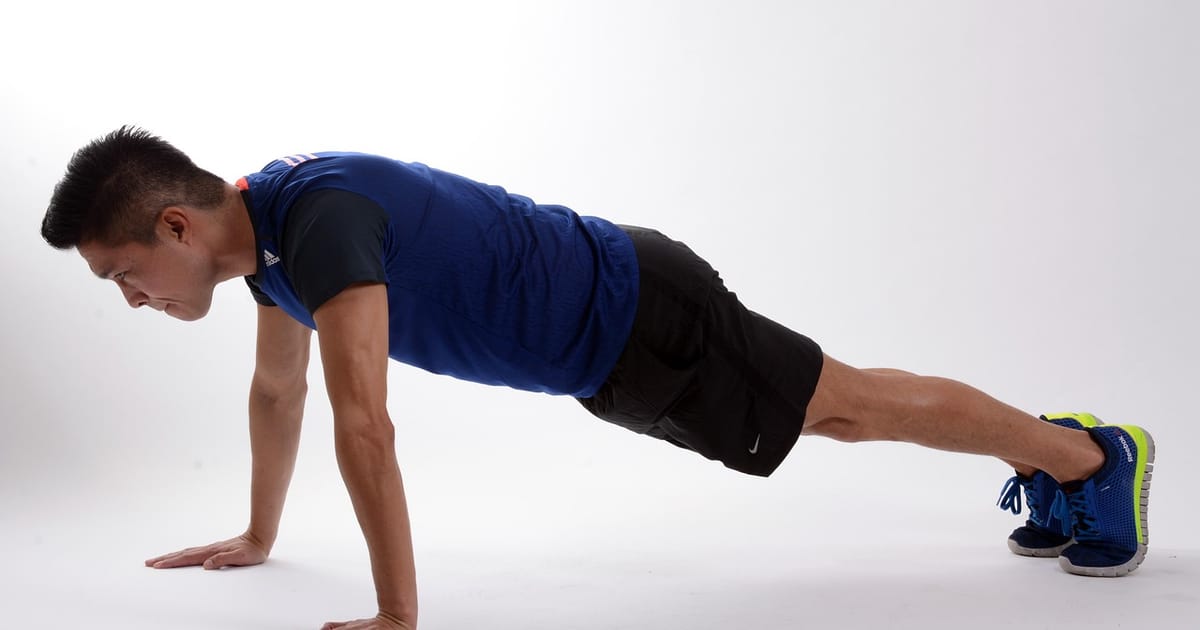
Yes. With no weights to add, the load comes from leverage: a harder push-up variation puts more of your body weight on your arms. In a small 8-week trial, 18 young men did either bench press at 40% of max or push-ups adjusted (for example on the knees) to the same load. Chest and triceps thickness and bench press strength increased similarly in both groups.
The same double progression works at home. Add reps until you hit the top of your range, then move to the next variation:
- Push-ups: wall, incline, knees, floor, feet elevated.
- Squats: chair squat, bodyweight squat, split squat, rear-foot-elevated split squat.
- Rows: high table row, lower table row, feet on a chair.
Our beginner bodyweight workout program lays out six of these ladders with a test for each level. If push-ups are your main lift, the guide to increasing your push-ups applies the same rules to a 6-week plan.
An 8-week progressive overload plan
This plan wraps around the routine you already do, in a gym or at home. Train 3 non-consecutive days a week with 4-6 exercises that cover your legs, push, pull and hips. It is a coaching plan built on the studies above, not a protocol from one trial.
- Choose a range for each exercise. The 2009 ACSM stand recommends 8-12 reps for beginners, so use that for most moves.
- In week 1, pick a weight or variation where your first set lands near the bottom of the range with 2-3 reps left.
- Write down the weight and the reps of every set. Progression you do not record is a guess.
- Each session, try to add at least one rep to one set. Move up a weight or variation only when every set reaches the top of the range.
- Rest 1-2 minutes between sets, the range the 2009 ACSM stand gives for hypertrophy training. Our guide on how long to rest between sets shows when to take longer.
| Weeks | Sets per exercise | Weekly sets per muscle (3 days) | Focus |
|---|---|---|---|
| 1-2 | 2 | 6 | Learn the moves, find your starting weights |
| 3-4 | 3 | 9 | Add reps each session |
| 5-8 | 3-4 | 9-12 | Add reps, then weight; add the 4th set to lagging muscles |
At the end of week 8, compare your log with week 1. Most exercises should show more weight, more reps, or a harder version.
What to do when you stop progressing
As a working rule, a stall is two or three sessions in a row with no added rep on an exercise. Before changing the program, check what happens outside it:
- Sleep. Compare your nights with the research in how much sleep you need for muscle recovery.
- Protein. Check your intake against the targets in how much protein per day to build muscle.
- Effort. Make sure your sets end with only 1-3 reps left, not 5 or 6.
If those are in order, change one thing: add a set, use a smaller weight jump, or switch to a close variation of the exercise. A planned week off is not required. In a 9-week trial in 39 trained adults, a one-week break at the midpoint left muscle growth unchanged and slightly reduced strength gains compared with training straight through. Our coaching rule: take a lighter week when you feel worn down, rather than on a fixed schedule.
Progression should never mean training through pain. If a joint hurts during or after an exercise, stop that exercise and see a doctor or physiotherapist.