
Protein Per Day to Build Muscle: Grams by Body Weight
Protein per day to build muscle: a table of grams for your body weight, how much to eat per meal, and a sample day that reaches 120 g from everyday foods.
PushSlayer Editorial Team · Updated · 6 min read
Leer en español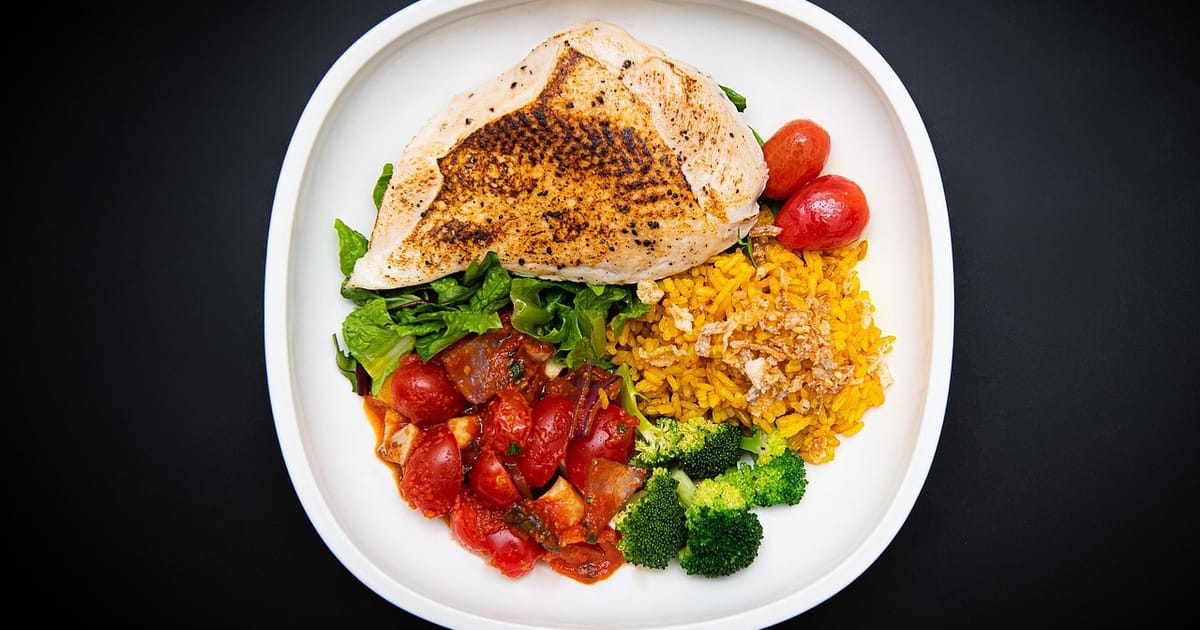
To build muscle, eat about 1.6 g of protein per kilogram of body weight per day, which is 0.7 g per pound. A 2018 meta-analysis of 49 trials with 1,863 people found that muscle gains from strength training stopped rising above roughly that intake. Because the estimate is uncertain, the authors suggest up to 2.2 g/kg (1 g per pound) if you want to cover every chance of extra gains. For a 160 lb (73 kg) person, that is 116-160 g a day, split over 3-5 meals.
How much protein per day to build muscle by body weight?
Multiply your weight in pounds by 0.7 for the evidence-based target, or by 1.0 for the upper end. In the Morton meta-analysis, gains in fat-free mass leveled off at 1.62 g/kg/day, with a 95% confidence interval of 1.03-2.20 g/kg. The International Society of Sports Nutrition (ISSN) gives a similar range for most people who exercise: 1.4-2.0 g/kg a day.
| Body weight | Daily target (0.7 g/lb, 1.6 g/kg) | Upper end (1 g/lb, 2.2 g/kg) | Per meal, 4 meals (0.4 g/kg) |
|---|---|---|---|
| 120 lb (54 kg) | 87 g | 120 g | 22 g |
| 140 lb (64 kg) | 102 g | 140 g | 25 g |
| 160 lb (73 kg) | 116 g | 160 g | 29 g |
| 180 lb (82 kg) | 131 g | 180 g | 33 g |
| 200 lb (91 kg) | 145 g | 200 g | 36 g |
| 220 lb (100 kg) | 160 g | 220 g | 40 g |
Start at the daily target. It is the point where the average gain stopped improving in the research, and it is easier to hit every day than the upper end. Consistency over weeks matters more than a perfect number on any single day.
Is 1 gram of protein per pound too much?
No, it is not too much, but most people do not need it. One gram per pound equals 2.2 g/kg, the top of the confidence interval in the Morton analysis. The authors call ~2.2 g/kg a prudent target for people who want to maximize gains, because some individuals may sit above the 1.62 g/kg average.
So 1 g per pound is a safety margin, not a requirement. If you like eating that much protein and it fits your budget, trials in healthy adults have not found that it harms kidney function (see the kidney section below). If it is a struggle, 0.7 g per pound covers the point where the studies stopped seeing extra muscle.
Is the RDA of 0.8 g/kg enough to build muscle?
Probably not if you lift. The ISSN position stand says the current RDA of 0.8 g/kg/day is not an appropriate amount for people in training. The Morton authors reached the same conclusion: eating at the RDA appears insufficient for people who want to gain strength and muscle with resistance training.
The Morton data shows why more helps. The people in those trials already ate about 1.4 g/kg on average, 75% above the RDA, and adding about 35 g of protein a day still produced extra gains: 0.7 lb (0.30 kg) more fat-free mass and 5.5 lb (2.49 kg) more on their one-rep max over the training period. Those are modest numbers, which tells you protein supports training rather than replacing it.
How much protein per meal to build muscle?
Aim for about 0.4 g/kg per meal, over at least four meals. Schoenfeld and Aragon proposed that split to reach 1.6 g/kg a day, and up to 0.55 g/kg per meal if you are aiming for 2.2 g/kg. The ISSN gives the same idea in round numbers: 20-40 g per serving, or 0.25 g/kg, every 3-4 hours.
The claim that your body can only use 30 g at a time does not hold up. In a 2023 randomized trial of 36 healthy young men, 100 g of protein after a full-body workout produced a larger muscle-building response than 25 g, and it lasted more than 12 hours. That was a single-session lab study, so it does not show more muscle over months, but it means a big dinner is not wasted. For the full routine in the hours after training, see how to recover after a workout.
In practice, spreading protein over the day makes the daily total easier to reach, and the total is what the long-term studies measured. Use per-meal targets as a planning tool, not a rule.
High-protein foods: how much protein is in a serving?
Lean meat, fish, dairy, eggs, tofu and beans cover most needs. These values come from USDA FoodData Central; the serving column is the per-100 g value scaled to the portion shown.
| Food | Protein per 3.5 oz (100 g) | Example serving | Protein in that serving |
|---|---|---|---|
| Chicken breast, roasted, no skin | 31 g | 4 oz (113 g) | 35 g |
| Tuna, canned in water, drained | 25.5 g | 3.5 oz (100 g) | 26 g |
| Firm tofu | 17.3 g | 5 oz (140 g) | 24 g |
| Egg, hard-boiled | 12.6 g | 2 eggs (about 100 g) | 13 g |
| Cottage cheese, 2% fat | 10.4 g | 7 oz (200 g) | 21 g |
| Greek yogurt, plain, low-fat | 10 g | 6 oz (170 g) | 17 g |
| Lentils, boiled | 9 g | 7 oz (200 g) | 18 g |
| Black beans, boiled | 8.9 g | 7 oz (200 g) | 18 g |
| Milk, 2% | 3.3 g | 1 cup (about 245 g) | 8 g |
Weights are for cooked or ready-to-eat food. Raw chicken weighs more than cooked, so weigh it the same way every time.
A sample day with 120 g of protein
This day fits a 160 lb (73 kg) person aiming for the daily target, with 20-35 g at each of four meals:
- Breakfast: 2 hard-boiled eggs and 6 oz (170 g) of Greek yogurt, about 30 g.
- Lunch: a 3.5 oz (100 g) tin of tuna and a cup of 2% milk, about 34 g.
- Dinner: 4 oz (113 g) of roasted chicken breast, about 35 g.
- Evening snack: 7 oz (200 g) of cottage cheese, about 21 g.
That totals about 120 g. Add your usual rice, bread, fruit and vegetables around it; they add a little more protein too. For a plant-based day, swap in tofu, lentils and beans from the table and plan a slightly larger portion, since each serving carries less protein.
Do you need protein powder to build muscle?
No. The ISSN says whole foods can meet protein needs, and calls supplements a practical way to make sure you get enough. Powder helps when your meals fall short. Check the label for grams of protein per scoop, because products vary.
The Morton trials tested protein supplements, so they show that adding protein on top of a normal diet helps. They do not show that powder works better than the same protein from food.
Do you need more protein when cutting?
Yes, if you are already lean and training hard. A 2014 review of resistance-trained athletes on calorie-restricted diets estimated that they need 2.3-3.1 g/kg of fat-free mass, more as the deficit gets larger and body fat gets lower. The review included only 6 studies, so treat the range as an estimate.
Fat-free mass is your weight minus your body fat. If you do not know it, a simple rule of thumb is to use the upper end of the table above (1 g per pound) during a cut. For a lean lifter, that falls inside the review's range. A plan such as this full body workout plan for weight loss gives the training side of that cut.
Does age change how much protein you need?
Somewhat. In the Morton analysis, the extra muscle gained from protein supplements got smaller with each year of age, and the ISSN notes that older adults likely need larger doses, around 40 g per serving, to get the full muscle-building response from a meal. If you are older, aim for the higher per-meal numbers in the table and keep training, since lifting is what gives the protein something to build.
Is a high-protein diet bad for your kidneys?
Not in healthy adults, based on current trials. A 2018 meta-analysis of 28 trials with 1,358 participants compared higher-protein diets (at least 1.5 g/kg, 20% of calories or 100 g a day) with normal ones and found no difference in how kidney function changed over time.
Those trials only included people without kidney disease. If you have kidney disease, diabetes or another medical condition, talk to your doctor before raising your protein.
Protein works only if you train
Protein adds to training; it does not replace it. The Morton meta-analysis also found that supplements were more effective in people who were already training, and its authors note that for gains in one-rep max, practice at or near that max matters far more than protein supplements.
So pair your protein target with a program you will follow, and make it a little harder as you adapt, which is what progressive overload means. The beginner bodyweight workout program needs no equipment, the weightlifting routine for beginners is the gym version, and if your goal is upper-body strength, this guide to increasing your push-ups gives a 6-week progression. Sleep is the other half of recovery: here is how much sleep you need for muscle recovery.
How to hit your protein target every day
- Find your number in the body-weight table, or multiply your weight in pounds by 0.7.
- Divide it by the number of meals you eat, usually 3-5, to get a per-meal target.
- Build each meal around one food from the protein table, then add the rest of the plate.
- Track for one week with food labels or a nutrition app to see where you fall short.
- Fill the gap with a snack such as Greek yogurt, cottage cheese or milk, or with a protein shake.
- Keep it up for at least 6 weeks alongside your training before judging the results. Every trial in the Morton analysis lasted 6 weeks or more.