
Calisthenics Back Workout With No Equipment: A 6-Week Plan
A calisthenics back workout with no equipment: 7 home moves from table rows to bird dogs, the sets and reps for each, and a 6-week plan to build your back.
PushSlayer Editorial Team · Updated · 7 min read
Leer en español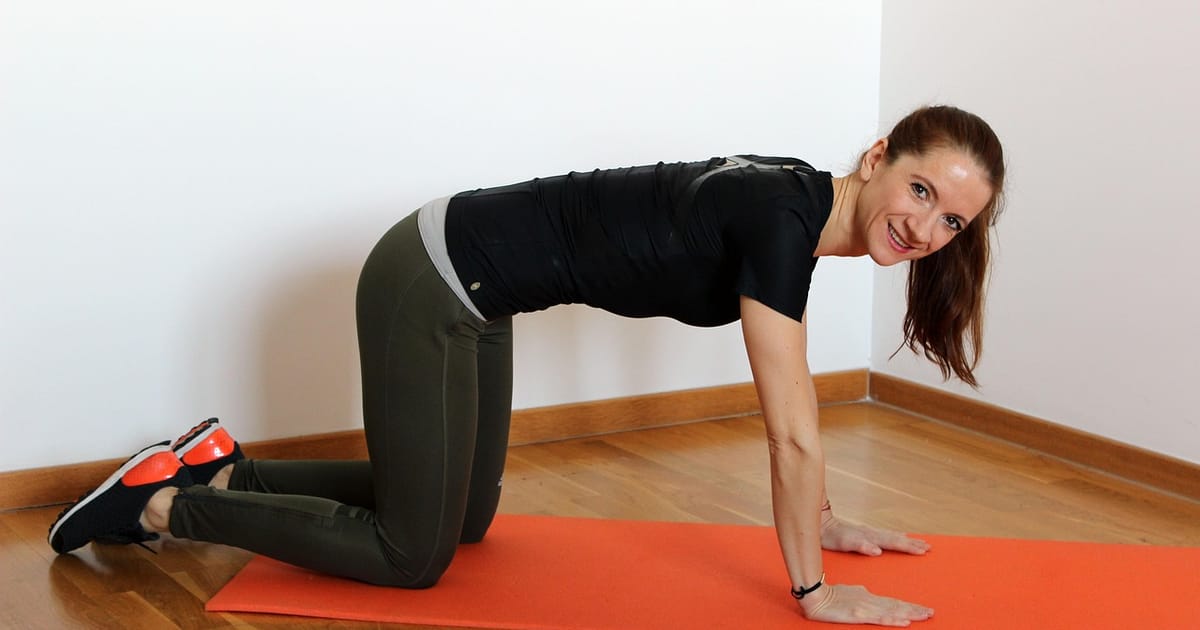
A calisthenics back workout with no equipment needs one row and a few floor moves. The row trains your lats, the big muscles under your arms, and nothing on the floor can replace it, because a floor raise only lifts the weight of your arms. Pull yourself up to the edge of a sturdy table (or a doorframe, or row a loaded backpack), then add prone Y and T raises for the upper back and bird dogs for the lower back. Do 3 sets of 8-12 rows, two or three times a week, and follow the 6-week plan below.
The 7 best bodyweight back exercises
Pick one row from the first three moves, the hardest one you can do for 8 clean reps, then do all four floor moves. This table sums up what each one trains.
| Exercise | Main muscles | Sets x reps | What you need |
|---|---|---|---|
| 1. Table row | Lats, mid back, biceps | 3 x 8-12 | A heavy table |
| 2. Doorframe row | Lats, mid back, biceps | 3 x 8-12 | An open doorway |
| 3. Backpack row | Lats, mid back, biceps | 3 x 8-12 per arm | A backpack and a chair |
| 4. Prone Y raise | Lower and middle trapezius | 2-3 x 10-15 | Floor |
| 5. Prone T raise | Middle trapezius, rear shoulders | 2-3 x 10-15 | Floor |
| 6. Bird dog | Lower back, glutes | 2-3 x 6-10 per side | Floor |
| 7. Superman | Lower back | 2 x 8-12 | Floor |
The sets and reps are coaching choices built on the ACSM ranges below. The floor moves get higher reps because they move a light load.
1. Table row
The table row is a home version of the inverted row, and it is the best back exercise you can do without equipment. In a 2009 lab study of seven healthy men, the inverted row produced the highest activation of the latissimus dorsi, upper back and hip extensors of three rows tested, including the standing bent-over row. It also put the lowest load on the lower spine. The study did not test a table, and seven men is a small sample.
- Lie on your back under a heavy dining table, chest under the edge.
- Grab the edge with your hands shoulder-width apart, palms facing away from you.
- Bend your knees, feet flat, and lift your hips until your body is straight from knees to shoulders.
- Pull your chest to the edge, squeezing your shoulder blades together, then lower in about 2 seconds.
Straighten your legs to make it harder. Use only a heavy table with a leg at each corner (not a pedestal, folding, glass or extendable table) that does not move when you pull hard on its edge while standing.
2. Doorframe row
Stand facing the edge of an open doorway with your toes near its base, wrap both hands around the frame at chest height, lean back until your arms are straight, then pull your chest toward the frame. Walk your feet closer to the base to make it harder, and lean back only as far as your grip stays firm. It is lighter than the table row, so it is the starting point for most beginners.
3. Backpack row
Fill a backpack with books, put one hand and one knee on a chair, and row the bag from the floor to your hip with the other arm. Keep your back flat and your shoulders level. Add books when you reach 3 sets of 12 per arm. Use this row when you have no table or doorway that passes the safety check.
4. Prone Y raise
Lie face down, arms overhead in a Y with thumbs up, forehead resting on a folded towel. Lift both arms a few inches off the floor, hold for 1 second, and lower. In a 2003 study of 30 healthy adults, this prone overhead raise produced the most lower trapezius activity of 10 exercises and was among the top two for the middle trapezius.
5. Prone T raise
Lie face down with your arms straight out to the sides, thumbs pointing up. Squeeze your shoulder blades together and lift your arms a few inches. In the same 2003 study, this movement (horizontal extension with the arm turned out) was the other top exercise for the middle trapezius, the muscle between your shoulder blades.
6. Bird dog
Start on your hands and knees, then reach one arm forward and the opposite leg back until both are level with your body. Hold for 2-3 seconds without letting your hips twist, return and switch sides. A 2007 study in 30 healthy adults found the bird dog may help strengthen the gluteus maximus, while the lower back muscles worked at levels the authors judged better suited to endurance and stability than to strength.
7. Superman
Lie face down with your arms overhead, then lift your chest, arms and legs off the floor together, hold for 2 seconds and lower. The superman works the lower back harder than the bird dog, and it also loads the spine more. A 1998 study in 13 young men found that exercises where the trunk actively extends produced the highest spine loads and muscle activity, while lifting one leg with the spine held still kept the load low. Start with bird dogs, and add supermans once the bird dog feels easy.
The workout
Do the workout below two or three times a week, with a rest day between sessions. Each session takes about 25 minutes.
| Order | Exercise | Sets x reps | Rest |
|---|---|---|---|
| 1a | Your row (table, doorframe or backpack) | 3 x 8-12 | 60 seconds |
| 1b | Push-ups at your level | 3 x 8-12 | 60 seconds |
| 2 | Prone Y raise | 2-3 x 10-15 | 45 seconds |
| 3 | Prone T raise | 2-3 x 10-15 | 45 seconds |
| 4 | Bird dog | 2-3 x 6-10 per side | 45 seconds |
| 5 | Superman (from week 3) | 2 x 8-12 | 45 seconds |
Alternate a set of rows with a set of push-ups. Pairing a pull with a push saves time and gives each a rest while you do the other. Rows come first because the ACSM's 2026 position stand, which pooled 137 systematic reviews, found strength gains were larger for exercises done at the start of a session. The push-up pairing and the rest times are coaching choices.
Warm up for 3-5 minutes first: arm circles, 10 easy rows at a gentle lean and a few cat-cow stretches.
How to make each move harder
Move up a level once you can do 3 sets of 12 clean reps, then start again at 3 sets of 8. This is the bodyweight version of the rule in the ACSM's 2009 position stand on progression: raise the load when you can do one or two reps more than your target.
- Table row: knees bent, then legs straight, then feet up on a chair.
- Doorframe row: walk your feet a few inches closer to the frame each week, then switch to the table row.
- Backpack row: add books.
- Y and T raises: hold each rep for 3 seconds at the top, then hold a full water bottle in each hand.
- Bird dog: hold for 5 seconds, then move to the superman.
Slowing the lowering phase to 3 seconds is the next step when no harder version is left.
The 6-week plan
This is a coaching plan built on the research in this article, not a protocol tested in one study.
| Week | Sessions | Row sets | Floor move sets | Reps left at the end of each set |
|---|---|---|---|---|
| 1 | 2 | 2 | 2 | 3 or more |
| 2 | 2 | 3 | 2 | 2-3 |
| 3 | 3 | 3 | 2, add supermans | 1-3 |
| 4 | 3 | 3 | 3 | 1-3, move up any row at 3 x 12 |
| 5 | 3 | 4 | 3 | 1-3 |
| 6 | 3 | 4 | 3 | 1-3, retest your row in the last session |
By week 5 your back gets 12 sets of rows plus 18 sets of Y and T raises a week. The ACSM's 2026 stand found more muscle growth with 10 or more sets per muscle group a week. Write down your row level and reps in week 1 and compare them in week 6.
Can you build back muscle without weights or a pull-up bar?
Yes, if your sets end close to failure. A 2017 meta-analysis of 21 studies found that light loads and heavy loads built similar muscle when every set was taken to failure, while heavy loads gave bigger gains in maximal strength. Your body weight on a table row is a light-to-moderate load, so a set of 12 has to be hard to count.
That is why the row matters most. A prone raise lifts only your arms, so it cannot load the lats the way pulling your body up does. The floor moves round out the workout by training the muscles around your shoulder blades and spine.
How do you train your back without a pull-up bar?
Row instead of pulling up. A table row, a doorframe row or a backpack row each train your lats and mid back with your body weight or a loaded bag, and the 2009 rowing study found the inverted row worked the lats harder than the standing bent-over row. Once your table row with straight legs reaches 3 x 12, a doorway pull-up bar is a good next purchase if you want pull-ups, and how to do your first pull-up takes you from there.
How often should you train your back?
Two to three times a week. The WHO 2020 guidelines ask adults to do muscle-strengthening activities for all major muscle groups on 2 or more days a week, and the ACSM's 2009 stand recommends 2-3 days a week for beginners. The ACSM's 2026 stand found strength improved more with 2 or more sessions a week.
If you also do push-ups every day, keep the rows on two or three of those days and the floor moves on the same days. See whether push-ups every day are a good idea for how to spread a daily habit.
Are supermans bad for your back?
Supermans are a normal back exercise, but they load your spine more than the bird dog does. The 1998 study found the highest spine loads during exercises where the trunk actively extends, and it suggested lifting one leg with the spine held still as a low-risk first step. That is why this plan starts with bird dogs and adds supermans in week 3.
If you have back pain, a back injury or a diagnosed spine condition, see a doctor or physiotherapist before you start, and stop any move that causes pain rather than muscle effort.
What to do next
- If you want a full-body routine, the beginner bodyweight workout program puts the same row ladder next to squats, push-ups and hinges.
- If push-ups are your weak point, follow how to increase push-ups and keep these rows as its pulling half.
- If you want chest, shoulder and arm work in the same session, the upper body workout at home with no equipment pairs these rows with three push-up variations.
- If your lower back needs more trunk work, add the beginner core workout routine after one session a week.