
Upper Body Workout at Home, No Equipment: 6 Moves and a Plan
An upper body workout at home with no equipment: 3 pushes and 3 pulls, a level for every starting point, sets and reps from research and a 6-week plan.
PushSlayer Editorial Team · Updated · 7 min read
Leer en español
A good upper body workout at home with no equipment pairs three pushes with three pulls: push-ups, pike push-ups and diamond push-ups for your chest, shoulders and triceps, and table rows, doorframe rows and prone Y raises for your back and biceps. Many no-equipment routines skip the pulls, which leaves your back untrained. Do 3 sets of 8-12 reps of each move at the level that fits you, two or three times a week, and follow the 6-week plan below.
The 6 moves at a glance
Pick the hardest level of each move where you can do 8 clean reps. The table gives the starting dose; the levels come further down.
| Move | Type | Main muscles | Sets x reps | What you need |
|---|---|---|---|---|
| 1. Push-up | Push | Chest, triceps, front shoulders | 3 x 8-12 | Floor, or a bench to raise your hands |
| 2. Table row | Pull | Lats, mid back, biceps | 3 x 8-12 | A heavy table |
| 3. Pike push-up | Push | Shoulders, triceps | 3 x 6-12 | Floor, or a step |
| 4. Doorframe row | Pull | Mid back, biceps | 3 x 8-12 | An open doorway |
| 5. Diamond push-up | Push | Triceps, chest | 2-3 x 6-12 | Floor, or a bench |
| 6. Prone Y raise | Pull | Lower and middle trapezius | 2-3 x 10-15 | Floor |
The 8-12 range comes from the ACSM's 2009 position stand on progression, which recommends loads of 8-12 repetitions for beginners. The pairings, the 6-12 range for the harder presses and the 10-15 range for the light Y raise are our coaching choices.
How to do each move
These bodyweight upper body exercises each have an easy and a hard version, so one routine works from your first week to your hundredth push-up.
1. Push-up
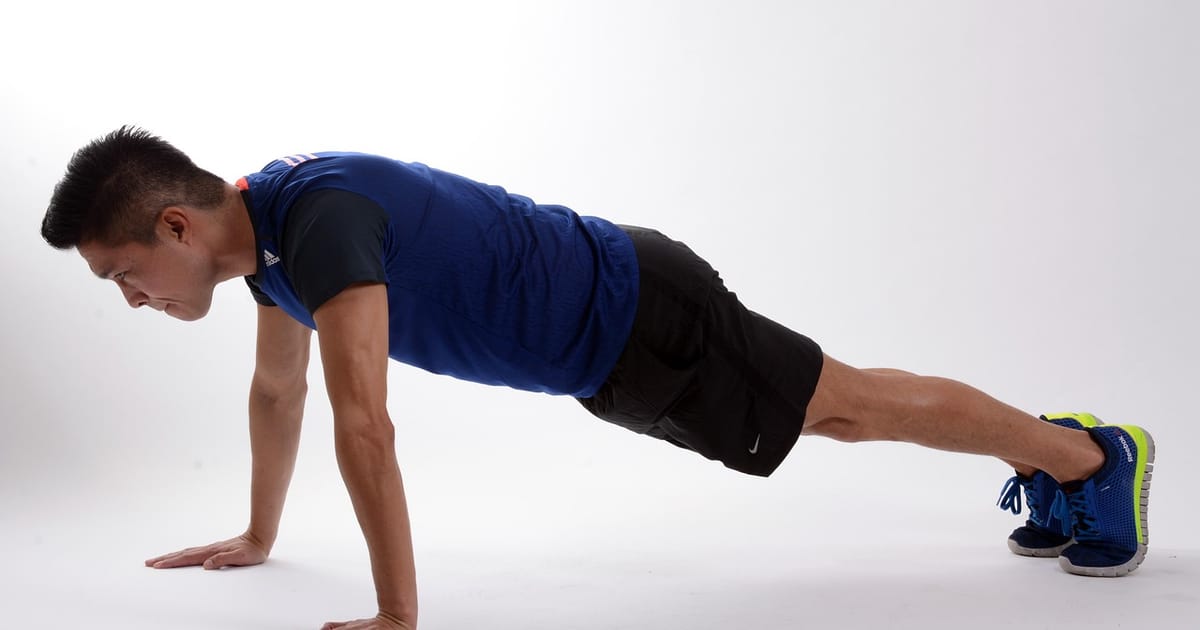
Hands a little wider than your shoulders, body straight from head to heels, lower until your chest is a fist's height from the floor, then press up. Keep your elbows angled back at about 45 degrees rather than flared out.
If floor push-ups are too hard, raise your hands on a bench, a counter or a wall. Our guide to incline push-ups shows which height to pick. To make them harder, put your feet on a step.
2. Table row
The table row is the home version of the inverted row and the most important pull in this workout. In a 2009 lab study of seven healthy men, the inverted row produced the highest activation of the lats and upper back of three rows tested, with the lowest load on the lower spine. Seven men is a small sample, and the study used a bar, not a table.
- Lie on your back under a heavy table, chest under the edge.
- Grab the edge with your hands shoulder-width apart.
- Bend your knees, feet flat, and lift your hips until your body is straight from knees to shoulders.
- Pull your chest to the edge, squeeze your shoulder blades together, and lower in about 2 seconds.
Use only a heavy table with a leg at each corner that does not move when you pull hard on its edge while standing. Skip pedestal, folding, glass and extendable tables. Straighten your legs to make the row harder.
3. Pike push-up
Start in a push-up position, walk your feet in and push your hips up into an upside-down V, then lower the top of your head to a spot just in front of your hands. With your hips over your hands, the press tilts toward an overhead press. In a 2013 study in 24 women using dumbbells, the front shoulders worked hardest in the upright shoulder press, less in the incline press and least in the flat bench press. Our pike push-up progression has five levels if you want to go further.
4. Doorframe row
Stand facing the edge of an open doorway with your toes near its base, hold the frame with both hands at chest height, lean back until your arms are straight, and pull your chest to the frame. Walk your feet closer to the base to make it harder, and lean back only as far as your grip stays firm. It is lighter than the table row, so it works as a second pull at the end of a hard session, or as the first pull for beginners.
5. Diamond push-up
Set your hands under your chest with your thumbs and index fingers touching, then do a push-up with your elbows close to your sides. In a 2026 study of 20 young men, diamond push-ups produced the highest relative activation of both the triceps and the chest of three hand positions, ahead of standard and wide push-ups. Do them on your knees or with your hands on a bench until you get 6 clean reps on the floor. See diamond push-up form for the common mistakes.
6. Prone Y raise
Lie face down, arms overhead in a Y with thumbs up, forehead on a folded towel. Lift both arms a few inches, hold for 1 second and lower. In a 2003 study of 30 healthy adults, this prone overhead raise produced the most lower trapezius activity of 10 exercises. Hold a full water bottle in each hand once 15 reps feel easy.
Which push-up level should you start at?
Start where you can do 8 clean reps, and move up as each version gets easy. Raising your hands takes weight off your arms and raising your feet adds it, as a force-plate study from Marquette University showed in 23 recreationally fit young adults:
| Push-up version | Load on your hands (% of body weight) |
|---|---|
| Hands on a 24-inch (61 cm) box | 41% |
| From the knees | 49% |
| Hands on a 12-inch (30 cm) box | 55% |
| Regular push-up on the floor | 64% |
| Feet on a 12-inch (30 cm) box | 70% |
| Feet on a 24-inch (61 cm) box | 74% |
Each person did only two reps of each version, so treat the numbers as a ranking, not an exact load. The same ladder idea applies to the other moves: knees bent before legs straight on the table row, incline pikes before floor pikes, diamonds on a bench before the floor.
The workout
Do the six moves as three pairs, a push and then a pull, two or three times a week with a rest day between sessions. A session takes about 30-35 minutes.
| Order | Move | Sets x reps | Rest after the set |
|---|---|---|---|
| 1a | Push-up at your level | 3 x 8-12 | 60 seconds |
| 1b | Table row | 3 x 8-12 | 60 seconds |
| 2a | Pike push-up | 3 x 6-12 | 60 seconds |
| 2b | Doorframe row | 3 x 8-12 | 60 seconds |
| 3a | Diamond push-up | 2-3 x 6-12 | 60 seconds |
| 3b | Prone Y raise | 2-3 x 10-15 | 60 seconds |
Finish all sets of a pair before moving on. Each muscle rests about 2 minutes between its own sets while you work the other half of the pair, in line with the 1-2 minutes the ACSM's 2009 stand recommends for muscle growth. The two main moves come first because the ACSM's 2026 position stand, which pooled 137 systematic reviews, found strength gains were larger for exercises done at the start of a session.
Warm up for 3-5 minutes first: arm circles, 10 easy push-ups against a wall and 10 easy doorframe rows.
The 6-week plan
This plan is our coaching plan built on the research in this article, not a protocol tested in one study. "Reps left" means how many more clean reps you could have done at the end of each set.
| Week | Sessions | Sets per move | Reps left at the end of each set |
|---|---|---|---|
| 1 | 2 | 2 | 3 or more |
| 2 | 2 | 3 | 2-3 |
| 3 | 3 | 2 | 2-3 |
| 4 | 3 | 3 | 1-3 |
| 5 | 3 | 3 | 1-2 |
| 6 | 3 | 3 | 1-2, then retest your push-ups and rows in the last session |
Move up a level on any move once you can do 3 sets of 12 clean reps, then start again at 3 sets of 8. This is the bodyweight version of the ACSM's 2009 rule: add load when you can do one or two reps more than your target.
From week 4, your chest gets 18 sets a week (push-ups plus diamonds) and your back gets 18 sets of rows. The ACSM's 2026 stand found more muscle growth with 10 or more sets per muscle group a week, so this is plenty. Write down your level and reps for each move in week 1 and compare them in week 6.
Can you build upper body muscle without weights?
Yes, as long as your sets end close to failure and the moves keep getting harder. Two small trials compared push-ups with the bench press:
- In a 2017 randomized trial, 18 young men, physical education students, did either bench presses at 40% of their max or push-ups adjusted to the same load, 3 sets to failure, twice a week for 8 weeks. Both groups gained bench press strength and grew their chest and triceps, with no significant difference between groups.
- In a 2018 trial, 23 moderately trained men did either the bench press or push-ups that moved to harder versions over time, 3 days a week for 4 weeks. Both groups raised their bench press max. Muscle thickness did not change significantly in either group in that short time.
A 2017 meta-analysis of 21 studies explains why the effort matters: light and heavy loads built similar muscle when every set went to failure, while heavy loads gave bigger gains in maximal strength. You do not have to fail on every set, though. The ACSM's 2026 stand found that training to momentary failure did not consistently change results, so ending sets 1-2 reps short is a reasonable middle.
How often should you train your upper body?
Two or three times a week. The WHO 2020 guidelines ask adults to do muscle-strengthening activities for all major muscle groups on 2 or more days a week, and the ACSM's 2009 stand recommends 2-3 days a week for beginners. The ACSM's 2026 stand found strength improved more with 2 or more sessions a week.
This workout covers only the upper body. Add squats or lunges on the same days, or on the days between, to meet the WHO's "all major muscle groups".
Are push-ups enough for a full upper body workout?
No. Push-ups train your chest, triceps and front shoulders, but nothing in a push-up trains the muscles that pull your arms back. That is why half of this workout is rows and raises. If you want more back work, our calisthenics back workout with no equipment adds a backpack row for homes without a safe table or doorway, plus floor moves for the lower back.
If you have shoulder, elbow or wrist pain, or an injury, see a doctor or physiotherapist before you start, and stop any move that causes pain rather than muscle effort.
What to do next
After week 6, keep the same workout and keep moving up levels. When the table row with straight legs reaches 3 x 12, a doorway pull-up bar is the next purchase worth making, and it opens the door to pull-ups. When the feet-elevated push-up reaches 3 x 12, work toward the higher pike levels.