
Weightlifting Routine for Beginners: A 12-Week Gym Plan
A weightlifting routine for beginners: two full-body gym workouts, how to pick your starting weight, when to add more, and a 12-week plan.
PushSlayer Editorial Team · Updated · 7 min read
Leer en español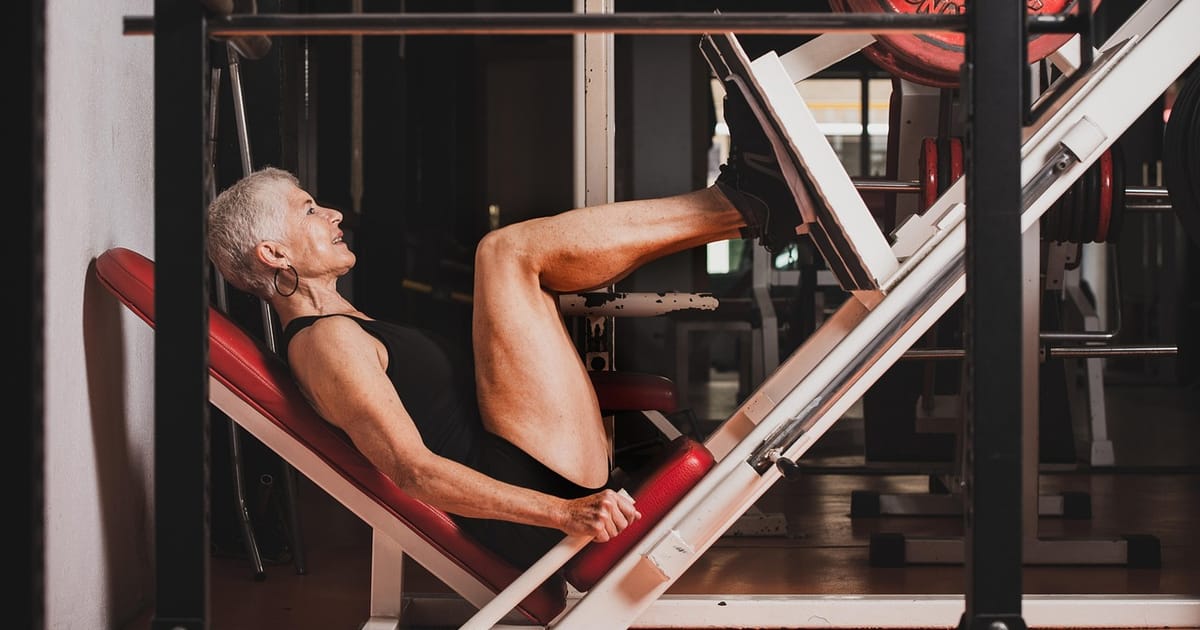
A good weightlifting routine for beginners is two full-body workouts, A and B, alternated three days a week with a rest day between sessions. Each workout has four or five exercises that cover your legs, chest, back and hips, done for 2-3 sets of 8-12 reps with a weight that leaves 1-3 reps in the tank. When you can do 12 reps on every set, add a little weight. That outline matches the ACSM's 2009 guidance for novices and fits the main recommendation of its 2026 update: hard sets, at least twice a week, for every major muscle group.
The routine: workout A and workout B
Train three non-consecutive days, for example Monday, Wednesday and Friday, and alternate the workouts: A, B, A one week, then B, A, B the next. Every exercise has a machine and a free-weight option. Pick the one that is free and that you can do with clean form.
Workout A
| Exercise | Free-weight option | Machine option | Sets x reps |
|---|---|---|---|
| Squat | Goblet squat (one dumbbell at your chest) | Leg press | 2-3 x 8-12 |
| Chest press | Dumbbell bench press | Chest press machine | 2-3 x 8-12 |
| Vertical pull | Assisted pull-up | Lat pulldown | 2-3 x 8-12 |
| Hamstrings and glutes | Dumbbell Romanian deadlift | Seated leg curl | 2-3 x 8-12 |
| Core | Plank | Plank | 2-3 holds of 20-40 seconds |
Workout B
| Exercise | Free-weight option | Machine option | Sets x reps |
|---|---|---|---|
| Legs | Dumbbell split squat (per leg) | Leg press | 2-3 x 8-12 |
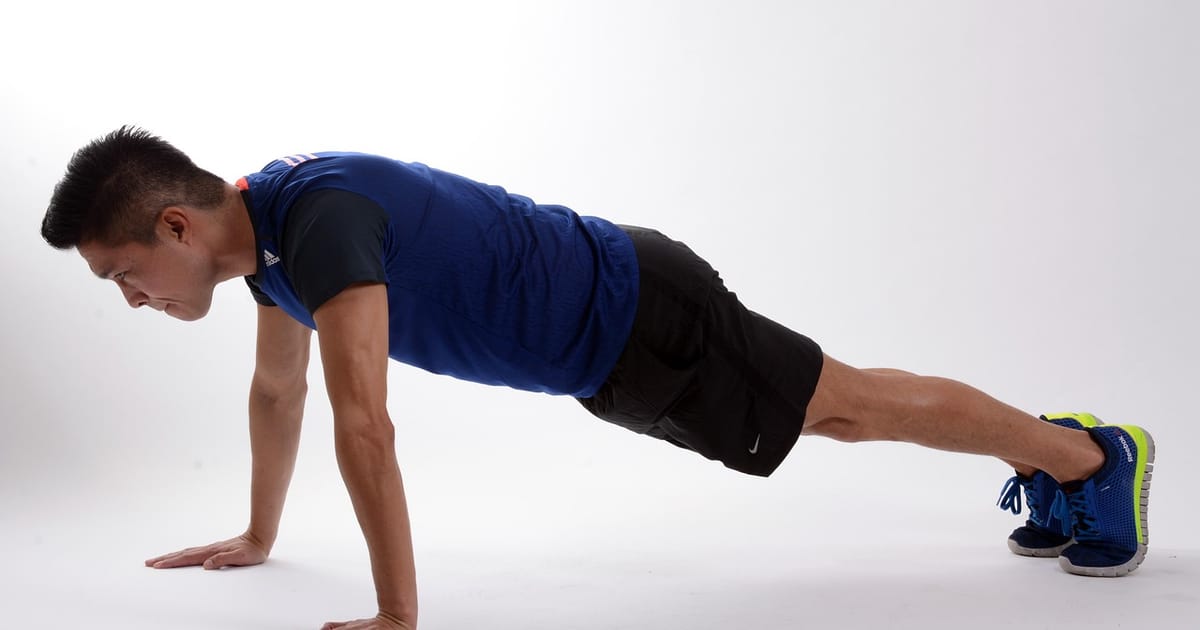
| Push-up | Push-up, hands on a bench if the floor is too hard | Push-up | 2-3 x 8-12 |
| Row | One-arm dumbbell row | Seated cable row | 2-3 x 8-12 |
| Overhead press | Seated dumbbell shoulder press | Shoulder press machine | 2-3 x 8-12 |
| Hip extension | Glute bridge with a dumbbell on your hips | Back extension bench | 2-3 x 8-12 |
The exercise choice, the A/B split and the plank times are coaching choices. They follow the WHO 2020 guidelines, which ask adults to train "all major muscle groups on 2 or more days a week", and the ACSM's 2026 position stand, whose main recommendation is high-effort training at least twice a week that engages all major muscle groups.
Do the exercises in the order listed. The 2026 stand found that strength improved more for exercises done at the beginning of a session, so the big lower-body and pressing lifts go first. Rest 1-2 minutes between sets, the range the 2009 stand gives for muscle growth. The 2026 review found that rest periods shorter or longer than a minute made no difference to strength, so you do not need a stopwatch.
Use the full range of motion your joints allow without pain, since the 2026 stand also linked full range of motion with greater strength gains.
How much weight should a beginner start with?
Start with a weight you can lift 10 times with clean form while 2-3 more reps still feel possible. You find it during your first two sessions, not with a max test.
- Do one warm-up set of 10 with the lightest dumbbell, the empty bar or the lightest pin on the machine.
- Pick a weight you think you can lift 10 times and do one set.
- If you could clearly do 4 or more extra reps, go up one step on the next set. If you could not finish 8 reps with good form, go down one step.
- Write down the weight that lands you at 10 reps with 2-3 left. That is your starting weight.
Counting the reps you have left is called "repetitions in reserve". A 2016 review in the Strength and Conditioning Journal describes it as a way to set loads that adjusts to how you feel on the day, and notes that a one-rep max is not stable in novices. Your estimate will be rough at first. It gets better as you learn what a hard set feels like.
How do you know when to add weight?
Add weight when you can do 12 reps on every set of an exercise. The ACSM's 2009 stand recommends a 2-10% increase in load once you can do one or two reps more than your target, and 12 is two more than the 10 you started at.
In practice:
- Try to add one rep somewhere each session, for example going from 10, 10, 9 to 10, 10, 10.
- Once you hit 12, 12, 12, use the next weight up the following session. For dumbbells and most machines that is usually 5 lb (about 2.5 kg).
- Your reps drop back to about 8-10. Build them back to 12 and repeat.
With light dumbbells, that smallest step is often more than the 2-10% the ACSM suggests, which is why your reps drop and you build them back up. The 5 lb step follows how gym equipment is made; it is a coaching choice, not a number from a study.
If an exercise stalls for three sessions in a row, lower the weight by about 10% and build back up. That reset is a coaching choice, not a rule from a study.
A 12-week beginner plan
The weekly structure stays the same for 12 weeks. What changes is the number of sets and how close to failure you push each set.
| Weeks | Sessions per week | Sets per exercise | Reps left at the end of each set | What to focus on |
|---|---|---|---|---|
| 1-2 | 3 | 2 | 2-3 | Learn each exercise, find your starting weights |
| 3-6 | 3 | 3 | 2-3 | Add reps, then weight, using the rule above |
| 7-10 | 3 | 3 | 1-2 | Keep adding weight; sets should feel hard by the last rep |
| 11-12 | 3 | 4 on the first three exercises, 3 on the rest | 1-2 | More sets for the main lifts |
From week 3, the routine gives each movement pattern (squat, push, pull, hinge) about 9 hard sets a week, and the extra sets in weeks 11-12 bring squats, presses and pulls to 12. That lines up with the 2026 position stand, which found greater muscle growth at 10 or more sets per muscle group per week, and with a 2017 meta-analysis of 15 studies that found muscle growth rose with each extra weekly set. The week-by-week set counts and effort targets are a coaching plan built on those findings, not a protocol tested as a whole.
Warm up for 5 minutes before each session (a common coaching routine, not a tested protocol): brisk walking or cycling, then one light set of the first exercise. If you have a heart condition, a recent injury, high blood pressure, or you are pregnant, talk to your doctor before you start. Joint pain that is sharp, or that lasts into the next day, is a reason to stop that exercise and see a doctor or physiotherapist.
How many days a week should a beginner lift weights?
Lift two or three days a week. The ACSM's 2009 stand recommends 2-3 days a week for novices, and its 2026 update found that strength improved more with at least 2 sessions a week than with fewer.
Three days is the default in this plan because it spreads the work out and gives you room to miss a session. Two days also works. A 2016 meta-analysis found that training each muscle group twice a week led to more muscle growth than once a week. It could not tell whether three times beats twice.
If two days is all you have, do workout A on one day and B on the other, at least two days apart, and use 4 sets per exercise from week 3 so your weekly sets stay close to the 3-day plan. The 4 sets are a coaching choice.
Should beginners do full body or a split?
Full body is the simpler choice for beginners training two or three days a week. When total weekly sets are the same, how you spread them across the week matters little for muscle growth: a 2019 meta-analysis of 25 studies found no meaningful difference between higher and lower training frequencies when volume was equated, and concluded you can pick based on preference.
A split (upper body one day, lower body the next) makes sense once you train four or more days a week and the full-body sessions get too long. Before then, full-body workouts hit each muscle at least twice a week on only 2-3 gym visits, and a missed session costs you less.
Is a weightlifting routine different for women?
No. The same routine works for men and women. A 2020 meta-analysis that compared men and women on the same lifting program found no difference in muscle growth or lower-body strength gains, and women gained more upper-body strength in relative terms.
What differs from person to person is the starting weight, not the structure. If your priority is glutes and legs, add one set to the squat and the glute bridge.
Should beginners use machines or free weights?
Use whichever you can do with good form. The ACSM's 2026 review found that strength gains did not differ between free weights and machines.
Machines guide the path of the weight, so they are easy to learn and easy to load in small steps. Dumbbells let each side work on its own and are available in most gyms when the machines are busy. Many beginners start a lift on the machine and switch to the dumbbell version after a few weeks. Either way, the progression rule is the same.
Do you need to lift to failure?
No. The ACSM's 2026 review found that training to momentary muscle failure did not consistently change strength or muscle growth. What it did recommend is high effort.
Ending each set with 1-3 reps left gets you close to that effort without the form breakdown that tends to happen on the last grinding rep. This plan starts at 2-3 reps left while you learn the exercises and moves to 1-2 left from week 7.
How long does it take to see results from lifting weights?
Both strength and muscle size can start to change within a few weeks. In a small 2007 study of 7 young, healthy volunteers who trained their thighs on one machine three times a week, muscle size was measurably larger after 20 days, and maximal strength was up about 39% after 35 days.
That was one exercise in a handful of people, so your numbers will differ. Track the weights you lift: if they climb over the 12 weeks, the routine is working, whatever the mirror says yet. Muscle growth also depends on eating enough protein; the guide on how much protein per day to build muscle has a table by body weight.
What if you miss the gym or train at home?
Replace the session with push-ups and bodyweight squats instead of skipping it. Do 3 sets of each, stopping every set with 1-3 reps left, and pick up the gym plan where you left off.
If the floor push-up is too hard, put your hands on a counter or bench; the guide to incline push-ups shows which height to start from. If you plan to train at home for good, the 8-week beginner bodyweight program gives you a full routine without equipment. If your main goal is weight loss, the full body workout plan for weight loss pairs three strength days with brisk walks.