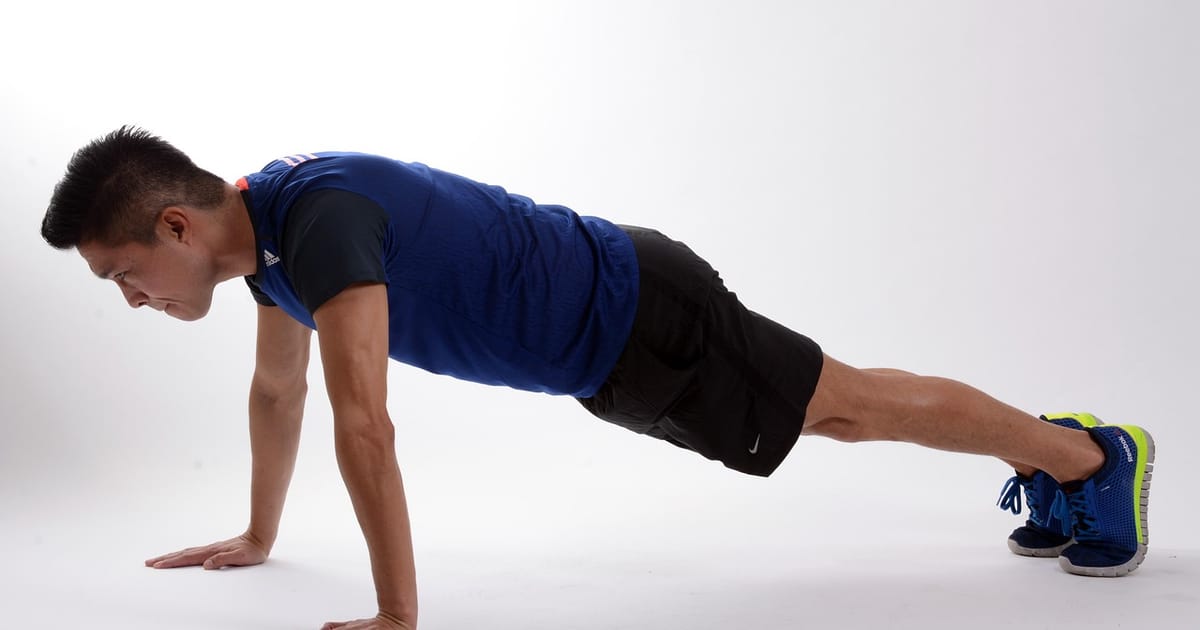

EMOM Workout Meaning: How It Works and a 6-Week Plan
EMOM workout meaning: how every minute on the minute training works, how many reps to do each minute, what studies show, and a 6-week push-up and squat plan.
PushSlayer Editorial Team · Updated · 6 min read
Leer en español
EMOM means "every minute on the minute." When a new minute starts on the clock, you do a set number of reps, and whatever is left of that minute is your rest. Then the next minute starts and you go again. If 8 push-ups take you 15 seconds, you rest 45 seconds. A 10-minute EMOM is 10 sets, each one starting exactly 60 seconds after the last. The trick is picking a rep count you can repeat every minute with clean form, and the rule below gives you that number.
How an EMOM workout works
You need a timer that beeps every minute, one or two exercises, and a fixed number of reps per minute.
- Start the timer. At 0:00, do your reps.
- Rest until the clock reaches 1:00.
- At 1:00, do the same reps again (or the next exercise, if you alternate).
- Keep going until the planned minutes run out, or until you can no longer finish the reps inside the minute.
Three common layouts:
| Layout | What you do | Example, 10 minutes |
|---|---|---|
| One exercise | The same reps every minute | 6 push-ups every minute |
| Alternating | Odd minutes one move, even minutes another | Odd: 6 push-ups. Even: 12 squats |
| Rotating | A different move each minute, then repeat | Push-ups, squats, plank hold, repeat |
The alternating layout is the one to start with. Each muscle group gets close to 2 minutes between its own sets while you keep working.
How many reps per minute should you do?
Pick a number that takes 15-25 seconds and that you could still finish in the last minute. Here is the rule we use, as coaches; no study has tested these exact numbers:
- Test your max: do as many clean reps of the exercise as you can in one set. Rest a day.
- Start your EMOM at 40-50% of that max. A max of 15 push-ups means 6-7 reps per minute.
- Watch the clock. If the first rounds take more than 25 seconds, drop 1-2 reps. If your last minute still takes under 15 seconds and feels easy, add 1 rep next session.
- End the workout early if you miss the reps inside a minute or your form breaks down.
You don't need to train to failure for muscle growth. A 2023 meta-analysis of 15 studies found no evidence that training to momentary failure builds more muscle than stopping before it. The same review hints that sets ending very far from failure may build less, so the later minutes of an EMOM, when the reps start to feel hard, are the ones that count. That is why the plan below adds reps and minutes every two weeks.
Why the rest inside each minute matters
The short break after each set keeps your reps fast and crisp. That is the idea behind cluster sets, where you split a set into small groups of reps with brief rests between them. A 2019 meta-analysis of 25 studies found that cluster sets reduced the loss of speed, power and force across a session compared with traditional sets done straight through. An EMOM works on the same principle: small sets, regular rest.
Two recent studies tested the EMOM format itself in people who do functional fitness (CrossFit-style) training:
- A 2025 study in 12 trained athletes did the same work twice: once as a 20-minute EMOM, once as fast as possible. Done for time, it took about 12 minutes, average heart rate was 91% of max against 82% in the EMOM, and blood lactate after the workout was 11.2 mmol/L against 6.5. Average effort was 7 out of 10, against 4 in the EMOM.
- A 2025 study in 25 men and women matched the volume of an EMOM, an AMRAP and a for-time workout to each person. The EMOM produced the lowest lactate and effort ratings, and jump height dropped after the AMRAP, and after the for-time workout in the less experienced group, but not after the EMOM.
Both were single sessions in small groups of experienced trainees, so they show how an EMOM feels and how tiring it is, not what it builds over months.
A 6-week EMOM plan for push-ups and squats
Do 3 sessions a week on non-consecutive days. Use the alternating layout: push-ups on odd minutes, squats on even minutes. Set your reps with the rule above (40-50% of your max for each move) and keep them for the first two weeks.
| Weeks | Minutes | Sets of each move | Reps per minute | What changes |
|---|---|---|---|---|
| 1-2 | 10 | 5 | Starting reps | Learn the rhythm |
| 3-4 | 14 | 7 | Starting reps +1 | One more rep, two more sets |
| 5 | 16 | 8 | Starting reps +2 | One more rep, one more set |
| 6 | 10, then retest | 5 | Starting reps | Lighter week, then test your max |
Warm up for 3-5 minutes before each session: a brisk walk around the room, 10 slow squats and 5 easy push-ups. If floor push-ups are too hard for even 3 reps a minute, use the incline push-up height that gives you a max of at least 8 and run the plan on that.
At the end of week 6, retest your max a day after a session, then start a new 6-week block at 40-50% of the new number. If your push-up max has stalled, add one session a week of normal sets to failure from the push-up plan to increase your reps; the reason is in the next section. The plan above is a coaching progression, not one a study tested.
Is EMOM good for building muscle?
Yes, about as good as normal sets with the same total reps. A 2021 meta-analysis of 17 studies compared traditional sets with set structures that add short rests between reps or groups of reps. Strength and muscle growth came out the same.
One difference matters for push-up goals: traditional sets improved muscular endurance more. If your target is a higher max in one set, keep some regular sets in your week alongside your EMOMs.
Push-ups count as real resistance work here. In an 8-week trial in 18 young men, push-ups at a load matched to 40% of their bench press max built chest and triceps thickness and strength similar to the bench press itself. That trial used normal sets, twice a week.
EMOM vs AMRAP: what's the difference?
In an EMOM the clock sets the pace and builds in rest; in an AMRAP (as many reps or rounds as possible) you work nonstop until the time is up. Same work, different strain:
| EMOM | AMRAP | |
|---|---|---|
| Rest | Built in, every minute | None planned; you pace yourself |
| Score | Did you finish every minute? | Total reps or rounds |
| Lactate and effort | Lowest of the three formats in the 2025 study | Higher than EMOM |
| Jump height after | Unchanged | Dropped |
| Best for | Practicing form, adding volume, strength work | Pushing hard for conditioning |
For a beginner, the EMOM is the easier one to control: the rest is guaranteed and you cannot speed through your reps with sloppy form to beat a score.
Is EMOM cardio or strength training?
Either, depending on the reps and the moves. Low reps of a hard exercise with long rest is strength work. More reps, faster moves (burpees, jumping jacks) and less rest push it toward cardio. In the 2025 study, the EMOM version averaged 82% of max heart rate, so it still raised heart rate a lot, just less than the all-out version.
If your goal is conditioning, a dedicated interval session does that job more directly; the HIIT workout for beginners at home is a 6-week plan built for it. The WHO guidelines ask adults for 150-300 minutes of moderate aerobic activity a week, or 75-150 of vigorous activity, plus muscle-strengthening work on 2 or more days. A push-up and squat EMOM 3 times a week counts toward the strength part, but the guideline asks for all major muscle groups, so you still need a pulling move such as a row; the calisthenics back workout has options with no equipment.
How long should an EMOM workout be?
In our coaching, 10-20 minutes covers most goals; no study has compared EMOM lengths. Beginners should start at 10 minutes, as in the plan above, and add time only while the last minute still looks like the first. The 2025 Frontiers study used 20 minutes with trained athletes.
Longer EMOMs (30 minutes or more) usually mean lighter moves or rotating several exercises, which makes them more of a conditioning session. If a long EMOM makes you rush reps to save rest time, shorten it.
Is EMOM good for beginners?
Yes, if the reps are set low. The built-in rest and the fixed rep count make it simpler to pace than an AMRAP or a for-time workout. Both 2025 studies tested people who already trained, so for beginners this is a reasonable inference, not a tested result.
Use the 40-50% rule, start at 10 minutes and pick moves you already do with good form. If you are coming back after a long break, the guide on how to start working out again shows how much to cut back first. If a move causes joint pain rather than muscle effort, stop it and see a doctor or physiotherapist.