
Pull-Up, Push-Up, Squat Workout: 3 Levels and a Plan
A pull-up, push-up and squat workout for every level, even with zero pull-ups: sets, reps, how often to train and the one move the three of them miss.
PushSlayer Editorial Team · Updated · 6 min read
Leer en español
A pull-up, push-up and squat workout covers your back, chest, arms and thighs with one bar and the floor. Do it three non-consecutive days a week, 3-4 sets of each move, with most sets ending 1-3 reps short of failure. That builds each move to 12 hard sets a week; the ACSM's 2026 position stand found more muscle growth at 10 or more. Pick your level below by how many strict pull-ups you can do today. Zero is a level too.
The workout at 3 levels
Choose the level that matches your pull-ups, then do the three moves as a circuit: one set of each, rest about 90 seconds, repeat. The level sets the pulling exercise; push-ups and squats follow their own rep targets.
| Level | Strict pull-ups today | Pull | Push | Squat | Rounds |
|---|---|---|---|---|---|
| 1 | 0 | Inverted rows x 6-12, then 2 slow negatives | Incline or floor push-ups x 6-12 | Bodyweight squats x 12-20 | 2-4, see the 8-week plan |
| 2 | 1-5 | Pull-ups x half your max, then 1 slow negative | Floor push-ups x 8-15 | Slow squats x 10-15 | 2-4, see the 8-week plan |
| 3 | 6 or more | Pull-ups x 4-8 | Feet-elevated push-ups x 8-15 | Split squats x 8-12 per leg | 2-4, see the 8-week plan |
The rep ranges, the circuit format and the rest time are coaching choices built on the research in this article, not a protocol from one study. Warm up first with 3 minutes of easy movement and one light set of each exercise. A session takes about 20-30 minutes.
Level 1: no pull-up yet
For an inverted row, lie under a sturdy bar set at hip height (a low bar in a park, or a Smith machine at the gym), grab it with your hands just wider than your shoulders, and pull your chest to the bar with your body straight. The higher the bar, the easier the row.
For a negative, step or jump to the top of a pull-up with your chin over the bar, then lower yourself as slowly as you can, aiming for 3-5 seconds. Two negatives per round are enough to start.
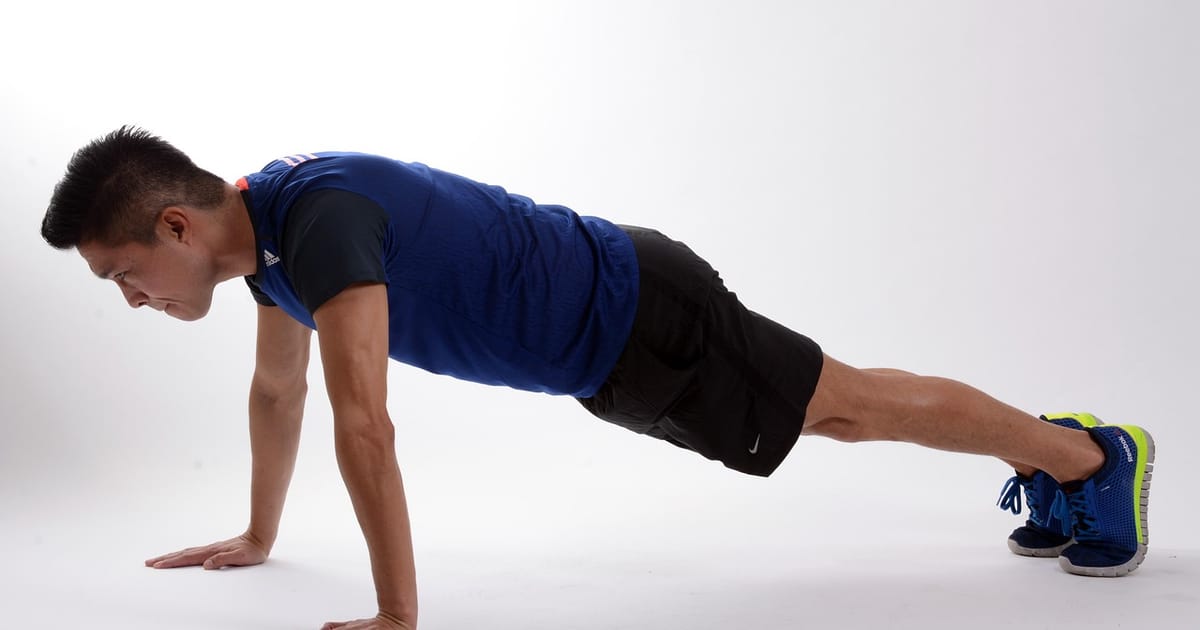
Push-ups: if you cannot do 6 floor push-ups with your body straight, put your hands on a bench or a sturdy table. Our incline push-up guide shows how much each height takes off.
Level 2: 1-5 pull-ups
Do half your max per set, rounded up (2 reps if your max is 3), and finish each round with one slow negative. If your max is 1, do one pull-up per round with a full rest before it, plus the negative. Splitting your max into several easy sets lets you practice more good reps than one all-out set would. For the squat, take 3 seconds on the way down.
Level 3: 6 or more pull-ups
Do sets of 4-8 that stop 1-3 reps before your max. Make push-ups harder by putting your feet on a step, and make squats harder with split squats, one foot forward and one back. Once 8 pull-ups per set feels easy, wear a backpack with a few books in it.
Why these three moves
Together they work your back, chest, arms, front thighs and glutes. In a 2010 EMG study of 25 young adults, the latissimus dorsi (the wide back muscle) was the most active muscle during pull-ups, followed by the biceps, with the lower trapezius and chest also working. In the trials further down, push-up training thickened the chest and triceps, and squat training grew most of the front thigh, the inner thigh and the glutes.
EMG measures how active a muscle is in a single set, not how much it grows over months, so read it as a map of which muscles a move uses.
What if you can't do a pull-up?
Start with inverted rows and slow negatives, as in level 1, and test your strict pull-up in weeks 4 and 8 of the plan below. Inverted rows train the same back muscles from an easier angle: a 2026 review of EMG studies found that, in one small preliminary study, the inverted row produced the highest lat activity of the rows tested. The reviewers called for that result to be repeated.
When you have no bar at all, a heavy, sturdy table that does not move when you pull on its edge works for rows. Our plan for your first pull-up gives a 10-week path from zero, and the calisthenics back workout with no equipment adds more pulling without a bar.
An 8-week plan
Train three days a week with a rest day between sessions, for example Monday, Wednesday and Friday. Retest your pull-ups in week 4 and week 8, and move up a level when you pass its threshold.
| Week | Rounds | Reps left at the end of each set | Focus |
|---|---|---|---|
| 1 | 2 | 3 or more | Learn the moves, test your pull-ups on day 1 |
| 2 | 3 | 2-3 | Full workout at your level |
| 3 | 3 | 1-3 | Add a rep to any set that felt easy |
| 4 | 3 | 1-3 | Retest pull-ups in the last session |
| 5 | 4 | 1-3 | Add the fourth round |
| 6 | 4 | 1-3 | Keep adding reps |
| 7 | 4 | 1-3 | Same |
| 8 | 2 | 3 or more | Easy week, retest pull-ups in the last session |
Four rounds three times a week gives each move 12 sets a week. The ACSM stand found that muscle growth was greater with 10 or more weekly sets, and that strength improved more with 2 or more sessions a week. Week 8 is lighter so you retest without leftover fatigue. If you want more push-ups specifically, how to increase push-ups has a 6-week plan you can run on the same days.
Can you build muscle with just push-ups, pull-ups and squats?
Yes, if the sets are hard and you keep making them harder. In a small 2017 randomized trial, 18 men with at least a year of lifting experience trained twice a week for 8 weeks with either bench presses at 40% of their max or push-ups adjusted (for example, on the knees) to the same load. Both groups gained bench press strength and triceps and chest thickness, with no difference between them.
The ACSM stand, which drew on 137 systematic reviews, found that equipment type did not consistently change results, while higher weekly volume did. In that trial the push-ups were made easier, with bent knees or raised hands, to match 40% of the men's bench press max, and every set went to failure, so the effort did the work. That is why each level has a harder version to move to.
Are these three exercises enough on their own?
They are enough to start, but they leave out the back of your thighs. In a 2019 trial, 17 men did barbell squats (full or half depth) twice a week for 10 weeks. MRI showed that most of their front thigh muscles (the vastus muscles), their inner thigh and their glutes grew, but their hamstrings and the rectus femoris did not change in size.
Add one move that works the hamstrings directly, after the circuit: single-leg Romanian deadlifts (stand on one leg, hinge forward at the hip with a flat back, then stand tall) or sliding leg curls (on your back with heels on a towel on a smooth floor, lift your hips and pull your heels toward you). Do 3 sets of 8-12. The choice of moves is ours, not something the 2019 trial tested. For your core, a plank or the moves in our beginner core workout routine fill the rest.
Strength work is also only half of the health guidelines. The WHO 2020 guidelines ask adults for 150-300 minutes of moderate aerobic activity a week, such as brisk walking, on top of muscle-strengthening work for all major muscle groups on 2 or more days.
Can you do push-ups, pull-ups and squats every day?
You can, but daily training is not needed to build muscle. A 2019 meta-analysis of 25 studies found no meaningful difference in muscle growth between training a muscle more or less often per week when the total weekly volume was the same. Three days a week reaches the same weekly sets with rest days in between.
If you want to move every day, keep the extra days light: a few easy sets of push-ups and squats, well short of failure, and skip the pull-ups if your elbows or forearms feel sore. For the push-up side of that question, see is it OK to do push-ups every day. If a joint hurts during or after a set, rather than your muscles feeling tired, stop that move and see a doctor or physiotherapist if the pain persists.
How hard should each set be?
Stop most sets with 1-3 reps left in you. A 2026 meta-analysis of 20 trials with 556 adults found no significant difference in muscle growth between stopping short of failure and training to failure, and a small strength advantage for stopping short. The ACSM stand likewise found that training to momentary fatigue did not consistently change results.
In practice: if you could have done 4 or more extra reps, the set was too easy, so add reps next time. If your form breaks down on the last rep (hips sag on push-ups, you kick on pull-ups), stop one rep earlier.
What to do after week 8
Retest, move up a level where you passed the threshold, and run the plan again. If you want to train more days with different moves, our workout split for muscle growth shows how to arrange 4-6 days a week. If you have no pull-up bar and want a fuller home program, the beginner bodyweight workout program uses six movements and household items.